Classification of Elastic Coupling
Elastic couplings are essential mechanical components designed to connect two rotating shafts while transmitting power efficiently, compensating for misalignments, and dampening vibrations and shock loads. Unlike rigid couplings, which require near-perfect alignment between shafts and offer no flexibility, elastic couplings utilize elastic elements to accommodate small to moderate deviations in shaft alignment, reduce wear on connected equipment, and extend the service life of mechanical systems. The classification of elastic couplings is primarily based on several key factors, including the type of elastic element used, the method of torque transmission, the degree of flexibility, and the specific application requirements. Each category of elastic coupling possesses unique structural characteristics, performance capabilities, and suitability for different industrial scenarios, making a clear understanding of their classification crucial for selecting the optimal coupling for a given application.
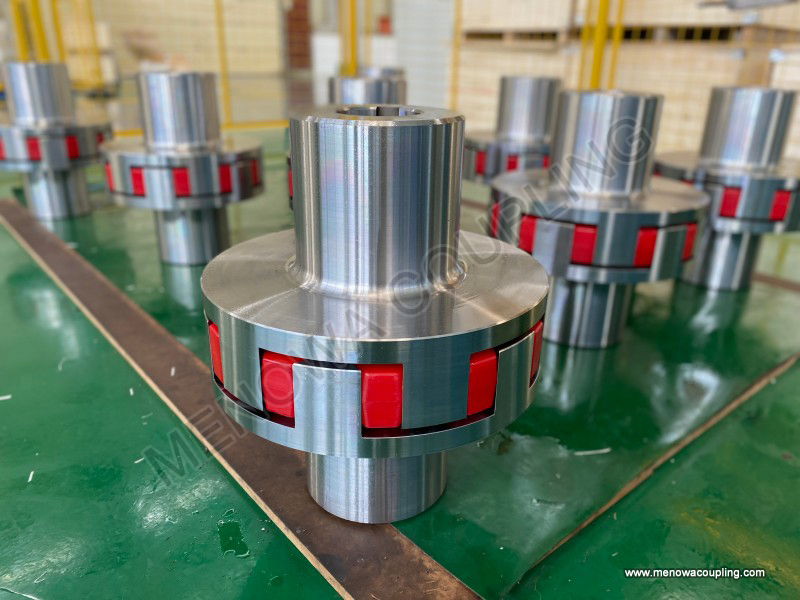
The most fundamental classification of elastic couplings is based on the material of the elastic element, which directly influences the coupling’s flexibility, torque capacity, temperature resistance, and durability. Elastic elements can be broadly divided into two main types: metallic elastic elements and non-metallic elastic elements. This division forms the basis for further subclassification and helps distinguish the performance attributes of different coupling designs. Metallic elastic elements are typically made from high-strength metals such as steel, stainless steel, or aluminum alloys, offering excellent mechanical strength, high torque transmission capacity, and resistance to high temperatures, chemical corrosion, and aging. In contrast, non-metallic elastic elements are composed of materials like rubber, polyurethane, nylon, or acetal, providing superior vibration damping properties, good flexibility, and cost-effectiveness, though they may have limitations in terms of torque capacity and temperature resistance.
Metallic elastic couplings, characterized by their robust construction and high performance, are further classified based on their structural design and the form of the elastic element. One common type within this category is the beam coupling, also known as the helical coupling. Beam couplings are manufactured from a single piece of metallic material, with material removed along a spiral path to create a curved, flexible beam structure. This one-piece design eliminates backlash, a common issue in multi-piece couplings, and ensures precise torque transmission. The helical beam design allows for angular misalignment, parallel offset, and even axial motion between the connected shafts, making them ideal for applications requiring high precision, such as rotary encoders, robotics, and motion control systems. The performance of beam couplings can be adjusted by modifying the lead of the helical beam, which affects misalignment capabilities, torque capacity, and torsional stiffness. Multiple starts within the same helix can also be incorporated to enhance performance. Common materials used for beam couplings include aluminum alloy and stainless steel, while specialized applications may utilize maraging steel or titanium for enhanced strength and corrosion resistance.
Another important type of metallic elastic coupling is the disc coupling, which uses one or more thin metallic discs (typically made of stainless steel) as the elastic element. These discs are bolted between two flanges, with the discs’ flexibility allowing for angular and axial misalignment while transmitting torque efficiently. Disc couplings are known for their high torsional stiffness, low backlash, and ability to operate at high speeds, making them suitable for high-performance applications such as gas turbines, compressors, and precision machinery. The number and thickness of the discs can be adjusted to vary the coupling’s flexibility and torque capacity; thinner discs offer greater flexibility, while thicker discs or multiple disc packs provide higher torque transmission capabilities. Disc couplings do not require lubrication, reducing maintenance requirements, and are resistant to high temperatures and harsh environments, making them a reliable choice for industrial applications where durability and precision are critical.
Bellows couplings are another subclass of metallic elastic couplings, featuring a metallic bellows (usually made of stainless steel or Inconel) as the elastic element. The bellows is a flexible, cylindrical structure with corrugations that allow for axial, angular, and radial misalignment. Bellows couplings offer excellent torsional stiffness and zero backlash, making them suitable for applications requiring precise torque transmission, such as servo systems, machine tools, and aerospace equipment. The corrugated design of the bellows provides good vibration damping and shock absorption, while the metallic construction ensures resistance to high temperatures, pressure, and chemical exposure. Bellows couplings are often used in applications where space is limited, as their compact design allows for installation in tight spaces without compromising performance.
Non-metallic elastic couplings, which rely on non-metallic materials for their elastic elements, are widely used in industrial applications due to their cost-effectiveness, excellent vibration damping, and ease of installation. The most common type in this category is the elastomeric jaw coupling, which consists of two metal hubs with jaw-like projections and a non-metallic elastomeric insert (often made of rubber or polyurethane) that fits between the jaws. The elastomeric insert acts as the elastic element, transmitting torque between the hubs while accommodating angular, parallel, and axial misalignment. Jaw couplings are simple in structure, easy to assemble and disassemble, and provide effective vibration damping, making them suitable for a wide range of applications, including pumps, fans, conveyors, and general machinery. The elastomeric insert can be replaced when worn, extending the service life of the coupling and reducing maintenance costs. Different durometers (hardness levels) of the elastomeric insert are available to suit different torque requirements and vibration damping needs.
Tire couplings are another popular type of non-metallic elastic coupling, utilizing a tire-shaped elastomeric element (typically made of rubber reinforced with fabric or cord) to connect two metal hubs. The tire element is bolted or clamped to the hubs, providing high flexibility and excellent vibration damping. Tire couplings can accommodate large amounts of misalignment, particularly axial misalignment, and are resistant to shock loads, making them ideal for applications with frequent starts, stops, and load fluctuations, such as crushers, mixers, and construction machinery. The elastomeric tire is easily replaceable, and the coupling requires no lubrication, simplifying maintenance. However, tire couplings have lower torsional stiffness compared to metallic couplings and may not be suitable for high-precision applications or high-temperature environments.
Another type of non-metallic elastic coupling is the elastic pin coupling, which uses elastic pins (made of nylon, polyurethane, or rubber) to connect two flanged hubs. The pins are inserted through holes in the flanges, with the elastic material of the pins providing flexibility and vibration damping. Elastic pin couplings are simple in structure, cost-effective, and can accommodate small to moderate misalignments. They are commonly used in light to medium-duty applications, such as electric motors, pumps, and agricultural machinery. The elastic pins can be easily replaced when worn, and the coupling does not require lubrication, making it low-maintenance. However, elastic pin couplings have lower torque capacity compared to metallic couplings and may not be suitable for high-speed or heavy-duty applications.
In addition to classification based on elastic element material, elastic couplings can also be categorized by their misalignment compensation capabilities. Different coupling designs are optimized to handle specific types and degrees of misalignment, which is a critical factor in selecting the right coupling for a given application. Angular misalignment occurs when the two shafts are not collinear but intersect at a common point, while parallel misalignment (radial misalignment) occurs when the shafts are parallel but offset from each other. Axial misalignment occurs when the shafts move along their axial direction relative to each other. Some couplings are designed to handle a single type of misalignment, while others can accommodate a combination of angular, parallel, and axial misalignment.
Beam couplings and bellows couplings, for example, are highly effective at compensating for angular and parallel misalignment, while also allowing for some axial motion. Disc couplings excel at handling angular and axial misalignment, making them suitable for applications where shaft movement along the axial direction is common. Jaw couplings and tire couplings can accommodate moderate levels of all three types of misalignment, making them versatile for general industrial applications. Oldham couplings, a type of elastic coupling that uses a sliding disc with tenons to connect two hubs, are specifically designed to handle large parallel misalignment, making them ideal for applications where radial offset between shafts is significant, such as vertical pumps and some types of conveyors.
Torque capacity is another important factor in the classification of elastic couplings, as different designs are engineered to transmit different levels of torque. Metallic elastic couplings, such as disc couplings, bellows couplings, and beam couplings, typically have higher torque capacities compared to non-metallic couplings, making them suitable for heavy-duty applications such as industrial machinery, marine propulsion systems, and power generation equipment. Non-metallic elastic couplings, such as jaw couplings and elastic pin couplings, are designed for light to medium-duty applications with lower torque requirements, such as small electric motors, pumps, and fans. The torque capacity of a coupling is determined by the material of the elastic element, the structural design, and the size of the coupling, with larger couplings and stronger materials capable of transmitting higher torques.
The operating speed of the application also influences the classification and selection of elastic couplings. High-speed applications, such as gas turbines, compressors, and precision machine tools, require couplings with low backlash, high torsional stiffness, and good balance to avoid vibration and ensure smooth operation. Disc couplings, bellows couplings, and beam couplings are well-suited for high-speed applications due to their rigid construction and low inertia. In contrast, low-speed applications, such as crushers, mixers, and conveyors, can utilize couplings with higher flexibility and vibration damping, such as tire couplings and jaw couplings, which can handle the slower speeds and higher shock loads associated with these applications.
Environmental factors, such as temperature, humidity, chemical exposure, and dust, also play a role in the classification and selection of elastic couplings. Metallic elastic couplings are more resistant to high temperatures, chemical corrosion, and harsh environments, making them suitable for applications in industries such as aerospace, automotive, and chemical processing. Non-metallic elastic couplings, while cost-effective and flexible, may degrade over time in high-temperature or chemical-rich environments, limiting their use in such applications. For example, rubber-based elastomeric elements may soften or degrade at high temperatures, while nylon pins may become brittle in cold environments. Therefore, the operating environment must be carefully considered when classifying and selecting elastic couplings to ensure long-term reliability and performance.
It is also important to note that some elastic couplings may combine features of both metallic and non-metallic designs, blurring the lines between the two main categories. For example, some couplings use a combination of metallic hubs and non-metallic elastic elements to leverage the strength of metal and the flexibility of non-metallic materials. These hybrid couplings offer a balance of torque capacity, flexibility, and vibration damping, making them suitable for a wide range of applications where neither pure metallic nor pure non-metallic couplings would be optimal.
In summary, the classification of elastic couplings is a multi-faceted process that considers the material of the elastic element, structural design, misalignment compensation capabilities, torque capacity, operating speed, and environmental resistance. Metallic elastic couplings, including beam couplings, disc couplings, and bellows couplings, are characterized by high strength, high torque capacity, and resistance to harsh environments, making them suitable for high-performance and heavy-duty applications. Non-metallic elastic couplings, such as jaw couplings, tire couplings, and elastic pin couplings, offer excellent vibration damping, cost-effectiveness, and ease of maintenance, making them ideal for light to medium-duty applications. By understanding the different classifications and their respective characteristics, engineers and technicians can select the most appropriate elastic coupling for a given application, ensuring efficient power transmission, reduced equipment wear, and extended service life. The proper classification and selection of elastic couplings are critical to the overall performance and reliability of mechanical systems, making it an essential topic in mechanical engineering and industrial design.
Each category of elastic coupling has its own unique advantages and limitations, and the choice of coupling depends on a comprehensive assessment of the application’s requirements. For example, in precision motion control systems, where backlash and torsional stiffness are critical, beam couplings or disc couplings are often the preferred choice. In applications with high vibration and shock loads, such as construction machinery, tire couplings or jaw couplings provide the necessary damping to protect equipment. In high-temperature or corrosive environments, metallic couplings like bellows couplings or disc couplings are more durable and reliable. By carefully evaluating the specific needs of the application, including torque requirements, misalignment levels, operating speed, and environmental conditions, the optimal elastic coupling can be selected to ensure optimal performance and longevity.
Furthermore, the classification of elastic couplings is not static, as advancements in material science and manufacturing technology continue to introduce new designs and improvements to existing ones. New materials, such as advanced composites and high-performance elastomers, are being used to enhance the performance of elastic elements, increasing torque capacity, temperature resistance, and durability. Manufacturing processes, such as 3D printing, are also enabling the production of complex coupling designs with improved flexibility and precision. As a result, the classification of elastic couplings will continue to evolve, reflecting the latest innovations in mechanical engineering and industrial design.
Post Date: May 14, 2026
https://www.menowacoupling.com/china-coupling/classification-of-elastic-coupling.html
Products

Related Articles
Gap Chart of Elastic Coupling
In the realm of mechanical power transmission, elastic couplings serve as critical components that bridge the gap between driving and driven shafts, accommodating misalignments while ensuring efficient torque transfer. Among the various tools and methodologies used to optimize the performance and longevity of elastic co…Size Chart of Elastic Coupling
The size chart of elastic coupling is an indispensable reference tool in mechanical transmission systems, serving as a bridge between the coupling’s design parameters and its practical application. It systematically organizes key dimensional and performance data, enabling engineers, technicians, and procurement personn…Material of Elastic Coupling
Elastic couplings play a crucial role in mechanical transmission systems, serving as a vital connection between driving and driven shafts to transmit torque while compensating for axial, radial, and angular misalignments. The performance, durability, and suitability of an elastic coupling for specific applications are l…Structure of Elastic Coupling
An elastic coupling is a critical mechanical component designed to connect two rotating shafts—typically a driving shaft and a driven shaft—in various mechanical systems, enabling the seamless transmission of torque while accommodating misalignments and dampening vibrations. Unlike rigid couplings that require precise…Parts of Elastic Coupling
Elastic couplings are essential components in mechanical transmission systems, designed to connect two rotating shafts while accommodating misalignments, absorbing vibrations, and protecting connected equipment from damage. Unlike rigid couplings that require precise alignment and offer no flexibility, elastic couplings…Elastic Coupling For Sale
In the complex world of mechanical transmission systems, elastic couplings stand as essential components that bridge the gap between rotating shafts, ensuring smooth power transfer while accommodating the inevitable misalignments and vibrations that occur during operation. These versatile devices are designed to transmi…
 WeChat
 WhatsApp