Curved Jaw Shaft Coupling
In the vast and complex system of modern mechanical power transmission, the connection between rotating shafts serves as one of the most fundamental and indispensable links that determine the overall operational stability, transmission efficiency, and service cycle of entire mechanical equipment. Every mechanical device that relies on rotational power output and transmission, from conventional general industrial machinery to professional processing and production equipment, from continuous operating production lines to intermittent starting power devices, needs reliable shaft connection components to realize the stable transfer of torque, rotational speed, and kinetic energy between driving ends and driven ends. Among numerous types of shaft connection components developed and optimized for different transmission scenarios and working conditions, curved jaw shaft coupling has gradually become a mainstream configuration widely adopted in medium and light-duty as well as partial heavy-duty power transmission fields by virtue of its unique curved tooth profile design, excellent torsional flexibility, reliable misalignment compensation capacity, and simple and practical structural form. Unlike rigid shaft connecting parts that pursue absolute rigid connection and zero displacement allowance, this type of coupling focuses on balancing efficient torque transmission and flexible buffering performance, perfectly solving the common mechanical problems such as shaft position deviation generated by equipment installation errors, thermal expansion and contraction during long-term operation, mechanical vibration and impact load fluctuation in actual industrial production environments. Its structural design abandons the straight tooth profile adopted by traditional ordinary jaw couplings, and adopts optimized curved jaw profiles for the contact parts of the coupling hubs. This subtle but crucial structural adjustment fundamentally changes the stress distribution state during torque transmission, effectively reducing local contact pressure and mechanical wear at the meshing position, and greatly improving the overall durability and operational smoothness of the coupling in long-cycle continuous working scenarios. As a typical material flexing coupling relying on the compression deformation of intermediate elastic components to complete power transmission, curved jaw shaft coupling does not require complex lubrication maintenance systems, does not produce metal-to-metal hard friction collision during operation, and can maintain stable transmission performance under various harsh working conditions including variable load operation, frequent start-stop switching, and slight shaft displacement deviation, making it adaptable to almost all conventional industrial power transmission scenarios involving motor drive, engine power output, and mechanical auxiliary equipment linkage transmission.
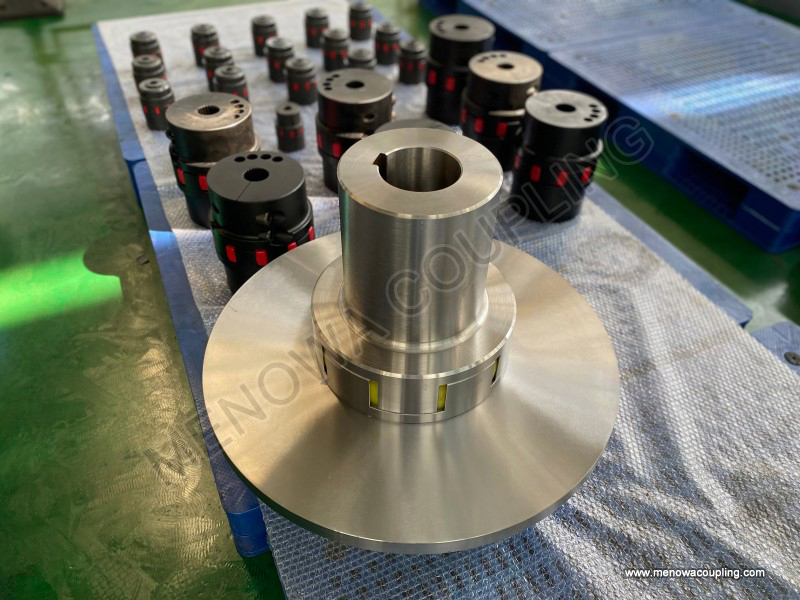
To fully understand the inherent advantages and application value of curved jaw shaft coupling in mechanical transmission systems, it is necessary to start with its basic structural composition and clarify the functional division and collaborative matching relationship of each component in the whole coupling assembly. The overall structure of curved jaw shaft coupling follows a simple and compact design concept, and the whole assembly is mainly composed of two independent coupling hubs with curved jaw structures and a central elastic spider insert clamped between the two hubs, without additional complex transmission accessories, fastening auxiliary parts or transmission transition structures. The two coupling hubs are symmetrical in overall structure and consistent in basic specification design, and each hub is integrally processed with multiple curved convex jaws arranged in an evenly distributed circumferential layout. The core difference between these jaws and the jaws of ordinary straight jaw couplings lies in the curved contour design of the contact working surface. The curved surface structure enables the contact area between the jaws and the intermediate elastic insert to be more uniform and reasonable during the torque transmission process, avoiding the stress concentration phenomenon that is easy to occur at the edge contact position of straight jaws during operation. Each coupling hub is designed with a central shaft hole that matches the outer diameter of the connected mechanical shaft, and the shaft hole is equipped with conventional fastening structures to ensure that the hub and the rotating shaft can maintain a tight and fixed connection without relative rotation or displacement during high-speed rotation and torque transmission. The intermediate elastic spider insert is the core flexible force-bearing and buffering component of the entire curved jaw shaft coupling, usually designed into a plum blossom-shaped integrated structure matching the distribution quantity of the curved jaws of the two hubs. The protruding parts of the elastic insert are accurately embedded in the gaps between the curved jaws of the two opposite hubs, forming a stable compression transmission structure. When the driving shaft rotates and outputs torque, the curved jaws of the driving end hub continuously squeeze the corresponding protruding parts of the elastic insert, and the elastic insert transfers the torque to the curved jaws of the driven end hub through mild compression deformation, thereby driving the driven shaft to rotate synchronously and realizing the continuous and stable transmission of rotational power. All power transmission processes are completed through the elastic compression of the intermediate insert, and there is no direct hard contact between the metal hubs on both sides, which fundamentally eliminates the rigid impact and harsh friction noise generated by metal collision during equipment operation, and lays a solid structural foundation for vibration damping and buffering of the entire transmission system.
The working mechanism of curved jaw shaft coupling is based on the principle of elastic compression torque transmission and flexible deformation misalignment compensation, and the whole operation process can be divided into three core functional stages: torque transfer and power output, vibration and impact absorption and buffering, and multi-dimensional shaft misalignment adaptive compensation. In the torque transfer stage, the optimized curved contact design between the curved jaws and the elastic insert ensures that the contact stress generated during the compression process is evenly distributed on the entire contact surface, rather than being concentrated on a certain local edge or point position. Even under the condition of fluctuating torque load or instantaneous impact torque, the curved structure can disperse the instantaneous pressure, avoid local excessive deformation or rapid wear of the elastic insert, and ensure the continuity and stability of torque transmission. This uniform stress transmission characteristic also enables the coupling to maintain consistent transmission efficiency under different load levels, whether it is low-load stable operation or medium-load conventional transmission, there will be no obvious power transmission attenuation or rotational speed jitter. In the vibration and impact absorption stage, the intermediate elastic insert made of high polymer elastic materials relies on its own good elastic deformation performance and damping characteristics to absorb and dissipate the mechanical vibration energy generated by equipment start-stop, load change, mechanical operation resonance and external impact load in the form of elastic potential energy and heat energy. When the mechanical equipment is started frequently or suddenly loaded and unloaded, the instantaneous impact force generated by power mutation will be buffered and weakened by the gradual compression deformation of the elastic insert, avoiding the direct transmission of impact vibration to the driving and driven shafts and the connected mechanical equipment, thus effectively protecting the core mechanical components such as bearings, gears and reducers in the transmission system from impact damage and prolonging the overall service life of the equipment. In the multi-dimensional misalignment compensation stage, the flexible deformation allowance of the elastic insert and the reserved assembly gap formed by the curved jaw structure work together to adapt to three common types of shaft misalignment in actual mechanical installation and operation, including radial misalignment, angular misalignment and axial displacement deviation. During the long-term operation of mechanical equipment, affected by installation and assembly accuracy, long-term mechanical vibration, thermal expansion and contraction of metal components after temperature rise, and slight foundation settlement, the two connected rotating shafts are difficult to maintain an absolute ideal coaxial state all the time, and various degrees of misalignment deviation will inevitably occur. If rigid couplings or ordinary straight jaw couplings with low misalignment tolerance are used, additional bending stress and shear stress will be generated on the rotating shafts and key mechanical components, leading to accelerated component wear, increased equipment operation failure rate, and even shaft deformation and fracture in severe cases. The curved jaw shaft coupling can rely on the flexible deformation of the elastic insert and the reasonable gap matching of the curved jaws to automatically adapt to these slight deviations, eliminate additional mechanical stress caused by misalignment, and ensure that the transmission system always operates in a low-stress and stable state.
Material selection of each component of curved jaw shaft coupling directly determines its mechanical bearing capacity, environmental adaptability, wear resistance and overall service life, and different matching material combinations can meet the use needs of various working conditions from conventional room temperature general environment to special high temperature, low temperature, corrosion and high-load working scenarios. For the two metal coupling hubs with curved jaw structures, the commonly used processing and manufacturing materials include aluminum alloy, gray cast iron, carbon steel and stainless steel, and each material has its own unique performance characteristics and applicable application ranges. Aluminum alloy hubs feature low overall density, light weight, good processing performance and low rotational inertia, which can effectively reduce the additional load of the transmission system during high-speed rotation, avoid excessive energy consumption caused by the weight of the coupling itself, and are very suitable for light-duty high-speed transmission equipment such as small and medium-sized motor supporting equipment, precision conveying machinery and small fan and blower devices. Gray cast iron hubs have good casting performance, low production and processing cost, high structural rigidity and strong pressure-bearing capacity, and can maintain stable structural performance under medium-load conventional operation conditions. They are not easy to deform under long-term static and dynamic load, and are widely used in general industrial equipment such as conventional water pumps, ordinary conveyors and general gearbox connection transmission occasions. Carbon steel hubs have higher mechanical strength, better impact resistance and stronger fatigue resistance, and can adapt to medium and heavy-duty transmission scenarios with large torque fluctuation and frequent impact load. They will not produce plastic deformation or structural damage under long-term high-load operation, and are suitable for industrial supporting equipment such as compressors, large mixers and medium-sized generator sets. Stainless steel hubs have excellent corrosion resistance, rust resistance and high and low temperature resistance, and can work stably in humid, corrosive, high temperature or low temperature special working environments for a long time, avoiding structural rust, material corrosion and performance attenuation of the hubs, and are mostly used in chemical industry, food processing, marine supporting machinery and other special industrial fields with high environmental requirements. For the core intermediate elastic spider insert, the mainstream manufacturing materials are polyurethane and rubber materials with different hardness grades, and different hardness specifications of elastic inserts can be selected according to actual transmission load and vibration damping requirements. Elastic inserts with lower hardness have better flexibility and vibration damping and buffering effects, suitable for equipment with severe vibration and frequent start-stop; elastic inserts with higher hardness have stronger compression resistance and torque bearing capacity, suitable for high-torque transmission occasions with low vibration requirements and high transmission stability requirements. These elastic materials do not need additional lubrication during operation, have good wear resistance and aging resistance, and can maintain stable elastic performance after long-term repeated compression deformation, ensuring the long-term stable operation of the coupling.
Compared with other common types of shaft couplings used in industrial power transmission, curved jaw shaft coupling has prominent comprehensive performance advantages in structural design, operational performance, daily maintenance and scenario adaptability, and these advantages make it stand out in many coupling products and become the preferred connection component for most conventional mechanical transmission systems. First of all, the curved jaw profile design brings more uniform stress distribution and lower contact pressure, which effectively reduces the wear speed of the elastic insert and the metal jaw contact surface. Ordinary straight jaw couplings are prone to edge extrusion and local stress concentration during operation, resulting in rapid wear of the elastic insert, easy aging and damage, and frequent replacement of parts is required in the later stage. The curved structure of curved jaw shaft coupling disperses the contact force on the whole curved surface, reduces local pressure, slows down the wear rate of components, and significantly prolongs the service cycle of the entire coupling assembly and wearing parts. Secondly, this type of coupling has excellent multi-dimensional misalignment compensation ability, which can adapt to a certain range of radial, angular and axial misalignment deviations, and has higher misalignment tolerance than straight jaw couplings and ordinary rigid couplings. In actual industrial production, most mechanical equipment does not have ultra-high-precision installation conditions, and there will inevitably be installation errors and later operation deviation. The good misalignment adaptation performance of curved jaw shaft coupling can effectively offset the adverse effects caused by these deviations, reduce the failure rate of equipment operation, and reduce the downtime loss caused by shaft connection failure. Thirdly, the whole machine has a simple and compact structure with few components, convenient installation, disassembly and replacement operations, and no professional and complex installation tools and technical processes are required. During the equipment assembly process, workers can quickly complete the butt joint and fixing of the two hubs and the embedding of the elastic insert according to the conventional assembly steps; during later maintenance and replacement of wearing parts, the elastic insert can be replaced independently without disassembling the overall mechanical structure of the equipment, which saves maintenance time and labor costs, and improves the overall operation efficiency of the production line. Fourthly, the operation process does not need any lubrication and oil maintenance, avoiding the pollution of lubricating oil to the production environment and the equipment failure caused by lubricating oil deterioration and leakage. Many mechanical transmission parts need regular oil injection lubrication and oil replacement maintenance, which not only increases the daily maintenance workload, but also may cause equipment corrosion and environmental pollution due to lubricating oil leakage. Curved jaw shaft coupling relies entirely on elastic compression to transmit power, no lubrication is needed in the whole life cycle, and the later maintenance cost is extremely low. In addition, the coupling has good torsional flexibility and vibration damping performance, which can effectively reduce mechanical vibration and operation noise during equipment operation, improve the overall operation comfort of the workshop production environment, and reduce the vibration damage of precision components inside the equipment.
Curved jaw shaft coupling has extremely wide industrial application coverage, covering almost all conventional mechanical power transmission links from civil light industrial machinery to heavy industrial production equipment, and can achieve stable and reliable connection and transmission effects in different industry scenarios and working condition environments. In the fluid conveying and pressurization equipment industry, this coupling is widely used for the shaft connection between various water pumps, oil pumps, chemical medium delivery pumps and supporting drive motors. Pump equipment needs to maintain stable rotational speed and torque output during long-term continuous operation, and will generate slight mechanical vibration and shaft position deviation due to fluid impact and long-term operation. The vibration damping performance and misalignment compensation capacity of curved jaw shaft coupling can effectively adapt to the stable operation needs of pump equipment, avoid pump body vibration and shaft connection loosening caused by vibration and deviation, and ensure the continuous and efficient conveying operation of fluid medium. In the ventilation and air supply industrial equipment field, the coupling is used for the power connection of various fans, blowers and ventilation exhaust equipment. Such equipment usually runs at medium and high speed for a long time, with obvious operation vibration, and frequent start-stop adjustment according to production needs. The elastic buffering performance of the coupling can weaken the vibration generated by fan operation, reduce the start-stop impact of the equipment, ensure the stable rotation of the fan shaft, and avoid the problem of reduced ventilation efficiency caused by shaft connection jitter. In the material conveying and processing production line industry, curved jaw shaft coupling is applied to the shaft connection of various belt conveyors, screw conveyors, mixing and stirring equipment and material processing auxiliary machinery. Conveying and mixing equipment often has unstable load and instantaneous load fluctuation during operation, and frequent forward and reverse rotation working conditions in some scenarios. The compression transmission mode of the coupling can adapt to variable load and forward and reverse rotation transmission, maintain stable torque transmission during load change and steering switching, and ensure the continuous and stable operation of the production line. In the power transmission and power generation supporting equipment industry, the coupling is used for the connection between generator sets and power drive equipment, as well as the shaft matching connection of various gearboxes and speed change devices. Power transmission and speed change equipment have high requirements for transmission stability and torque accuracy, and the uniform stress transmission characteristics of curved jaw shaft coupling can ensure no torque loss and rotational speed jitter in the transmission process, maintain the stable output of power and rotational speed, and meet the precise power transmission needs of power equipment. In addition, in chemical industry, textile industry, mining auxiliary equipment, food processing machinery and other industrial fields, curved jaw shaft coupling also has a large number of application cases, adapting to different environmental characteristics and working load requirements of various industries, and providing reliable basic guarantee for the normal operation of various mechanical equipment.
The correct installation operation and daily scientific maintenance management are important prerequisites to ensure the long-term stable operation and extended service life of curved jaw shaft coupling, and standardized operation specifications can avoid abnormal wear, early damage and transmission failure of the coupling caused by improper installation and maintenance. In the installation and assembly stage, the first step is to check the dimensional matching degree and surface integrity of the two coupling hubs, the intermediate elastic insert and the connected rotating shaft, confirm that there is no obvious damage, deformation, crack or dimensional deviation on the surface of each component, and ensure that the specifications and models of all components are consistent and matched, avoiding the assembly mismatch problem caused by model confusion. Before formal installation, the surface of the rotating shaft and the inner wall of the hub shaft hole need to be cleaned and polished to remove surface rust, oil stain, iron filings and other sundries, ensuring that the matching connection surface is clean and smooth, so as to avoid assembly gap and fixation looseness caused by sundries residues. Then the two coupling hubs are respectively installed on the driving shaft and the driven shaft, and the fastening structures are properly tightened to ensure that the hubs and the rotating shafts are firmly connected without relative rotation and axial displacement. After the hub is fixed, the intermediate elastic insert is accurately embedded in the curved jaw gap of one hub, and then the two shafts are gently butt jointed to make the curved jaws of the other hub naturally clamped on the outer side of the elastic insert, ensuring that the elastic insert is evenly stressed without extrusion deviation and dislocation, and the butt joint gap between the two hubs is kept uniform and reasonable, without excessive compression or loose assembly. After the assembly is completed, manual rotation debugging is required to check whether the coupling rotates flexibly and smoothly, whether there is jamming, abnormal friction and uneven rotation, and confirm that the installation coaxiality meets the basic operation requirements, and then the equipment can be started for trial operation. In the daily use and maintenance stage, regular visual inspection and operation state observation are mainly carried out without complex maintenance operations. Daily inspection focuses on checking whether the elastic insert has obvious aging deformation, crack damage, excessive compression wear and falling off deviation, and checking whether the fastening parts of the hub are loose or displaced. If slight wear and aging signs of the elastic insert are found, it should be replaced in time to avoid the problem of transmission instability caused by failure of the flexible buffer component. For the metal hubs, regular surface inspection is carried out to check whether there is corrosion, rust and structural deformation, and regular anti-rust treatment is carried out according to the operating environment to ensure the structural rigidity and connection stability of the hubs. In the process of equipment operation, abnormal vibration, noise and rotational speed jitter of the coupling should be observed. Once abnormal operation state is found, the equipment should be stopped in time for inspection and troubleshooting, and the coupling components should be checked for wear and damage, so as to avoid small faults evolving into large equipment failures and affecting the normal production operation. In addition, according to different operating load and environmental conditions, the replacement cycle of wearing parts such as elastic inserts should be reasonably formulated, and regular replacement and maintenance should be done to ensure that the coupling always maintains good transmission performance and buffer compensation capacity.
The reasonable selection and type matching of curved jaw shaft coupling is the key link to give full play to its transmission performance and meet the actual working condition needs, and the selection process needs to comprehensively consider multiple core factors including equipment transmission torque, operating rotational speed, shaft misalignment range, operating environmental conditions and load change characteristics, rather than simply selecting according to shaft diameter size alone. First of all, the actual working torque of the transmission equipment should be calculated accurately, including the rated torque under normal operation and the instantaneous peak torque under starting, load mutation and forward and reverse rotation switching. The selected coupling needs to have sufficient torque bearing margin on the basis of meeting the rated transmission torque, so as to avoid long-term overload operation of the coupling resulting in accelerated wear and early damage of elastic components. Secondly, the operating rotational speed of the equipment should be matched with the allowable rotational speed range of the coupling. Different specifications and material combinations of curved jaw shaft couplings have different adaptive rotational speed limits. High-speed rotating equipment needs to select couplings with small rotational inertia and high dynamic balance performance, while low-speed and heavy-load equipment can select products with high structural rigidity and large torque bearing capacity. Thirdly, the actual shaft misalignment deviation of the equipment after installation and long-term operation should be fully considered, and the coupling with corresponding misalignment compensation range should be selected according to the measured deviation data, so as to ensure that the coupling can effectively adapt to the shaft displacement deviation generated during operation and eliminate additional mechanical stress. In addition, the operating environmental conditions of the equipment are also important selection basis. For conventional room temperature and dry industrial environments, conventional material matching couplings can be selected; for humid, easy to rust and corrosive environments, hubs made of corrosion-resistant materials and elastic inserts with anti-aging and corrosion-resistant properties need to be selected; for high-temperature or low-temperature extreme working environments, components with high and low temperature resistance should be matched to ensure that the coupling will not have performance attenuation and structural damage due to temperature change. At the same time, according to the load change characteristics of the equipment, such as stable load operation, frequent start-stop load fluctuation and impact load operation, elastic inserts with different hardness and buffer performance are selected to balance the transmission efficiency and vibration damping and buffering effect, so that the coupling can achieve the best matching use effect under specific working conditions.
With the continuous upgrading and development of modern industrial mechanical equipment towards high efficiency, energy saving, stability and low failure rate, the requirements for the comprehensive performance of shaft connection transmission components are also constantly improving, and curved jaw shaft coupling, as a mature and optimized flexible transmission component, will still maintain irreplaceable application value in the field of industrial power transmission in the future. Its unique curved jaw structural design realizes the perfect integration of efficient torque transmission, multi-dimensional misalignment compensation, vibration damping and impact buffering, and simple maintenance and use, solving many practical pain points in the actual operation of traditional shaft connection components. In the future industrial production and mechanical design process, with the continuous innovation of material technology and processing technology, the performance of curved jaw shaft coupling in high temperature resistance, corrosion resistance, wear resistance and fatigue resistance will be further optimized, and the applicable working condition scenarios will be further expanded, adapting to more emerging industrial mechanical equipment and special working environment transmission needs. For all mechanical equipment designers, production and processing enterprises and equipment operation and maintenance personnel, fully understanding the structural characteristics, working mechanism, material performance, application scenarios, installation and maintenance specifications and selection logic of curved jaw shaft coupling, and scientifically selecting and using this type of coupling according to actual working conditions, can effectively improve the overall operational stability of mechanical transmission systems, reduce equipment operation failure rate and later maintenance costs, extend the overall service life of mechanical equipment, and create more stable and efficient operation conditions for industrial production and mechanical power transmission work. In the complex and changeable modern industrial transmission system, a small and simple curved jaw shaft coupling undertakes the important basic task of connecting power and stabilizing transmission, and its reliable operation is an indispensable important guarantee for the long-term stable and efficient operation of various mechanical equipment.
Post Date: Apr 26, 2026
https://www.menowacoupling.com/coupling-supplier/curved-jaw-shaft-coupling.html
Products

Tags
Related Articles
Specification of Elastic Coupling
An elastic coupling is a critical mechanical component designed to connect two rotating shafts in a power transmission system, enabling the transfer of torque while accommodating various forms of misalignment and dampening vibrations. Unlike rigid couplings that require precise alignment and offer no flexibility, elasti…Diagram of Elastic Coupling
Diagram of Elastic CouplingAn elastic coupling is a critical mechanical component designed to connect two rotating shafts, transmitting torque while accommodating misalignments, absorbing vibrations, and mitigating shock loads in various industrial and mechanical systems. Unlike rigid couplings that require precise alig…Elastic Coupling Production
Elastic couplings are essential components in mechanical transmission systems, serving as the critical link between two rotating shafts to transmit torque while accommodating misalignments, absorbing vibrations, and reducing shock loads. The production of elastic couplings is a sophisticated process that combines precis…What is Elastic Coupling
Elastic coupling is a critical component in mechanical transmission systems, designed to connect two rotating shafts while accommodating misalignments, absorbing vibrations, and protecting machinery from damage. Unlike rigid couplings that require precise alignment and offer no flexibility, elastic couplings utilize ela…Characteristics of Elastic Coupling
Elastic coupling is a critical component in mechanical transmission systems, designed to connect two rotating shafts while accommodating various forms of misalignment, absorbing vibrations, and transmitting torque efficiently. Unlike rigid couplings that require precise alignment and offer no flexibility, elastic coupli…Working Principle of Elastic Coupling
In the complex and interconnected world of mechanical power transmission, elastic couplings stand as indispensable components that bridge the gap between driving and driven shafts, ensuring the smooth, efficient, and protected transfer of torque. Unlike rigid couplings that demand precise alignment and offer no flexibil…Uses of Elastic Coupling
In the complex landscape of mechanical power transmission, elastic couplings stand as indispensable components that bridge the gap between rotating shafts, ensuring seamless torque transfer while addressing the inherent challenges of misalignment, vibration, and shock. Unlike rigid couplings that demand precise alignmen…Classification of Elastic Coupling
Elastic couplings are essential mechanical components designed to connect two rotating shafts while transmitting power efficiently, compensating for misalignments, and dampening vibrations and shock loads. Unlike rigid couplings, which require near-perfect alignment between shafts and offer no flexibility, elastic coupl…Components of Elastic Coupling
Elastic couplings are essential mechanical components widely used in various industrial applications to connect two rotating shafts, transmitting torque while accommodating misalignments, absorbing vibrations, and protecting connected equipment from damage. Unlike rigid couplings that require precise alignment and offer…Maintenance of Elastic Coupling
Elastic couplings are essential components in mechanical transmission systems, serving to connect two rotating shafts, transmit torque, and compensate for axial, radial, and angular misalignments. They also play a crucial role in absorbing vibrations and shock loads, thereby protecting the connected equipment such as mo…
 WeChat
 WhatsApp