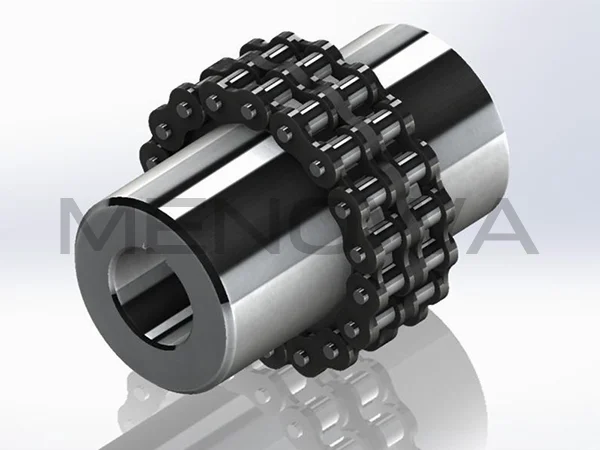
GL Roller Chain Coupling
Menowa is a gl roller chain coupling supplier from china, wholesale and direct sales gl roller chain coupling at a reasonable price. GL Roller chain couplings connect two rotating shafts to transfer torque steadily. Their simple structure allows easy installation and good tolerance for minor shaft misalignment in mechanical operation.
Our GL roller chain coupling uses a common mechanical chain to mesh with two parallel sprockets with the same number of teeth to realize torque and motion. The main difference between chain couplings with different structures lies in the chains used. We generally recommend customers to use the common A- double-row roller chain couplings, B- single-row roller chain couplings, C- toothed chain couplings and D- nylon chain couplings. This type of coupling has simple structure (consisting of four parts), no need to move the coupled two shafts during disassembly, compact size, light weight, certain compensation capability, low requirement on installation accuracy, reliable operation, long service life and low cost. We provide installation and maintenance manuals to help customers better understand and maintain the products during use.
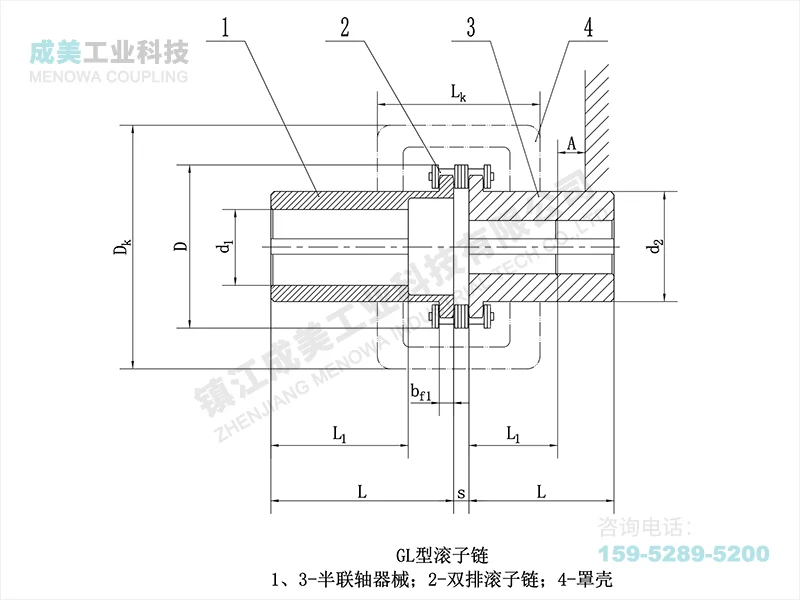
| Model | Nominal Torque N ·m | Allowable Rotating Speed rpm | Shaft Hole Diameter d1、d2 mm | Shaft Hole Length mm | Chain Number | Chain Pitch P mm | Number of Teeth Z | D | S | Dk (Max) | Lk (Max) | Weight kg | Rotational Inertia Kg ·m² | Allowable Compensation Amount | ||||
|---|---|---|---|---|---|---|---|---|---|---|---|---|---|---|---|---|---|---|
| Without Cover | Installing Cover | Y型 | J1型 | Radial mm | Axial mm | Angular Orientation | ||||||||||||
| L | mm | |||||||||||||||||
| GL1 | 125 | 1400 | 4500 | 16 | 42 | 一 | 06B | 9.525 | 14 | 51.06 | 4.9 | 70 | 70 | 0.40 | 0.00010 | 0.19 | 1.4 | 1° |
| 18 | 42 | 一 | ||||||||||||||||
| 18 | 42 | 一 | ||||||||||||||||
| 20 | 52 | 38 | ||||||||||||||||
| GL2 | 160 | 1250 | 4500 | 19 | 42 | 一 | 06B | 9.525 | 16 | 57.08 | 4.9 | 75 | 75 | 0.70 | 0.00020 | 0.19 | 1.4 | 1° |
| 20 | 52 | 38 | ||||||||||||||||
| 22 | 52 | 38 | ||||||||||||||||
| 24 | 52 | 38 | ||||||||||||||||
| GL3 | 250 | 1000 | 4000 | 20 | 52 | 38 | 08B | 12.7 | 14 | 68.88 | 6.7 | 85 | 80 | 1.1 | 0.00038 | 0.25 | 1.9 | 1° |
| 22 | 52 | 38 | ||||||||||||||||
| 24 | 52 | 38 | ||||||||||||||||
| 25 | 62 | 44 | ||||||||||||||||
| GL4 | 400 | 1000 | 4000 | 24 | 52 | 一 | 08B | 12.7 | 16 | 76.91 | 6.7 | 95 | 88 | 1.8 | 0.00086 | 0.25 | 1.9 | 1° |
| 25 | 62 | 44 | ||||||||||||||||
| 28 | 62 | 44 | ||||||||||||||||
| 30 | 82 | 60 | ||||||||||||||||
| 32 | 82 | 60 | ||||||||||||||||
| GL5 | 630 | 800 | 3150 | 28 | 62 | 一 | 10A | 15.875 | 16 | 94.46 | 9.2 | 112 | 100 | 3.2 | 0.0025 | 0.32 | 2.3 | 1° |
| 30 | 82 | 60 | ||||||||||||||||
| 32 | 82 | 60 | ||||||||||||||||
| 35 | 82 | 60 | ||||||||||||||||
| 38 | 82 | 60 | ||||||||||||||||
| 40 | 112 | 84 | ||||||||||||||||
| GL6 | 790 | 630 | 2500 | 32 | 82 | 60 | 10A | 15.875 | 20 | 116.57 | 9.2 | 140 | 105 | 5.0 | 0.0058 | 0.32 | 2.3 | 1° |
| 35 | 82 | 60 | ||||||||||||||||
| 38 | 82 | 60 | ||||||||||||||||
| 40 | 112 | 84 | ||||||||||||||||
| 42 | 112 | 84 | ||||||||||||||||
| 45 | 112 | 84 | ||||||||||||||||
| 48 | 112 | 84 | ||||||||||||||||
| 50 | 112 | 84 | ||||||||||||||||
| GL7 | 1600 | 630 | 2500 | 40 | 112 | 84 | 12A | 19.05 | 18 | 127.78 | 10.9 | 150 | 122 | 7.4 | 0.012 | 0.38 | 2.8 | 1° |
| 42 | 112 | 84 | ||||||||||||||||
| 45 | 112 | 84 | ||||||||||||||||
| 48 | 112 | 84 | ||||||||||||||||
| 50 | 112 | 84 | ||||||||||||||||
| 55 | 112 | 84 | ||||||||||||||||
| 60 | 142 | 107 | ||||||||||||||||
| GL8 | 2100 | 500 | 2240 | 45 | 112 | 84 | 16A | 25.40 | 16 | 154.33 | 14.3 | 180 | 135 | 11.1 | 0.025 | 0.50 | 3.8 | 1° |
| 48 | 112 | 84 | ||||||||||||||||
| 50 | 112 | 84 | ||||||||||||||||
| 55 | 112 | 84 | ||||||||||||||||
| 60 | 142 | 107 | ||||||||||||||||
| 65 | 142 | 107 | ||||||||||||||||
| 70 | 142 | 107 | ||||||||||||||||
| GL9 | 3500 | 500 | 2000 | 50 | 112 | 84 | 16A | 25.40 | 20 | 186.50 | 14.3 | 215 | 145 | 20.0 | 0.061 | 0.50 | 3.8 | 1° |
| 55 | 112 | 84 | ||||||||||||||||
| 60 | 142 | 107 | ||||||||||||||||
| 65 | 142 | 107 | ||||||||||||||||
| 70 | 142 | 107 | ||||||||||||||||
| 75 | 142 | 107 | ||||||||||||||||
| 80 | 172 | 132 | ||||||||||||||||
| GL10 | 4800 | 315 | 1600 | 60 | 142 | 107 | 20A | 31.75 | 18 | 213.02 | 17.8 | 245 | 165 | 26.1 | 0.079 | 0.63 | 4.7 | 1° |
| 65 | 142 | 107 | ||||||||||||||||
| 70 | 142 | 107 | ||||||||||||||||
| 75 | 142 | 107 | ||||||||||||||||
| 80 | 172 | 132 | ||||||||||||||||
| 85 | 172 | 132 | ||||||||||||||||
| 90 | 172 | 132 | ||||||||||||||||
| GL11 | 7500 | 250 | 1500 | 75 | 142 | 107 | 24A | 38.1 | 16 | 231.49 | 21.5 | 270 | 195 | 39.2 | 0.188 | 0.76 | 5.7 | 1° |
| 80 | 172 | 132 | ||||||||||||||||
| 85 | 172 | 132 | ||||||||||||||||
| 90 | 172 | 132 | ||||||||||||||||
| 95 | 172 | 132 | ||||||||||||||||
| 100 | 212 | 167 | ||||||||||||||||
| GL12 | 12000 | 250 | 1250 | 85 | 172 | 132 | 28A | 44.45 | 16 | 270.08 | 24.9 | 310 | 205 | 59.4 | 0.380 | 0.88 | 6.6 | 1° |
| 90 | 172 | 132 | ||||||||||||||||
| 95 | 172 | 132 | ||||||||||||||||
| 100 | 212 | 167 | ||||||||||||||||
| 110 | 212 | 167 | ||||||||||||||||
| 120 | 212 | 167 | ||||||||||||||||
| GL13 | 20000 | 200 | 1120 | 100 | 212 | 167 | 32A | 50.8 | 18 | 340.80 | 28.6 | 380 | 230 | 86.5 | 0.860 | 1.0 | 7.6 | 1° |
| 110 | 212 | 167 | ||||||||||||||||
| 120 | 212 | 167 | ||||||||||||||||
| 125 | 212 | 167 | ||||||||||||||||
| 130 | 252 | 202 | ||||||||||||||||
| 140 | 252 | 202 | ||||||||||||||||
| GL14 | 33000 | 200 | 1000 | 120 | 212 | 167 | 32A | 50.8 | 22 | 405.22 | 28.6 | 450 | 250 | 150.8 | 2.06 | 1.0 | 7.6 | 1° |
| 125 | 212 | 167 | ||||||||||||||||
| 130 | 252 | 202 | ||||||||||||||||
| 140 | 252 | 202 | ||||||||||||||||
| 150 | 252 | 202 | ||||||||||||||||
| 160 | 302 | 242 | ||||||||||||||||
| GL15 | 40000 | 200 | 900 | 140 | 252 | 202 | 40A | 63.5 | 20 | 466.25 | 35.6 | 510 | 285 | 234.4 | 4.37 | 1.27 | 9.5 | 1° |
| 150 | 252 | 202 | ||||||||||||||||
| 160 | 302 | 242 | ||||||||||||||||
| 170 | 302 | 242 | ||||||||||||||||
| 180 | 302 | 242 | ||||||||||||||||
| 190 | 352 | 282 | ||||||||||||||||
Mechanical transmission systems form the fundamental backbone of all industrial production and mechanical operation processes, serving as the critical medium that connects power input components and load execution components to ensure the stable and continuous transfer of rotational force and motion between adjacent rotating shafts in various mechanical equipment. In the complex and diverse industrial operation environment, different mechanical equipment presents distinct operational requirements for shaft connection components, including stable torque transmission, adaptive capacity to installation deviations, durable structural operation performance, convenient daily assembly and maintenance procedures, and good environmental adaptability to harsh working conditions. Among numerous types of shaft connection and transmission components, roller chain coupling structures have always occupied an important position in general industrial transmission scenarios by virtue of their unique mechanical design principles and practical application advantages, and the conventional GL structural form of roller chain coupling has become a widely adopted structural design in medium and low-speed torque transmission occasions after long-term practical application and structural optimization iteration in the mechanical industry. This type of coupling relies on mature meshing transmission cooperation between chain and sprocket components to complete power and torque transfer between two separated rotating shafts, abandoning the complex structural design of many traditional flexible transmission components, and balancing structural simplicity, operational reliability and application universality in the overall design, which can well meet the basic transmission needs of most conventional industrial machinery and auxiliary mechanical equipment in different production fields.
The overall structural composition of GL roller chain coupling follows a modular and simplified mechanical design concept, without redundant auxiliary parts and complex mechanical transmission accessories, and the whole equipment is assembled and combined by several core basic components to realize the complete function of shaft connection and torque transmission. The main components that constitute the main body of the coupling include two symmetrically arranged sprocket parts with consistent tooth profile specifications, a double-row roller chain matched with the sprocket tooth shape and pitch size, a protective outer cover body installed on the outer side of the chain and sprocket meshing area, and supporting fastening parts used for fixing the overall assembly position and preventing structural loosening during operation. Each core component bears different functional responsibilities in the actual operation process, and the coordinated cooperation between multiple components ensures that the coupling can maintain stable transmission state under various conventional working conditions. The two sprocket parts are installed and fixed on the driving shaft and the driven shaft of the mechanical equipment respectively, and the precise fit between the inner hole of the sprocket and the outer diameter of the rotating shaft ensures that the sprocket can rotate synchronously with the rotating shaft without relative sliding and rotational displacement during the power transmission process. The tooth profile design of the sprocket strictly conforms to the basic mechanical parameters matching standard of roller chain transmission, and the tooth pitch, tooth height and tooth groove radian are all designed according to the operation characteristics of double-row roller chain, so as to ensure that the chain can achieve close meshing contact with the sprocket teeth during operation, avoid abnormal meshing gaps and local stress concentration caused by mismatched specifications, and reduce additional mechanical wear and transmission vibration in the meshing process.
The double-row roller chain, as the core force-transmitting connecting part of the GL roller chain coupling, undertakes the key task of connecting two separate sprockets and realizing torque and rotational motion transfer between the driving end and the driven end. Different from the single-row chain structure used in some simple transmission couplings, the double-row structural design effectively disperses the transmission load borne by a single chain piece in the operation process, makes the stress distribution of each chain link and each roller part more uniform in the meshing and rotating cycle, avoids the problem of local excessive stress and accelerated partial wear caused by excessive load concentration on a single row of chain pieces, and significantly improves the overall operational stability and continuous working cycle of the coupling in long-term transmission work. Each chain link inside the double-row roller chain is connected by flexible pin shaft structures, which not only ensures that the chain can flexibly rotate and bend around the sprocket teeth during the transmission process to adapt to the rotational motion track of the sprocket, but also provides a certain flexible buffer space for the overall coupling structure. This flexible connection characteristic enables the coupling to effectively absorb small vibration and impact load generated in the starting and running process of mechanical equipment, avoid the direct rigid transmission of vibration and impact between the driving shaft and the driven shaft, and protect the main shaft components and key mechanical parts of the equipment from fatigue damage caused by long-term vibration impact.
The protective outer cover and supporting fastening parts of the GL roller chain coupling are auxiliary functional components that guarantee the long-term stable operation and structural safety of the coupling, and play an irreplaceable protective and fixed role in the actual application process. The protective outer cover is arranged on the outer periphery of the meshing part of the chain and the sprocket, forming a closed protective space for the core transmission meshing area. On the one hand, the outer cover can effectively isolate external dust, particulate impurities, moisture and other environmental pollutants in the working site, prevent these impurities from entering the meshing gap between the chain rollers and the sprocket teeth, avoid abrasive wear and corrosion damage caused by impurity friction on the contact surface, and keep the meshing transmission surface clean and well-lubricated for a long time. On the other hand, the inner cavity of the protective outer cover can store a certain amount of lubricating medium, which can continuously provide lubricating protection for the chain and sprocket meshing parts in the working process, reduce the friction coefficient between contact surfaces, reduce frictional heat generation and mechanical wear in the transmission process, and extend the overall service life of the coupling. The supporting fastening parts include conventional bolts, nuts and positioning locking parts, which are mainly used to fix the installation position of the sprocket on the rotating shaft and the assembly position of the protective outer cover, preventing the relative displacement and structural loosening of each component caused by rotational centrifugal force and mechanical vibration during the high-speed rotation and long-term operation of the coupling, ensuring that the overall structural state of the coupling remains stable and reliable in the whole working cycle.
The basic working principle of GL roller chain coupling is derived from the mature mechanical meshing transmission theory of chain and sprocket, and the whole power transmission process is realized through the synchronous meshing rotation cooperation between components without complex mechanical conversion and energy transfer links. When the mechanical equipment starts to operate, the driving shaft drives the corresponding sprocket fixed on its surface to rotate synchronously, and the rotating sprocket drives the double-row roller chain sleeved on the outer side to move circumferentially through the meshing force between the sprocket teeth and the chain rollers. In the process of chain movement, the tensile force generated by the chain transmission acts on the other symmetrically arranged sprocket, driving the driven sprocket to rotate synchronously with the driving sprocket, and then the driven sprocket drives the driven shaft connected with it to complete the rotational motion and torque output required by the equipment operation. The whole transmission process realizes the synchronous rotation of the driving shaft and the driven shaft through the mechanical meshing force between the chain and the sprocket, and the transmission efficiency remains stable in the rated load range, without obvious power loss and motion hysteresis. In this transmission mode, the flexible connection characteristics of the chain itself enable the coupling to have a certain displacement compensation capacity, which can adapt to the small axial displacement, radial deviation and angular deflection between the driving shaft and the driven shaft inevitably generated during equipment installation and long-term operation, avoiding the additional mechanical stress and component wear caused by rigid connection and forced alignment of the two shafts.
In terms of installation and alignment requirements, GL roller chain coupling has relatively low requirements for installation accuracy compared with many precision flexible couplings and rigid couplings, which is one of the important reasons why it is widely used in general industrial mechanical transmission occasions. In the actual equipment installation and commissioning process, due to the limitations of on-site installation conditions, equipment foundation settlement, machining errors of mechanical parts and other objective factors, it is difficult to achieve absolute precise coaxial alignment between the driving shaft and the driven shaft of all mechanical equipment, and a small amount of shaft displacement and deviation will inevitably exist after installation and fixing. For couplings with high installation accuracy requirements, even tiny shaft alignment deviations will cause severe vibration, abnormal wear and even structural damage during operation, requiring a lot of time and professional equipment for precise alignment and calibration in the installation stage. However, the structural design of GL roller chain coupling fully considers the objective situation of on-site installation deviations, and the flexible fit between the chain and the sprocket and the flexible movable space of the chain link structure can effectively adapt to the slight misalignment between the two shafts within a certain allowable range. During installation, workers only need to complete the basic coaxial positioning of the two shafts according to the conventional mechanical installation specifications, fix the two sprockets on the corresponding rotating shafts respectively, sleeve the double-row roller chain and install the protective outer cover and fastening parts to complete the whole installation process, without complex precision calibration and repeated alignment adjustment work, which greatly simplifies the on-site installation steps, shortens the equipment installation and commissioning cycle, and reduces the professional skill requirements for installation and construction personnel.
The environmental adaptability of GL roller chain coupling in industrial working conditions is very prominent, and it can maintain stable working performance in many harsh working environments where many precision transmission couplings are difficult to operate normally. A large number of mechanical production and processing sites, such as mining operation sites, metallurgical auxiliary production workshops, building materials processing production lines, agricultural machinery operation sites and light industrial production workshops, often have harsh environmental characteristics such as high ambient temperature, humid air, dense dust and particulate pollution. Many transmission couplings with sealing structure and precision elastic parts are prone to seal aging, elastic part corrosion, internal structure dust blockage and other problems in such environments, resulting in reduced transmission performance, accelerated component wear and shortened service life. GL roller chain coupling, however, has a simple and rugged overall structure, no delicate precision elastic parts and complex sealing components, and the main stress-bearing parts are made of high-strength metal materials with good high-temperature resistance, corrosion resistance and wear resistance. Under high-temperature working conditions, the metal structural parts will not undergo obvious structural deformation and performance attenuation due to temperature rise, and the lubricating medium matched with the outer cover can still maintain good lubricating effect. In humid and dusty environments, the protective outer cover can effectively isolate moisture and dust, prevent the internal meshing transmission parts from being corroded and worn by external pollutants, and ensure that the coupling can operate continuously and stably for a long time without frequent failure and shutdown maintenance.
In terms of disassembly, maintenance and daily overhaul work, GL roller chain coupling has obvious practical advantages, which can effectively reduce the daily maintenance workload and later operation and maintenance cost of mechanical equipment. For many integrated structural couplings, when equipment maintenance and component replacement are needed in the later stage, it is often necessary to disassemble the connected driving shaft and driven shaft and even disassemble the relevant mechanical equipment components, with complex disassembly steps and long maintenance time, which will affect the normal continuous production progress of the production line. The modular assembly design of GL roller chain coupling avoids this problem perfectly. When daily maintenance, lubricating medium replacement or worn component replacement are required, maintenance personnel only need to remove the protective outer cover and the connecting fasteners, take down the double-row roller chain between the two sprockets to complete the separation of the driving end and the driven end transmission structure, without moving and disassembling the two rotating shafts connected by the coupling and the main mechanical equipment. After the maintenance work is completed and the components are inspected and replaced, the chain can be reinstalled and the outer cover can be fixed to resume normal transmission work. The whole disassembly and assembly process is simple and efficient, the maintenance operation steps are easy to master, the downtime of equipment maintenance is greatly shortened, and the impact of maintenance work on industrial production efficiency is minimized. At the same time, the wearing parts of the coupling are mainly conventional roller chains and individual sprocket teeth parts, which are common standard mechanical parts in the market, with convenient procurement and low replacement cost, and the later maintenance and replacement work does not need high cost investment and professional maintenance equipment.
Although GL roller chain coupling has excellent comprehensive performance and wide application adaptability in conventional medium and low-speed torque transmission working conditions, it also has its own applicable working condition range and working limit requirements, and it is not suitable for all mechanical transmission scenarios, which needs to be reasonably selected and matched according to the actual working parameters and operation requirements of mechanical equipment in practical application. This type of coupling relies on chain and sprocket meshing for transmission, and inevitable meshing impact and mechanical vibration will be generated in the high-speed rotation state. With the continuous increase of rotation speed, the meshing vibration and impact force will gradually increase, which will easily cause excessive wear of chain and sprocket components, obvious transmission noise and even structural loosening of the coupling. Therefore, it is more suitable for medium and low-speed mechanical transmission occasions, and not recommended for long-term high-speed rotation transmission working conditions. In addition, the flexible buffer capacity of the coupling is limited by the structural characteristics of the chain itself, and it can only absorb small vibration and instantaneous slight impact load generated by equipment starting and normal operation. For mechanical equipment working conditions with long-term severe impact load, frequent sudden start and stop and alternating heavy load, the buffer and shock absorption effect of the coupling cannot meet the operation protection needs, and it is easy to cause fatigue damage to the chain and sprocket parts and shorten the service cycle. At the same time, the coupling mainly relies on mechanical meshing to transmit rotational torque and radial power, and has no special structural design for axial force transmission, so it is not suitable for working conditions that need to bear and transmit large axial thrust.
In the long-term continuous operation process of GL roller chain coupling, standardized daily lubrication management and regular inspection and maintenance work are key factors to ensure its stable operation state and extend the overall service life, and scientific maintenance management can effectively avoid most common operation failures and abnormal wear problems. Lubrication work is the core link in the daily maintenance of the coupling. The meshing friction between the chain rollers and the sprocket teeth is the main friction link in the transmission process, and good lubrication can reduce the friction resistance between contact surfaces, reduce frictional heat generation, avoid dry friction wear and metal surface scratch damage. Before the initial operation of the newly installed coupling, it is necessary to fill the inner cavity of the protective outer cover with a suitable amount of special lubricating grease for chain transmission, so that all meshing contact parts can be fully covered by the lubricating medium. In the subsequent continuous operation process, regular lubricating grease replenishment and replacement are required according to the actual working hours and working environment conditions of the equipment. Under conventional working conditions, the lubricating medium can be replenished and inspected every fixed working cycle, and the old deteriorated lubricating grease can be cleaned and replaced regularly; under high-temperature, dusty and other harsh working conditions, the lubrication maintenance cycle needs to be appropriately shortened to ensure the continuous and effective lubrication state of the meshing parts.
Regular visual inspection and structural fastening inspection work also play an important role in the stable operation of GL roller chain coupling. In the daily equipment operation and shutdown gap, maintenance personnel can regularly check the surface wear degree of the chain and sprocket teeth, observe whether there are abnormal phenomena such as chain link deformation, roller wear, sprocket tooth surface scratching and tooth shape wear, and timely replace the severely worn parts to avoid transmission instability and failure caused by excessive component wear. At the same time, it is necessary to regularly check the fastening state of all fastening bolts and positioning parts of the coupling, check whether there is loosening, falling off and corrosion of the fasteners caused by long-term vibration and environmental factors, and timely tighten and replace the loose and invalid fasteners to ensure that the overall structure of the coupling is firmly assembled without relative displacement. In addition, it is also necessary to check the sealing and protection state of the protective outer cover regularly to ensure that the outer cover is installed in place without gaps and damage, prevent external impurities from entering the inner meshing area due to poor protection effect, and keep the internal working environment of the coupling clean and stable.
GL roller chain coupling has been widely used in many industrial production fields and mechanical equipment types due to its simple structure, convenient installation and maintenance, strong environmental adaptability and good torque transmission performance. In mining and engineering machinery industry, this type of coupling is often used in the shaft transmission connection of various auxiliary conveying equipment, crushing auxiliary equipment and engineering operation auxiliary machinery. These mining and engineering equipment often work in outdoor dusty and humid environments, with medium and low operation speed and stable torque transmission demand, and the working characteristics of GL roller chain coupling can fully adapt to the harsh on-site working conditions and long-term continuous operation needs, ensuring the stable power transmission of the equipment and reducing the failure rate of shaft transmission parts. In agricultural machinery and rural supporting mechanical equipment, the coupling is applied to the power transmission connection of tillage machinery, harvesting auxiliary machinery and agricultural product processing machinery. The working environment of agricultural machinery is complex and changeable, with many field dust and humid working scenes, and the installation and maintenance conditions are relatively simple. The simple installation steps and convenient maintenance characteristics of the coupling are very suitable for the use and maintenance needs of agricultural machinery, ensuring that the agricultural machinery can operate stably in different field operation environments.
In light industry, chemical industry and building materials processing industry, GL roller chain coupling is used for the shaft transmission connection of various production line conveying equipment, mixing auxiliary equipment and processing auxiliary machinery. The production and processing working conditions of these industries are mostly medium-temperature and conventional load working environments, with continuous and stable production operation requirements and high requirements for the continuity and stability of equipment operation. The stable transmission performance and long-term reliable operation state of the coupling can ensure the continuous operation of the production line mechanical equipment, avoid production line shutdown and production interruption caused by transmission coupling failure, and effectively guarantee the smooth progress of industrial production and processing work. In addition, in the field of logistics and handling auxiliary machinery and general mechanical supporting equipment, the coupling is also widely used in various low-speed and medium-torque shaft transmission occasions, providing stable and reliable connection and transmission support for the normal operation of various general mechanical equipment.
With the continuous progress of mechanical design technology and the continuous upgrading of industrial production equipment, the structural design and application technology of GL roller chain coupling are also constantly optimized and improved with the development of the industry. On the basis of maintaining the original simple structural advantages and reliable transmission performance, the optimization direction of the coupling is mainly focused on improving the wear resistance and fatigue resistance of core components, optimizing the structural design of the protective outer cover to enhance the sealing and dustproof effect, and improving the overall structural coordination to further reduce transmission vibration and noise. The continuous optimization of material technology makes the metal materials used for sprockets and chains have higher hardness, better wear resistance and stronger corrosion resistance, so that the coupling can adapt to more harsh working conditions and longer continuous working cycle requirements. The optimized protective outer cover structure design further improves the closed protection performance of the meshing area, enhances the isolation effect of external pollutants, and makes the internal lubrication state more stable and lasting. At the same time, with the continuous improvement of industrial mechanical operation management requirements, the matching maintenance management technology of the coupling is also constantly improved, forming a complete set of standardized installation, operation, inspection and maintenance management procedures, which further gives play to the application advantages of the coupling and ensures that it can maintain excellent working performance in the whole life cycle of operation and use.
In the whole field of modern mechanical transmission design and industrial practical application, GL roller chain coupling, as a mature and practical flexible transmission component, has irreplaceable application value and market demand in general medium and low-speed torque transmission occasions. Its simple and rugged structural design reduces the manufacturing and application cost of the component, convenient installation and maintenance characteristics reduce the operation and maintenance pressure of mechanical equipment, good displacement compensation capacity and environmental adaptability ensure the stable operation effect in various complex working conditions, and reliable torque transmission performance meets the basic power connection needs of most industrial and agricultural mechanical equipment. Although it cannot be applied to high-speed, severe impact and special working condition transmission scenarios like professional precision couplings and special heavy-duty couplings, it has outstanding cost performance and practicality in conventional general transmission occasions. With the continuous development of industrialization and the continuous expansion of mechanical equipment application scenarios, GL roller chain coupling will still rely on its own mature performance and wide adaptability to occupy an important position in the field of mechanical shaft transmission, and continuously provide stable and reliable basic transmission support for the normal operation of various mechanical equipment in different industries.
 WeChat
 WhatsApp