Grid Coupling
In the complex and interconnected operating ecosystem of modern industrial mechanical transmission systems, the stable and efficient transmission of torque between driving equipment and driven machinery has always been the core foundational link that determines the overall operational reliability, service life and comprehensive operating efficiency of the entire production line. Every mechanical transmission scenario, whether it involves heavy-duty continuous operation in basic industrial manufacturing, frequent start-stop and variable load operation in material handling and logistics transportation, or high-speed stable rotation in precision processing and production equipment, faces unavoidable objective challenges in the actual working process. These challenges include inevitable shaft misalignment caused by installation deviation, mechanical vibration generated by equipment operation, instantaneous impact load formed by sudden load changes, axial displacement and angular offset caused by thermal expansion and cold contraction of mechanical components during long-term operation, and fatigue wear accumulation caused by long-cycle reciprocating motion. As a key flexible transmission component specially designed to solve these common pain points in mechanical connection and torque transmission, grid coupling has gradually become one of the most widely adopted and practically reliable connection accessories in the field of industrial transmission by virtue of its unique composite structural design, excellent elastic deformation buffering performance, outstanding misalignment compensation capability and durable mechanical fatigue resistance. Different from rigid connection components that simply pursue rigid torque transmission and lack adaptive adjustment functions, and also different from other flexible coupling types that only focus on single vibration reduction or simple displacement compensation, grid coupling integrates multiple core functions such as efficient torque transmission, vibration damping and noise reduction, impact load buffering and multi-dimensional misalignment coordination into one integrated structure, realizing the organic balance between rigid power transmission and flexible adaptive protection, and providing stable and lasting operational guarantee for various types of mechanical equipment under diverse and harsh working conditions.
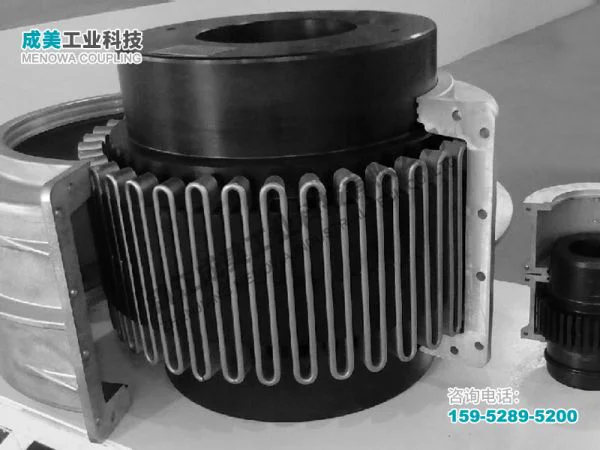
The basic structural composition of grid coupling follows a mature and optimized mechanical design logic formed through long-term industrial practice and continuous iterative upgrading of mechanical design concepts, and each component in the overall structure bears irreplaceable functional responsibilities in the torque transmission process and equipment protection link. The whole set of grid coupling equipment is mainly composed of two symmetrical metal hubs with special curved groove structures, a flexible metal grid elastic body installed in the matching grooves of the two hubs, and a supporting protective sealing shell and auxiliary fastening connecting parts. The two hubs are the basic rigid connecting parts of the grid coupling, which are respectively fixed on the output shaft of the driving power equipment and the input shaft of the driven working equipment through standard assembly and fixing methods. The surface of each hub is precisely processed with continuous curved tooth grooves with a special profile design. The curvature and spacing of these tooth grooves are scientifically calculated and precisely processed according to the mechanical characteristics of torque transmission and elastic deformation demand, which can ensure that the subsequent assembled flexible grid can form stable and progressive contact fit with the hubs in different load states. The flexible metal grid, as the most core functional component of the entire grid coupling, is usually made of high-strength alloy steel materials with excellent elasticity, fatigue resistance and mechanical toughness after special forging, heat treatment and precision processing technology. The overall structure of the grid presents a continuous serpentine grid shape, which has good elastic deformation space in multiple directions and can bear cyclic torque load and instantaneous impact load for a long time without permanent deformation or structural fracture. The protective sealing shell is wrapped outside the two hubs and the internal grid elastic body, which plays a vital role in isolating external dust, moisture, corrosive media and other harmful substances in the industrial working environment, preventing these impurities from entering the internal matching gap of the coupling and causing wear, corrosion or stuck failure of the grid and hub tooth grooves. At the same time, the sealing shell can also lock the internal lubricating medium required for the normal operation of the coupling, avoid the loss of lubricating grease caused by long-term high-speed operation, and ensure that the friction coefficient between the grid and the hub tooth grooves is always maintained within a reasonable and stable range. All auxiliary fastening parts are designed with standardized and durable structural forms, which can ensure that the overall assembly firmness of the coupling will not be loose or displaced due to long-term mechanical vibration and load impact, maintaining the stability of the overall structural connection state during the entire equipment operation cycle.
The core working principle of grid coupling is based on the organic combination of rigid torque transmission of metal components and flexible energy absorption and buffering of elastic grid deformation, realizing dual functions of stable power transmission and mechanical operation protection in the mechanical shaft connection system. When the industrial equipment starts to run normally and the driving shaft outputs rotational torque, the two hubs fixed on the driving and driven shafts synchronously rotate accordingly. The torque is not directly transmitted rigidly through the hard contact between the two hubs, but is gradually transmitted from the driving hub to the flexible metal grid through the contact between the curved tooth grooves of the driving hub and the grid structure, and then the torque is transmitted to the driven hub through the elastic grid, finally driving the driven shaft and the connected working equipment to operate synchronously. The most distinctive core advantage of this torque transmission mode lies in the progressive contact characteristic formed between the curved tooth profile of the hub and the flexible grid during the entire torque transmission process. Under the condition of low load and stable operation of the equipment, the contact area between the grid and the hub tooth grooves is relatively small, and the elastic deformation of the grid is slight, which can meet the basic demand of conventional torque transmission and maintain the high-efficiency operation state of the equipment. When the equipment encounters instantaneous load increase, sudden start-stop impact or fluctuating working conditions with changing operating torque, the torque borne by the coupling rises rapidly, the contact area between the grid and the hub tooth grooves increases synchronously, and the elastic grid undergoes appropriate flexible deformation under the action of increasing torque load. This progressive contact and elastic deformation process can effectively disperse and absorb the instantaneous peak impact energy generated by load mutation, avoid the direct action of huge instantaneous torque on the driving and driven shafts, bearings, reducers and other core precision components of the equipment, and effectively reduce the sharp fluctuation of mechanical stress inside the transmission system. In addition, the elastic deformation characteristics of the grid can also effectively adapt to the multi-dimensional misalignment between the two shafts caused by installation errors and thermal deformation, including angular misalignment, radial parallel misalignment and axial displacement, ensuring that the torque transmission process can still be carried out smoothly and stably even if the two connected shafts are not in an absolute ideal coaxial state, avoiding additional bending stress and mechanical wear caused by forced rigid connection of misaligned shafts.
In the actual industrial operation process, all mechanical transmission systems will inevitably produce mechanical vibration and running noise during operation, and long-term high-intensity vibration not only accelerates the fatigue wear of various mechanical components and reduces the overall service life of equipment, but also affects the operational stability and processing accuracy of production equipment, and even causes potential safety hazards in serious cases. Grid coupling has outstanding vibration damping and noise reduction performance compared with many other traditional rigid and common flexible couplings, which is an important reason why it is widely used in various industrial scenarios with high requirements for equipment operation stability. The serpentine flexible grid structure inside the coupling has natural elastic vibration absorption characteristics. When the mechanical equipment runs and produces periodic vibration and reciprocating impact, the elastic grid can convert the mechanical vibration energy and impact energy generated during operation into tiny elastic deformation energy through its own flexible deformation, and gradually dissipate this part of energy in the form of internal mechanical friction and micro deformation recovery, thus effectively reducing the vibration amplitude of the entire transmission system. Relevant practical application data of industrial operation shows that the reasonable application of grid coupling in the transmission system can significantly reduce the vibration level of the equipment operation process, and the vibration reduction effect is obvious and stable in long-term continuous operation. At the same time, the progressive contact transmission mode between the grid and the hub tooth grooves avoids the hard collision and rigid friction between metal components in the torque transmission process, reduces the mechanical friction noise and impact noise generated during equipment operation, makes the overall operation of the mechanical transmission system more stable and quiet, and improves the on-site working environment of industrial production. For industrial production scenarios that require long-term continuous operation and have strict requirements for equipment operation stability and low noise, such as large-scale fan and water pump operation systems, continuous conveyor production lines and industrial ventilation and dust removal equipment, the vibration damping and noise reduction advantages of grid coupling can be fully reflected, effectively reducing the failure rate of equipment caused by vibration and prolonging the maintenance cycle of mechanical components.
Misalignment compensation capability is one of the essential core performances that modern industrial couplings must have, and no matter how precise the mechanical installation and debugging work is in the early stage of equipment assembly, it is impossible to achieve absolute perfect coaxial connection between the driving shaft and the driven shaft. In addition, with the extension of equipment operation time, the mechanical components will have thermal expansion and cold contraction due to the change of operating temperature, and the basic frame of the equipment will have slight structural deformation due to long-term load bearing and mechanical vibration, which will further change the relative position of the two connected shafts and produce different degrees of angular, radial and axial misalignment. If the coupling used in the transmission system has no effective misalignment compensation function, the shaft and bearing components will bear continuous additional bending stress and shear stress during operation, which will lead to accelerated wear of shaft parts, abnormal heating of bearings, increased operating load of the transmission system, and even early fatigue fracture of key components in severe cases, affecting the normal production progress. The special structural design of grid coupling enables it to have excellent comprehensive compensation capability for multiple forms of shaft misalignment. The flexible elastic grid can produce slight adaptive bending deformation and telescopic deformation in multiple directions during torque transmission, which can well offset the angular offset between the two shafts caused by installation deviation and structural deformation, adapt to the radial parallel displacement of the two shafts, and allow a certain range of axial telescopic displacement of the shafts caused by thermal expansion. This multi-dimensional adaptive compensation function does not affect the normal and efficient transmission of torque, nor will it produce additional mechanical loss and stress concentration. It can always maintain the stable connection state of the transmission system in the dynamic operation process, avoid the additional mechanical damage caused by shaft misalignment to the equipment, and greatly improve the operational reliability and long-term service life of the entire mechanical transmission system.
Material selection and heat treatment process are the fundamental guarantees for the long-term stable operation and mechanical fatigue resistance of grid coupling, and determine the overall mechanical performance, load-bearing capacity and service life of the coupling in different working environments. The hub parts of grid coupling are generally made of high-quality carbon steel or low-alloy steel with high rigidity and good structural stability. These metal materials have high structural strength and hardness after rough machining and finish machining, and can maintain stable structural shape and assembly accuracy under long-term high torque load and mechanical vibration, without structural deformation or dimensional deviation. The flexible grid elastic body, as the core stress-bearing and deformation component, needs to have both high elastic deformability and strong fatigue resistance, so it is usually made of special alloy spring steel materials with excellent comprehensive mechanical properties. After professional quenching and tempering heat treatment and surface strengthening treatment, the grid material has good elastic toughness, high tensile strength and strong cyclic load resistance, which can withstand millions of times of elastic deformation and torque impact in long-term industrial operation without fatigue failure, crack generation or elastic attenuation. For grid couplings used in special harsh working environments, such as high-temperature industrial smelting workshops, humid and corrosive chemical production workshops and outdoor open-air operation equipment, the surface of hubs and grid components will also be treated with anti-corrosion, rust prevention and high-temperature resistance according to actual working conditions, so as to adapt to the adverse effects of special environments on metal components and ensure that the coupling can maintain stable working performance in high temperature, high humidity and corrosive working conditions. The protective sealing shell and fastening parts are made of durable metal and high-strength engineering materials, which have good compression resistance, aging resistance and impact resistance, and can protect the internal core components of the coupling from external environmental interference for a long time.
The installation, commissioning and daily maintenance management of grid coupling are simple and convenient, which is another important practical advantage that makes it favored by industrial production enterprises and mechanical equipment operation and maintenance personnel. Compared with some precision couplings that require complex installation procedures, high-precision debugging equipment and professional technical operation, the overall assembly structure of grid coupling is simple and intuitive, the assembly steps are clear and easy to operate, and no complex professional tools and high-precision debugging instruments are required in the installation process. The two hubs can be quickly assembled and fixed on the driving and driven shafts according to the standard assembly process, then the flexible grid is embedded in the hub tooth grooves, and finally the protective sealing shell is installed and the fastening parts are locked to complete the overall installation work of the coupling. In the commissioning link after installation, only simple coaxiality detection and fastening inspection are needed to ensure that the coupling is in a good assembly state, and the equipment can be put into normal operation quickly. In terms of daily maintenance and later component replacement, grid coupling has obvious convenience characteristics. Under the premise of normal equipment operation and regular maintenance, the coupling only needs to regularly check the tightness of fastening parts and the sealing state of the protective shell, and supplement the lubricating grease inside the shell regularly according to the operating cycle to maintain the good working state of the coupling. When the flexible grid reaches the service life limit or needs to be replaced due to accidental wear and damage in the later stage, the replacement operation can be completed directly without removing the two hubs fixed on the shafts and without re-commissioning the coaxiality of the equipment shafts. The whole replacement process takes a short time, has little impact on the normal production operation of the enterprise, effectively reduces the equipment shutdown maintenance time, improves the production continuity of the production line, and reduces the labor cost and time cost of equipment operation and maintenance.
Grid coupling has a wide range of industrial application scenarios, covering almost all mechanical transmission links that need torque transmission, vibration damping, impact buffering and misalignment compensation in various industrial fields, and can adapt to different working conditions such as heavy-duty operation, high-speed operation, frequent start-stop operation and variable load fluctuation operation. In the field of heavy industrial manufacturing and mechanical processing, grid coupling is widely used in the transmission connection of large-scale mechanical processing equipment, forging and pressing equipment, mining machinery and metallurgical machinery. These devices often bear heavy torque load and frequent impact load during operation, and have high requirements for the load-bearing capacity and impact resistance of couplings. The excellent torque transmission performance and impact buffering performance of grid coupling can effectively protect the core transmission components of heavy equipment and ensure the stable operation of heavy-duty mechanical production. In the field of building materials production and chemical industry production, the production equipment usually runs continuously for a long time, and the working environment has certain humidity and corrosiveness. The good sealing performance, anti-corrosion performance and long-term continuous operation stability of grid coupling can adapt to the harsh working environment of chemical and building materials production, avoid equipment failure caused by environmental factors, and ensure the long-term continuous and stable operation of the production line. In the field of logistics transportation and material handling machinery, such as various conveyor production lines, lifting and handling equipment and port loading and unloading machinery, the equipment often has frequent start-stop, forward and reverse rotation and load fluctuation changes. The flexible buffering and vibration damping performance of grid coupling can effectively adapt to the frequent load changes of such equipment, reduce the impact damage caused by start-stop and commutation to the equipment, and extend the service life of handling machinery. In the field of municipal engineering and environmental protection equipment, such as large-scale water supply and drainage pumps, ventilation fans and sewage treatment equipment, the stable and low-noise operation characteristics of grid coupling can meet the operation requirements of municipal public equipment, reduce equipment operating noise and vibration, and improve the stability and safety of municipal equipment operation.
In the long-term industrial practical application and continuous market verification, grid coupling has shown outstanding comprehensive use value and economic benefits for industrial production enterprises. From the perspective of equipment operation and maintenance cost control, the application of grid coupling can effectively reduce the failure rate of mechanical transmission systems, reduce the frequency of equipment shutdown maintenance and component replacement, reduce the consumption of spare parts and the labor input of maintenance personnel, and effectively save the daily operation and maintenance cost of enterprise equipment. From the perspective of production line operation efficiency improvement, the stable transmission performance and reliable protection function of grid coupling ensure the continuity and stability of industrial production, avoid production interruption and production efficiency reduction caused by coupling failure and equipment damage, and help enterprises maintain stable production output and good production efficiency. From the perspective of equipment service life extension, the vibration damping, impact buffering and misalignment compensation functions of grid coupling reduce the mechanical wear and stress damage of core equipment components such as shafts, bearings and reducers, delay the aging and fatigue damage speed of mechanical equipment, prolong the overall service life of production equipment, and create more long-term economic benefits for enterprises. Compared with other types of couplings, grid coupling has a good balance between use performance, application scope and maintenance cost, and has high cost performance in long-term industrial application, which is why it has been widely promoted and applied in various industrial fields.
With the continuous progress of modern industrial manufacturing technology, the continuous upgrading of mechanical equipment towards high efficiency, energy saving, stability and intelligence, and the increasingly stringent requirements of various industrial production scenarios for the operational reliability and environmental adaptability of mechanical transmission components, the design optimization and performance upgrading of grid coupling are also constantly advancing with the development of the industrial era. In terms of structural design optimization, combined with modern mechanical simulation analysis technology and finite element stress calculation method, the internal tooth groove curve of the coupling hub and the structural shape of the flexible grid are continuously optimized, so that the torque transmission efficiency of the coupling is further improved, the elastic deformation energy absorption effect is more excellent, and the misalignment compensation range is more reasonable, adapting to the higher standard transmission requirements of new high-speed and high-efficiency mechanical equipment. In terms of material technology innovation, with the continuous research and development and application of new high-strength, high-toughness and corrosion-resistant alloy materials, the comprehensive mechanical properties of grid coupling are continuously improved, the fatigue resistance and environmental adaptability are further enhanced, and it can adapt to more extreme and harsh industrial working conditions. In terms of intelligent matching application, grid coupling is gradually combined with modern equipment operation monitoring technology, realizing real-time monitoring of the operating state, torque load, vibration amplitude and working temperature of the coupling during operation, which can timely find potential hidden dangers of coupling failure, realize early warning and preventive maintenance, and further improve the intelligent operation level and operational safety of mechanical transmission systems.
In conclusion, as a mature, reliable and versatile flexible mechanical transmission component, grid coupling takes unique composite structural design and excellent comprehensive mechanical performance as the core support, integrates efficient torque transmission, vibration damping and noise reduction, impact load buffering and multi-dimensional misalignment compensation into one, and has the practical advantages of simple installation, convenient maintenance, long service life and wide application range. It solves various common practical pain points in the operation of modern industrial mechanical transmission systems, provides solid and reliable basic guarantee for the stable operation of various mechanical equipment in different industrial fields, and plays an indispensable and important role in ensuring the continuity of industrial production, improving the efficiency of equipment operation, reducing the cost of enterprise maintenance and prolonging the service life of production equipment. With the continuous development of industrial modernization and the continuous upgrading of mechanical manufacturing technology, grid coupling will continue to rely on continuous structural optimization, material innovation and intelligent matching upgrading to adapt to the changing industrial production needs, always maintain its core competitive advantages in the field of mechanical transmission, and continue to contribute stable and reliable power connection support to the high-quality development of various industrial sectors.
https://www.menowacoupling.com/industrial-coupling/grid-coupling.html
 WeChat
 WhatsApp