Tyre Coupling
In the vast field of mechanical power transmission systems, the reliable connection between rotating shafts serves as an indispensable foundational link for the stable operation of all types of industrial equipment and mechanical devices. Every mechanical system that relies on rotational power output and transmission needs a stable and durable connecting component to link driving shafts and driven shafts, ensuring the continuous and efficient transfer of torque while adapting to various complex operating conditions and subtle deviations generated during equipment operation. Among numerous types of shaft connecting components designed for power transmission, flexible coupling products have always occupied a crucial position due to their unique adaptive capacity and protective performance for mechanical equipment, and tyre coupling stands out among many flexible coupling options with its distinctive elastic deformation characteristics, simple structural layout and excellent comprehensive adaptive performance. As a typical elastomeric flexible transmission component, tyre coupling has been widely applied in light and heavy industrial production, mechanical supporting facilities, engineering operation equipment and many other fields, becoming a key basic part that balances efficient power transmission, mechanical vibration reduction, shaft displacement compensation and equipment operation protection in actual mechanical operation scenarios. Unlike rigid connecting components that pursue rigid and fixed connection effects and lack adaptive buffer space, tyre coupling takes elastic deformation of special rubber tyre-shaped components as the core working basis, abandoning the rigid transmission mode that easily causes rigid impact and mechanical component wear, and building a flexible and buffered power transmission channel between connected shafts through the excellent elasticity and toughness of elastomeric materials. This unique working mode not only realizes the basic torque transmission function required by mechanical operation, but also effectively solves many common practical problems in the operation of mechanical transmission systems, including inevitable shaft misalignment generated by equipment installation errors, mechanical vibration and impact load caused by frequent start-stop and variable load operation, and component fatigue wear caused by long-term rigid friction and collision between parts. The practical application value of tyre coupling is reflected in the whole process from equipment initial installation and commissioning, long-term continuous operation to daily maintenance and later replacement and maintenance, and its reasonable selection, standard installation and scientific maintenance are directly related to the overall operating stability, operating noise level, component service life and later operation and maintenance cost control of the entire mechanical transmission system. Understanding the internal structural composition, inherent working mechanism, core performance characteristics, applicable operating conditions, correct installation and commissioning methods and standardized daily maintenance management measures of tyre coupling is not only a necessary prerequisite for mechanical design personnel to carry out reasonable equipment matching design, but also an important guarantee for equipment operation and maintenance personnel to ensure long-term stable and efficient operation of mechanical equipment and reduce unnecessary equipment failure and shutdown loss.
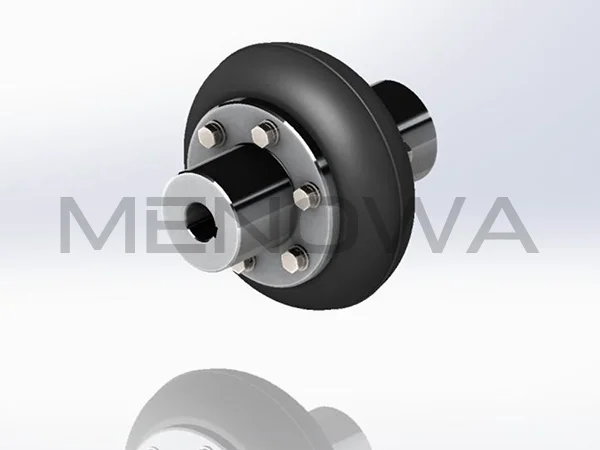
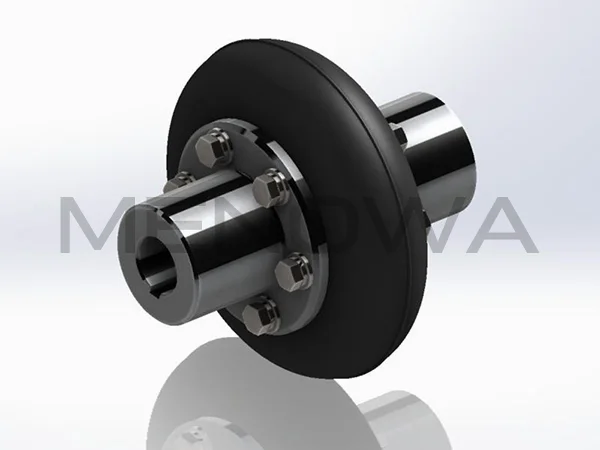
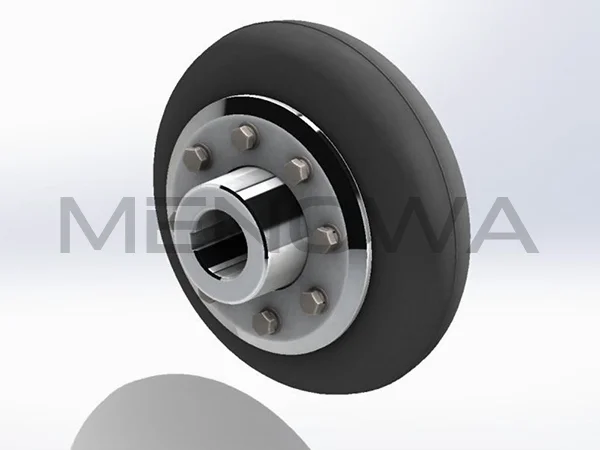
The overall structural design of tyre coupling follows the core design concept of simple composition, convenient assembly and disassembly, stable stress transmission and reliable elastic deformation, and the whole equipment is composed of several core functional parts without complex auxiliary transmission structures or redundant connecting accessories, which lays a solid foundation for its low failure rate and convenient later maintenance in long-term use. The main components of tyre coupling include two metal flange parts and a central elastic tyre-shaped elastomer component, and all parts cooperate with each other through simple bolt connection and fastening assembly to form a complete power transmission and flexible buffer integration structure. The two metal flanges are symmetrically arranged on both sides of the tyre-shaped elastomer, and each flange is processed with standard shaft mounting holes in the middle part, which can be stably sleeved and fixed on the driving shaft and driven shaft that need power transmission connection respectively. The metal flanges are made of high-strength metal materials with good rigidity and pressure resistance, which can bear the torque pressure and rotational tension generated in the process of power transmission without obvious deformation or structural damage, ensuring the stable connection between the coupling and the rotating shafts and avoiding connection looseness or displacement caused by long-term rotation and load impact. The end face of each metal flange in contact with the tyre-shaped elastomer is processed with flat and smooth connecting surfaces and reserved bolt mounting holes, and the bolt holes are uniformly distributed along the circumferential direction of the flange to ensure uniform stress on each connecting part during operation and avoid local stress concentration caused by uneven bolt distribution. The core functional part of tyre coupling is the intermediate tyre-shaped elastomer, which is made of high-elasticity rubber materials through integrated vulcanization processing, and the internal part of the elastomer is embedded with reinforced skeleton structures to enhance the overall structural stability and deformation recovery performance of the tyre body. The reinforced skeleton inside the tyre elastomer adopts reasonable weaving and laminating design, which can effectively improve the tear resistance and tensile resistance of the rubber tyre body on the premise of maintaining good elastic deformation capacity, prevent the tyre body from permanent deformation, crack damage or structural fracture due to long-term torsional shear force and impact load, and greatly extend the effective service life of the core elastic component. The tyre-shaped elastomer is designed into a circular structure similar to the shape of a tire, with a certain thickness and elastic buffer space in the middle part, which can produce reversible torsional shear deformation and compression deformation when subjected to torque and extrusion force, and rely on the elastic recovery performance of the material itself to maintain the continuity and stability of power transmission. All the connecting and fastening parts of tyre coupling adopt high-strength bolt assemblies, which are used to closely fasten the two metal flanges on both sides and the intermediate tyre elastomer together, forming a firm whole without relative displacement between parts during operation. The fastening force generated by bolt tightening forms stable friction between the flange end face and the tyre elastomer surface, and this friction becomes an important auxiliary force for torque transmission in the working process of the coupling, ensuring that the torque can be stably transferred from the driving side flange to the tyre elastomer and then to the driven side flange without slipping or power transmission loss. The overall structural layout of tyre coupling does not involve any precision transmission gears, rolling bearings or easily worn rotating friction parts, and there is no need to set up special lubrication channels or sealing structures for daily operation, which fundamentally reduces the types and quantity of vulnerable parts and simplifies the overall structural maintenance difficulty compared with other types of transmission couplings.
The working mechanism of tyre coupling is based on the elastic deformation characteristics of rubber elastomer materials and the friction transmission principle between contact surfaces, realizing the organic integration of efficient torque transmission, shaft displacement compensation and vibration and impact absorption in the mechanical power transmission process. When the mechanical equipment starts to operate normally, the driving shaft drives the connected driving side metal flange to perform synchronous rotational movement, and the rotational torque generated by the driving equipment is first transmitted to the tyre-shaped elastomer clamped between the two flanges through the fastening friction between the driving side flange and the tyre elastomer contact surface. Under the action of rotational torque, the tyre elastomer undergoes regular torsional shear deformation inside, and this elastic deformation does not cause structural damage to the tyre body, but relies on the good elasticity of the rubber material itself to generate stable elastic stress. The elastic stress generated by the torsional deformation of the tyre elastomer further drives the driven side metal flange to perform synchronous rotational movement, and finally the torque is stably transmitted to the driven shaft connected with the driven side flange, realizing the basic power transmission function of connecting the two rotating shafts and driving the normal operation of the driven mechanical equipment. In the whole torque transmission process, the tyre elastomer is always in a state of reversible elastic deformation, and the deformation degree changes dynamically with the fluctuation of transmission torque and operating load, which can well adapt to the dynamic load changes in the actual operation of mechanical equipment. In the actual installation and operation process of mechanical equipment, it is difficult to achieve absolute precise alignment between the driving shaft and the driven shaft due to objective factors such as equipment installation accuracy limitations, mechanical foundation settlement, long-term operation vibration and component slight wear, and different degrees of relative displacement deviation will inevitably be formed between the two connected shafts, including axial displacement deviation, radial displacement deviation and angular deflection deviation. For rigid couplings, such shaft displacement deviations will cause severe additional mechanical stress and friction between shafts and coupling parts, resulting in rapid wear of connecting parts, increased equipment operation noise, and even shaft bending deformation and equipment failure shutdown in serious cases. However, tyre coupling can effectively compensate for various shaft relative displacement deviations through its own elastic deformation capacity, and the tyre elastomer can produce corresponding adaptive deformation according to different types and degrees of displacement deviations, avoiding rigid extrusion and friction between the two flanges and between the shafts. When axial displacement occurs between the two shafts, the tyre elastomer can produce slight compression and stretching deformation in the axial direction to adapt to the axial position change of the shafts; when radial displacement deviation occurs, the elastic buffer space of the tyre body can absorb the radial position offset through local elastic deformation; when angular deflection exists between the two shafts, the torsional deformation of the tyre elastomer can adapt to the angle difference of shaft rotation, ensuring that the power transmission process is still smooth and continuous without additional rigid stress. In addition to shaft displacement compensation, the elastic deformation characteristics of tyre coupling also endow it with excellent vibration damping and impact absorption performance. When mechanical equipment is started, stopped frequently or operated under variable load and impact load conditions, the mechanical system will generate obvious vibration and instantaneous impact force, which will be transmitted along the rotating shafts to various mechanical components and easily cause fatigue damage of parts and increased operation noise. The tyre elastomer of tyre coupling can effectively absorb and buffer the instantaneous impact force and vibration energy generated in the power transmission process through its own elastic deformation, convert the instantaneous impact kinetic energy into elastic potential energy and slowly release it, reduce the vibration amplitude and impact strength transmitted between the driving end and the driven end, make the whole mechanical transmission system run more smoothly and quietly, and protect the relevant mechanical components and equipment from damage caused by long-term vibration and impact.
Tyre coupling has a variety of outstanding comprehensive performance advantages based on its unique structural design and working mechanism, which make it adaptable to complex and diverse mechanical operating environments and different types of power transmission working conditions, and show good application effects and long-term use stability in practical industrial production and mechanical operation. First of all, tyre coupling has excellent elastic buffer and vibration damping performance, which is far better than rigid couplings and some ordinary flexible couplings with low elasticity. The special rubber tyre elastomer can effectively weaken the vibration generated by equipment operation and the instantaneous impact caused by start-stop and load change, reduce the vibration conduction between the driving and driven equipment, lower the overall operation noise of the mechanical system, and create a more stable and low-noise operating environment for mechanical equipment. This performance advantage is particularly important for mechanical equipment that needs long-term continuous operation and equipment with high requirements for operation stability and low noise, which can effectively reduce the vibration fatigue wear of internal parts of equipment and prolong the overall service life of mechanical equipment. Secondly, tyre coupling has strong shaft misalignment compensation capacity, and can adapt to axial, radial and angular multi-dimensional displacement deviations between connected shafts generated by installation errors and long-term operation changes. In the actual industrial field, most mechanical equipment will have different degrees of shaft position deviation after long-term operation due to foundation vibration, component wear and thermal expansion and contraction during operation, and tyre coupling can adapt to these deviations through its own elastic deformation without generating additional mechanical stress, avoiding equipment failure and component damage caused by shaft misalignment, and reducing the failure rate of mechanical transmission system. Thirdly, the overall structure of tyre coupling is simple and compact, with few component types and no precision vulnerable parts and complex transmission structures, so the probability of structural failure and component damage in the working process is low, and the operation stability and reliability are high. Unlike some couplings that need regular lubrication, sealing maintenance and precision debugging, tyre coupling does not need any lubricating oil or grease for daily operation, and there is no need to regularly replace sealing accessories and wearing parts, which greatly reduces the daily operation and maintenance workload and maintenance cost of equipment. Fourthly, the installation, disassembly and replacement operation of tyre coupling is very convenient and fast. The whole coupling is connected and fixed by simple bolt assemblies, no special professional installation tools and complex installation processes are required, and ordinary equipment maintenance personnel can complete the installation and disassembly work in a short time. When the core tyre elastomer is worn and aged and needs to be replaced, only the connecting bolts need to be removed to separate the flanges and replace the elastomer part, without disassembling the overall shaft structure and mechanical equipment, which effectively shortens the equipment shutdown time for maintenance and replacement and reduces the economic loss caused by equipment shutdown. Fifthly, tyre coupling has good adaptability to different operating temperatures and conventional industrial operating environments, and the rubber materials used in the tyre elastomer can maintain stable elastic performance and structural stability within a reasonable temperature range, not easy to age and deform rapidly due to conventional temperature changes and ordinary industrial dust and humidity environments. It can work stably in indoor conventional production workshops, outdoor general operation sites and conventional industrial production environments with slight dust and humidity, and has strong environmental adaptability. In addition, the torque transmission process of tyre coupling is stable and reliable, with small power transmission loss, which can ensure that most of the torque generated by the driving equipment is efficiently transmitted to the driven equipment, avoiding power waste and transmission efficiency reduction caused by slipping and deformation in the transmission process, and meeting the power transmission efficiency requirements of most conventional mechanical equipment.
With its comprehensive performance advantages and stable working characteristics, tyre coupling has been widely used in many industrial production fields and mechanical equipment supporting scenarios, covering light industry and heavy industry, fixed production equipment and mobile operation equipment, and can meet the power transmission and equipment protection needs of different working condition characteristics. In the field of industrial production and manufacturing, various production and processing equipment that needs continuous rotational power transmission basically adopts tyre coupling as the connecting component between driving motors and driven working equipment, including various conveying and feeding equipment used in production lines, material mixing and stirring equipment, processing and grinding equipment and packaging and processing machinery. These production equipment often need to start and stop frequently and operate under variable load conditions, and will generate certain vibration and impact during operation. Tyre coupling can effectively buffer vibration and impact, compensate for shaft misalignment, ensure the stable operation of production equipment, reduce equipment failure and shutdown in the production process, and ensure the continuity and stability of industrial production work. In the field of water supply and drainage and fluid conveying equipment, various water pump units and fan equipment that run for a long time also widely use tyre coupling for shaft connection and power transmission. Water pumps and fans belong to equipment that runs continuously for a long time, and the vibration generated during long-term operation is easy to cause shaft position deviation and component wear. Tyre coupling can reduce vibration conduction, compensate for shaft displacement deviation, keep the long-term stable operation of pump and fan units, reduce the wear of pump body, fan blades and motor components, and extend the service life of fluid conveying equipment. In the field of engineering machinery and auxiliary operation equipment, many mobile engineering operation devices and mechanical auxiliary equipment that need to adapt to complex operation environments also apply tyre coupling, including small and medium-sized engineering supporting transmission equipment, mechanical walking transmission devices and on-site mobile operation machinery. The operating environment of engineering machinery is complex and changeable, with large vibration and impact during operation and easy shaft position deviation. The strong misalignment compensation and impact absorption performance of tyre coupling can adapt to the harsh working conditions of engineering operation and ensure the normal power transmission of engineering machinery in complex environments. In the field of agricultural machinery and rural operation equipment, various agricultural processing machinery and farmland operation machinery also use tyre coupling for power connection. Agricultural machinery usually has simple use conditions, poor operating environment and limited maintenance conditions, and the simple structure, convenient maintenance and strong environmental adaptability of tyre coupling are very in line with the use and maintenance needs of agricultural machinery equipment, which can ensure the stable operation of agricultural machinery under harsh field operating conditions and reduce the maintenance difficulty and cost of agricultural equipment. In addition, in the field of power transmission supporting facilities and general mechanical supporting equipment, various motor supporting transmission devices, reducer connecting parts and mechanical auxiliary transmission mechanisms also take tyre coupling as the conventional connecting component. These general mechanical transmission scenarios have universal requirements for stable power transmission, vibration reduction and convenient maintenance, and tyre coupling can well meet the basic use needs of general mechanical transmission, becoming a conventional and reliable basic supporting part in the mechanical industry. In all application scenarios, the core role of tyre coupling is not only to realize basic shaft connection and torque transmission, but also to protect the driving and driven equipment and internal transmission components through flexible buffering and adaptive compensation, reduce equipment operating failure rate and later maintenance cost, and create better operating economic benefits for equipment operation and production work.
The reasonable selection of tyre coupling is a key link to ensure its good use effect and long service life in practical application, and the selection work needs to be carried out comprehensively according to the actual operating parameters, working condition characteristics and equipment matching requirements of the mechanical system, instead of blind selection according to a single parameter or simple size matching. The first core factor to be considered in selection is the actual torque demand of the mechanical transmission system, including the rated torque required for normal operation of the equipment and the instantaneous peak torque generated during equipment start-stop and load mutation. It is necessary to select the corresponding specification model of tyre coupling according to the actual torque operating range of the equipment, ensuring that the coupling can bear the rated torque and instantaneous peak torque generated during equipment operation without excessive deformation, slipping or structural damage caused by overload. It is necessary to avoid selecting couplings with insufficient torque bearing capacity, which will lead to rapid damage of the tyre elastomer and affect the normal operation of the equipment, and also avoid selecting couplings with excessive torque bearing capacity, which will cause unnecessary waste of configuration cost and increase the overall matching volume of the equipment. The second factor to be considered is the shaft diameter and shaft connection size of the driving shaft and driven shaft of the equipment. The shaft mounting hole size of the selected tyre coupling flange needs to be perfectly matched with the actual shaft diameter of the equipment, ensuring that the coupling can be stably sleeved and fixed on the rotating shafts without looseness or excessive gap after installation, avoiding connection vibration and power transmission instability caused by mismatched shaft diameter sizes. At the same time, the overall installation space size of the coupling should also be considered to ensure that the installation position of the mechanical equipment has enough space to arrange and install the tyre coupling without installation interference with other surrounding mechanical components. The third selection factor is the actual operating condition characteristics of the equipment, including the operating speed of the mechanical system, operating temperature range, start-stop frequency, load fluctuation degree and operating environment conditions. For equipment with high operating speed, it is necessary to select tyre couplings with good structural stability and small deformation at high speed to ensure stable rotation and no abnormal vibration during high-speed operation; for equipment with frequent start-stop and large load fluctuation, it is necessary to select couplings with good elastic buffer performance and strong impact resistance to adapt to frequent impact load changes; for equipment operating in special temperature and dust-humid environments, it is necessary to select tyre elastomer materials with corresponding environmental adaptability to avoid rapid aging and performance attenuation of the elastomer due to environmental factors. The fourth selection factor is the allowable misalignment compensation demand of the mechanical shaft system. According to the actual installation accuracy and long-term operation shaft displacement deviation of the equipment, select the tyre coupling with corresponding displacement compensation capacity, ensuring that the coupling can effectively compensate for the shaft position deviation generated in the actual operation process and avoid additional mechanical stress caused by excessive misalignment beyond the compensation range. In the selection process, it is also necessary to comprehensively refer to the actual operation experience of similar mechanical equipment and the structural characteristics of the transmission system, avoid ignoring the influence of long-term operation aging and load change on the use of the coupling, and reserve a certain reasonable use margin for the selected coupling to ensure that it can still maintain stable working performance after long-term operation.
Standardized installation and commissioning work is the basic guarantee for tyre coupling to give full play to its comprehensive performance and achieve long-term stable operation, and non-standard installation will easily lead to poor coupling use effect, accelerated component wear and even early failure damage, so every link of installation and commissioning needs to be carried out in strict accordance with standardized operation requirements. Before the formal installation of tyre coupling, comprehensive preparation and inspection work must be done first. It is necessary to carefully check the appearance integrity of all components of the coupling, including whether the metal flange has deformation, crack and surface damage, whether the tyre-shaped elastomer has crack, aging, damage and uneven thickness, and whether the connecting bolts and fastening accessories are complete and undamaged. At the same time, the surface of the driving shaft and driven shaft connected with the coupling should be cleaned to remove dirt, rust, oil stains and sundries on the shaft surface, ensuring that the shaft surface is smooth and clean, which is conducive to the stable assembly and fixation of the coupling. In addition, the preliminary alignment adjustment of the driving shaft and driven shaft should be done in advance to minimize the initial installation misalignment between the two shafts, reduce the adaptive deformation range of the tyre coupling during subsequent operation, and help extend the service life of the core elastomer component. In the formal installation process, first, the two metal flanges of the tyre coupling are respectively sleeved on the driving shaft and the driven shaft, and the flanges are adjusted to the appropriate installation position on the shafts for preliminary positioning. Then the tyre-shaped elastomer is placed in the middle position between the two flanges, ensuring that the bolt mounting holes on the elastomer are aligned with the bolt holes on the two flanges one by one, and the position of the elastomer is kept centered without offset deviation. After the position alignment is completed, all connecting bolts are penetrated into the reserved bolt holes in sequence, and the bolts are preliminarily screwed and fixed by hand to ensure that all parts are closely attached without gaps and displacement. After the preliminary fixing is completed, the bolts need to be tightened symmetrically and evenly in accordance with the circumferential sequence, instead of tightening a single bolt one by one at will. Symmetrical and uniform tightening can ensure that the stress on the flange and tyre elastomer is uniform, avoid local stress concentration caused by uneven bolt tightening force, and prevent local excessive deformation and wear of the tyre body. After all bolts are tightened in place, the overall rotation flexibility of the coupling should be manually checked to ensure that the coupling can rotate smoothly without jamming, abnormal friction and rotation resistance, indicating that the installation position and tightening degree meet the standard requirements. After the installation is completed, the initial commissioning work of no-load trial operation should be carried out. The mechanical equipment is started for short-term no-load operation to observe the rotation state of the tyre coupling, check whether there is abnormal vibration, abnormal noise and obvious eccentric rotation during operation, and confirm whether the connection between the coupling and the shafts is loose or displaced. If abnormal conditions are found during no-load commissioning, the equipment should be stopped immediately for recheck and adjustment, and the equipment can only be put into formal load operation after ensuring that the coupling operates stably without abnormal conditions.
Scientific and standardized daily maintenance and regular inspection management are important measures to prolong the service life of tyre coupling, maintain its stable working performance and reduce equipment failure rate. Although tyre coupling has the advantages of simple maintenance and no need for lubrication, long-term operation in complex industrial environments will still be affected by factors such as dust accumulation, environmental erosion, material aging and load wear, so regular maintenance and inspection cannot be ignored. The daily maintenance work of tyre coupling is mainly simple surface cleaning and conventional operation observation. In the daily operation process of the equipment, it is necessary to regularly clean the surface dust, sundries and oil stains of the coupling to prevent a large amount of dust and dirt from accumulating on the surface of the tyre elastomer and flanges for a long time, avoid the erosion of dirt on the rubber material of the tyre body leading to accelerated aging and hardening, and keep the surface of the coupling components clean and dry. At the same time, equipment operators should regularly observe the operating state of the tyre coupling during daily equipment operation, pay attention to whether there is abnormal vibration, abnormal friction noise and obvious rotation jitter during the operation of the coupling, and check whether the connection position between the coupling and the shafts is displaced or loose. Once abnormal operation phenomena are found, the equipment should be inspected and maintained in a timely manner to avoid small problems evolving into large component damage and equipment failure. The regular inspection work of tyre coupling needs to be carried out regularly according to the equipment operation intensity and operating environment conditions, and the inspection cycle can be appropriately shortened for equipment with high operation frequency and harsh operating environment, and the inspection cycle can be appropriately extended for equipment with low operation frequency and good operating environment. The key contents of regular inspection include checking the fastening degree of all connecting bolts of the coupling, confirming whether the bolts are loose or missing due to long-term vibration and rotation, and tightening the loose bolts in time to ensure the stable connection of all parts of the coupling. It is also necessary to carefully check the surface state of the core tyre elastomer, observe whether there are surface cracks, local deformation, aging hardening, edge wear and peeling damage on the tyre body, and check whether the internal reinforced skeleton of the elastomer is exposed or damaged. If slight surface aging and wear are found, the operation and use can be continued with enhanced daily observation; if obvious cracks, serious deformation and damage are found, the tyre elastomer should be replaced in a timely manner to avoid sudden fracture and failure during operation. In addition, it is necessary to check the alignment state of the two connected shafts regularly, confirm whether the shaft misalignment exceeds the allowable compensation range of the coupling due to long-term operation and foundation settlement, and adjust the shaft position in time if the misalignment is too large to reduce the excessive adaptive deformation of the tyre coupling and slow down the wear and aging speed of the elastomer. During the long-term use of tyre coupling, the rubber tyre elastomer will inevitably have natural aging and performance attenuation with the increase of service time, which is a normal material aging phenomenon. Even if there is no obvious surface damage, the elastic buffer performance and deformation recovery performance of the elastomer will gradually decrease after long-term use, so it is necessary to regularly replace the ageing tyre elastomer according to the actual service time and use state, ensuring that the coupling always maintains good working performance. In the maintenance and replacement process, it is necessary to avoid using sharp tools to scratch and damage the tyre elastomer, and avoid exposing the coupling to high-temperature, corrosive and harsh environments for a long time, so as to effectively prolong the overall service life of the tyre coupling and ensure the long-term stable and reliable operation of the mechanical power transmission system.
https://www.menowacoupling.com/industrial-coupling/tyre-coupling.html
 WeChat
 WhatsApp