Tire Coupling
In the complex and interconnected world of mechanical power transmission, the smooth and reliable connection between rotating shafts stands as one of the most foundational and indispensable requirements for all types of industrial machinery and mechanical equipment. Every mechanical system that relies on rotational motion to generate power, transfer force, or drive production processes depends on a stable connecting component that can not only complete basic torque transmission tasks but also adapt to the various unavoidable deviations, vibrations, and impact loads that arise during actual operational processes. Among the numerous types of flexible coupling solutions developed to meet these diverse and rigorous industrial demands, tire coupling has gradually become a widely favored and practically applied connecting component in multiple industrial fields by virtue of its unique elastic deformation characteristics, excellent displacement compensation capability, and simple and reliable overall structural layout. Unlike rigid connecting parts that focus solely on rigid torque transmission and lack adaptive adjustment functions, and different from other flexible couplings with complex internal structures and high later-stage maintenance thresholds, tire coupling perfectly balances basic power transmission efficiency and operational buffer protection performance, creating a stable and durable connection state for shaft systems under various harsh and variable working conditions. Its core design concept is based on the elastic mechanical properties of rubber composite materials and the reasonable matching of metal structural accessories, realizing the organic integration of rigid connection and flexible buffering, ensuring that mechanical equipment can maintain continuous and stable operation even when facing shaft misalignment, frequent start-stop cycles, periodic vibration interference, and instantaneous impact loads generated by sudden load changes.
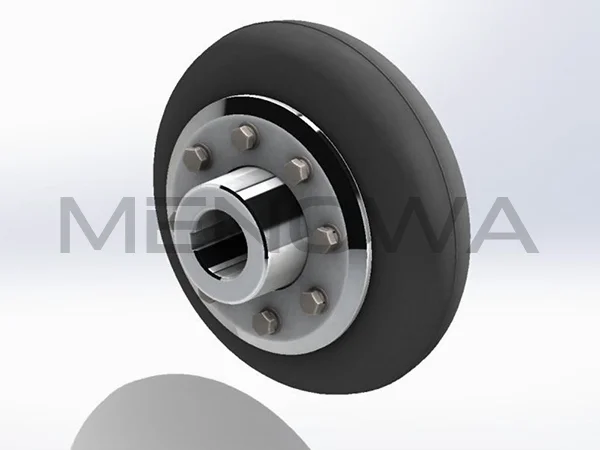
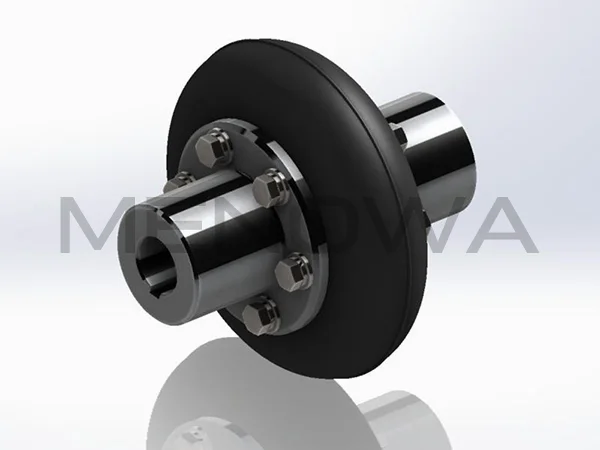
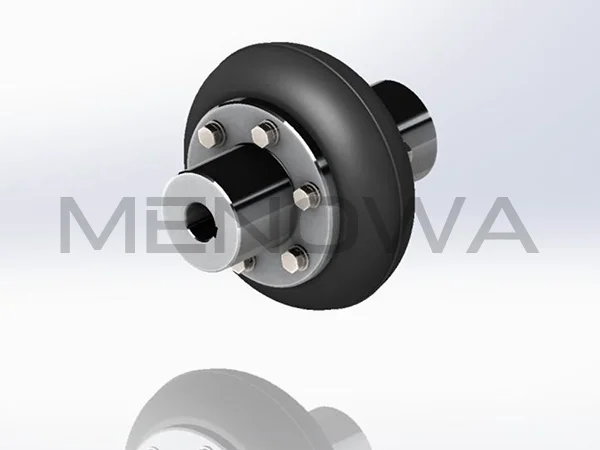
To fully understand the practical value and working advantages of tire coupling in modern mechanical transmission systems, it is first necessary to start with its basic structural composition and internal working mechanism, clarifying how each component coordinates and cooperates to complete torque transmission and vibration buffering functions. The overall structure of tire coupling follows a simple and practical design logic without redundant accessory parts or complex transmission structures, and the whole set of equipment is mainly composed of two symmetrical metal flange components and a central elastic tire-shaped elastomer that undertakes core deformation and buffering tasks. The two metal flanges are usually processed and manufactured with high-strength cast iron or carbon steel materials, which have good structural rigidity, compressive resistance, and torsional resistance, and can firmly connect with the driving shaft and driven shaft of mechanical equipment respectively in the actual installation and assembly process. Each metal flange is designed with precise shaft mounting holes and reserved bolt fixing positions, ensuring that the flange and the shaft can maintain a tight and synchronous rotating state after installation, and no relative rotation or position deviation occurs during long-term high-speed operation. The core functional part connecting the two metal flanges is the tire-shaped elastomer, which is named for its outer contour and structural shape similar to the tire used in transportation equipment, and this elastomer is the key component that determines the overall flexible performance, displacement compensation ability, and vibration damping effect of the entire tire coupling. In the production and manufacturing process of the tire-shaped elastomer, professional vulcanization technology is adopted to bond the rubber body with an embedded steel skeleton or high-strength fiber reinforcement layer as a whole, and the reasonable combination of flexible rubber matrix and rigid reinforcement structure makes the elastomer have both excellent elastic deformation recovery ability and enough structural tensile and tear resistance to cope with various complex stress states during long-term operation.
The assembly and torque transmission mode of tire coupling follows a stable friction and extrusion coordination principle, and all power transmission processes are completed through the tight fit between components and the torsional shear deformation of the elastic tire body. During formal assembly, the tire-shaped elastomer is placed in the middle position between the two metal flanges, and the reserved bolt holes on the elastomer are aligned with the fixing holes on the flanges one by one. Then, high-strength connecting bolts are used for uniform tightening and fixing, so that the end faces of the two metal flanges are closely pressed on both sides of the tire elastomer. After the assembly work is completed, the driving shaft drives one of the metal flanges to rotate synchronously when the equipment starts to operate, and the rotational torque is transmitted to the tire-shaped elastomer through the friction force generated by the compression between the flange end face and the elastomer surface. Under the action of torque, the tire elastomer undergoes regular torsional shear deformation, and then the deformation restoring force and friction coordination effect transfer the torque to the other metal flange, finally driving the driven shaft to rotate synchronously and realizing the continuous transmission of mechanical power between the two shafts. In this whole working process, the tire elastomer does not play a simple intermediate connection role; more importantly, it relies on its own elastic deformation characteristics to absorb and buffer various adverse mechanical factors generated during the operation of the equipment. When the mechanical system has instantaneous impact load due to sudden start, sudden stop, or sudden load change, the rubber material of the tire body can quickly produce elastic deformation to absorb the instantaneous impact force, avoiding the direct action of impact vibration on the metal shaft and key mechanical components, and effectively protecting the core equipment structure from impact damage.
One of the most prominent core advantages of tire coupling in practical industrial application lies in its excellent multi-directional displacement compensation performance, which can effectively adapt to various shaft misalignment problems that are inevitable in the installation and long-term operation of mechanical equipment. In the actual assembly and deployment process of various mechanical equipment, it is almost impossible to achieve absolute precise coaxial alignment between the driving shaft and the driven shaft due to manufacturing errors of mechanical parts, installation and construction deviations, slight structural deformation of the frame, and thermal expansion and contraction changes during equipment operation. These unavoidable deviations will form three main types of misalignment states between the two shafts, including radial displacement deviation, angular deflection deviation, and axial displacement deviation. If rigid couplings are used for connection in this case, the unbalanced stress caused by shaft misalignment will directly act on the shaft body, bearings, and other key components, resulting in increased equipment operation friction, intensified component wear, obvious vibration and noise during operation, and even early fatigue damage and service life shortening of shafts and bearings in severe cases. Tire coupling perfectly solves this common mechanical operation problem by virtue of the good elastic deformation space of the tire-shaped elastomer. The special structural design of the tire body allows it to produce adaptive small-scale deformation in the radial, angular, and axial directions at the same time during operation, without generating additional destructive stress on the shaft system while maintaining normal torque transmission. This natural adaptive compensation ability enables the equipment to always maintain a stable operating state even if there is a certain range of misalignment between the two shafts, greatly reducing the additional mechanical load borne by bearings and shafts, and creating a good basic operating environment for the long-term stable operation of the entire mechanical system.
The material selection and internal reinforcement design of the tire elastomer are crucial factors affecting the overall service performance and service life of tire coupling, and different material formulas and structural reinforcement methods will make the coupling show obvious differences in wear resistance, aging resistance, deformation recovery ability, and load-bearing capacity in different working environments. The basic matrix material of the tire elastomer is mostly high-elasticity synthetic rubber with good comprehensive mechanical properties. This type of rubber material has excellent tensile elasticity, compression resilience, and vibration absorption characteristics, and can maintain stable elastic performance for a long time under normal temperature and conventional working conditions. In order to further enhance the structural stability and deformation resistance of the tire body during long-term torsional shear operation, modern tire coupling products will add multi-layer reinforcement structures inside the rubber matrix, including nylon thread mesh skeleton, high-strength fiber cloth layer, and embedded thin steel plate skeleton structures. These reinforcement materials are closely combined with the rubber matrix through high-temperature vulcanization process, forming an integrated composite structure that is not easy to peel or separate. The existence of the reinforcement layer effectively improves the overall tear resistance and tensile strength of the tire elastomer, avoiding permanent deformation, crack damage, or local tearing failure of the rubber body after long-term repeated torsional deformation. For tire couplings used in special working environments such as high temperature, low temperature, or corrosive medium surroundings, the rubber formula of the tire body will be adjusted and optimized in a targeted manner. Special rubber materials with high temperature resistance, low temperature toughness, or corrosion resistance will be selected to ensure that the coupling can maintain stable working performance without performance attenuation or structural damage even in harsh environmental conditions.
Compared with many other types of flexible couplings commonly used in the mechanical transmission industry, tire coupling has obvious comprehensive advantages in structural simplicity, installation and maintenance convenience, and daily operation and management costs, which is also an important reason why it is widely used in various small, medium, and large mechanical equipment systems. The overall structure of tire coupling is concise and compact, with few internal parts, no complex spring components, gear structures, or hydraulic buffer accessories, and the whole set of connecting device can complete the connection work only through two flanges and one tire elastomer matched with connecting bolts. This simple structural feature makes the on-site installation and disassembly work of the coupling extremely convenient. During equipment assembly and installation, workers only need to fix the two flanges on the driving and driven shafts respectively, place the tire elastomer in the middle, and tighten the bolts evenly according to the standard operating specifications to complete all installation work. When the coupling needs to be inspected, maintained, or replaced with accessories after long-term operation, the disassembly process is also very simple, without the need for professional and complex disassembly tools and tedious operation steps, and the replacement and maintenance work can be completed in a short time, effectively reducing the downtime loss of industrial production caused by equipment maintenance. In addition, tire coupling does not need regular lubrication, oiling, or grease maintenance during daily operation, unlike gear couplings and other transmission components that need regular lubrication maintenance to reduce component wear. The rubber elastomer itself relies on its own material characteristics to complete flexible buffering and torque transmission, and no additional lubrication maintenance measures are required in the whole life cycle of normal use, which greatly reduces the daily operation and maintenance workload and long-term use cost of enterprise mechanical equipment.
The excellent vibration damping and noise reduction performance of tire coupling also makes it play an irreplaceable role in mechanical equipment systems that require stable operation and low noise working environment. In the operation process of various mechanical equipment, rotational vibration is inevitably generated due to the unbalanced mass of rotating parts, meshing friction of transmission components, and periodic load changes. This kind of vibration will not only cause obvious noise pollution during equipment operation, but also transmit the vibration to the whole equipment frame and even the entire production workshop foundation, affecting the normal operation accuracy of surrounding mechanical equipment and the working environment comfort of the production site. Tire coupling relies on the high elasticity and internal damping characteristics of rubber materials to effectively absorb and isolate most of the vibration energy generated during the operation of the shaft system. When vibration is transmitted from the driving shaft to the tire elastomer, the rubber material can convert the vibration mechanical energy into tiny internal thermal energy through its own internal friction and elastic deformation, and dissipate it naturally, so that the vibration transmitted to the driven shaft and subsequent mechanical components is greatly weakened. On the basis of reducing vibration transmission, the vibration friction and impact between metal components are also effectively reduced, thus significantly reducing the mechanical operation noise generated by vibration and impact. This vibration damping and noise reduction effect not only improves the operating stability of single mechanical equipment, but also helps optimize the overall working environment of the production workshop and reduce the adverse impact of mechanical vibration and noise on production operations and surrounding equipment.
Tire coupling has a wide range of applicable working conditions and strong working condition adaptability, and can maintain stable and reliable working performance in multiple industrial fields and different types of mechanical equipment. In the field of industrial production and manufacturing, tire coupling is widely used in various conveying and transmission equipment such as belt conveyors, screw conveyors, and bucket elevators. These conveying equipment often have frequent start-stop working states and unstable load changes during operation, and are prone to generate instantaneous impact load and shaft misalignment deviation. The good impact resistance and displacement compensation performance of tire coupling can well adapt to these working characteristics, ensuring the stable operation of conveying equipment and avoiding equipment failure caused by impact vibration and shaft deviation. In the field of power machinery and supporting equipment, tire coupling is also commonly used in the connection and matching of fans, water pumps, compressors, and other supporting power equipment. This type of power equipment runs continuously for a long time, and has high requirements for the stability and durability of shaft connection components. The simple structure and low maintenance characteristics of tire coupling can meet the long-term continuous operation needs of such equipment, reducing the failure rate and maintenance frequency of power equipment. In addition, in the field of construction machinery, agricultural machinery, and light industrial production equipment, tire coupling is also applied in large quantities. These mechanical equipment often work in complex and harsh outdoor or production environments, and are affected by environmental temperature changes, dust pollution, and load fluctuation for a long time. The strong environmental adaptability and structural durability of tire coupling enable it to maintain good working effect in these harsh working conditions.
Although tire coupling has many outstanding working advantages and wide application value, it is also necessary to follow scientific selection principles and standardized operation and maintenance management in the actual use process, so as to give full play to its working performance and extend its effective service life. In the selection and matching stage of tire coupling, it is necessary to comprehensively select the appropriate coupling model and specification according to the actual working torque of the equipment, rotating speed, shaft diameter size, misalignment range, and working environment conditions. It is necessary to avoid the problem of insufficient load-bearing capacity of the coupling caused by blind selection of small-size specifications, and also avoid the waste of equipment configuration resources caused by excessive selection of large-size models. In the actual installation process, it is necessary to strictly follow the installation operation specifications to ensure that the flange installation position is accurate, the bolt tightening force is uniform and moderate, and excessive tightening force that causes excessive compression and permanent deformation of the tire elastomer is avoided, as well as insufficient tightening force that leads to relative sliding between the flange and the tire body and affects torque transmission efficiency. In the daily operation and use process, regular visual inspection and simple performance check work should be done well. The surface state of the tire elastomer should be regularly observed to check whether there are cracks, aging hardening, local wear, or deformation and bulging problems. At the same time, the fastening state of the connecting bolts should be checked regularly to prevent bolt loosening caused by long-term vibration operation, which affects the connection stability of the coupling.
With the continuous progress of modern material science and mechanical design technology, the overall performance of tire coupling is also constantly optimized and upgraded, and the application scope in the industrial field is also continuously expanded. The continuous innovation of rubber composite material formulas further improves the high temperature resistance, low temperature resistance, corrosion resistance, and aging resistance of tire elastomers, enabling tire couplings to adapt to more extreme special working environments that could not be adapted to in the past. The continuous optimization of internal structural reinforcement design further enhances the load-bearing capacity and fatigue resistance of tire couplings, making them able to meet the torque transmission needs of larger power and heavier load mechanical equipment. The continuous improvement of production and processing technology makes the overall structural precision and component matching degree of tire couplings higher, and the operation stability and transmission efficiency in actual use are further improved. As modern industrial production continues to develop in the direction of high efficiency, stability, energy saving, and low consumption, the importance of flexible connecting components such as tire couplings in mechanical transmission systems will become more prominent. Relying on its unique structural advantages, excellent comprehensive performance, and low maintenance cost characteristics, tire coupling will continue to play an important basic supporting role in various industrial mechanical equipment, providing reliable guarantee for the stable operation and efficient production of various mechanical systems.
In the long-term industrial practical application process, the practical application effect of tire coupling has fully proved that a simple and reasonably designed flexible connecting component can effectively solve many common practical problems in mechanical power transmission. It is not complicated structural design and expensive configuration accessories that determine the long-term operation effect of mechanical equipment, but whether the selected connecting components can accurately match the actual working conditions and meet the core needs of equipment stable transmission, vibration buffering, and adaptive compensation. Tire coupling precisely grasps this core demand of mechanical transmission, takes elastic flexible connection as the core, takes simple and reliable structure as the foundation, and takes convenient installation and low maintenance as the advantage, forming a very practical and efficient shaft connection solution. For all types of mechanical equipment operation and maintenance personnel and mechanical design engineers, fully understanding the working principle, structural characteristics, material performance, application scope, and maintenance points of tire coupling is conducive to better selecting and applying this coupling component, giving full play to its due working value, reducing equipment operation failure rate, extending the overall service life of mechanical equipment, and creating more stable and efficient operation conditions for industrial production and mechanical operation. In the future industrial mechanical design and equipment supporting work, tire coupling will still rely on its mature technology and stable performance to become one of the preferred flexible coupling types for most conventional mechanical transmission systems, and continue to contribute to the safe and stable operation of various mechanical equipment.
https://www.menowacoupling.com/industrial-coupling/tire-coupling.html
 WeChat
 WhatsApp