In the entire field of mechanical power transmission systems, the stable connection and coordinated operation of rotating shafts are the core prerequisites for all types of industrial mechanical equipment to maintain continuous and efficient operation. Every mechanical device that relies on rotational power output and transmission, from large-scale heavy-duty industrial production equipment to medium and small-sized supporting mechanical facilities in civilian production and processing links, needs reliable connecting components to connect the driving shaft and the driven shaft, realize the stable transfer of torque, and ensure the synchronization of rotational speed and operating rhythm between different mechanical parts. Among numerous types of flexible coupling products developed and applied in the mechanical industry, tire couplings have gradually become one of the most widely used and practically valuable connecting components in modern industrial transmission scenarios by virtue of their unique elastic structural design, excellent displacement compensation capacity, reliable vibration damping and shock absorption effects, and simple and convenient overall application and later maintenance characteristics. Unlike rigid couplings that can only achieve rigid connection and cannot adapt to any shaft system deviation and flexible couplings with complex internal structures and high later maintenance costs, tire couplings balance structural simplicity and functional diversity in the design process, taking into account both basic torque transmission efficiency and adaptive protection performance of equipment operation, and can maintain stable working conditions in various complex and harsh industrial working environments, effectively reducing the operating failure rate of mechanical equipment and extending the overall service life of the entire transmission shaft system and supporting mechanical components.
The basic design concept of tire couplings originates from the practical demand for solving various adverse problems in the actual operation of mechanical transmission shafts. In the actual installation and long-term operation of industrial mechanical equipment, it is almost impossible to achieve absolute perfect alignment between the driving shaft and the driven shaft. Affected by many objective factors such as equipment installation accuracy errors, foundation settlement changes of the factory building, thermal expansion and contraction of metal parts during equipment operation, mechanical vibration and load impact during long-term operation, and slight deformation of the frame structure, various relative displacements and deviations will inevitably occur between the two connected shafts. These deviations include angular deviation where the center lines of the two shafts form a certain included angle, radial parallel displacement where the two shafts are parallel but not on the same central axis, and axial displacement along the linear direction of the shaft body. If rigid connection methods are adopted for such shaft systems with inevitable deviations, additional mechanical stress will be continuously generated inside the shaft body, bearings, gear components and other key parts of the equipment during the power transmission process. This kind of additional stress will not only cause severe mechanical wear and tear on the connecting parts and transmission components in a short time, leading to frequent equipment failures and shutdown maintenance, but also easily induce strong mechanical vibration and running noise during equipment operation, affect the stability of the entire production process, and even cause irreversible damage to key mechanical structures in serious cases, bringing unnecessary production losses and maintenance costs to industrial production enterprises. It is precisely to solve these practical pain points in mechanical transmission that rubber tire couplings adopt a special tire-shaped elastic intermediate structure design, relying on the elastic deformation characteristics of the core rubber tire body to naturally compensate for various relative displacements and deviations between the two shafts, absorb vibration and impact loads generated during equipment operation, and realize flexible and buffer-type torque transmission between shafts, thereby fundamentally protecting the safe and stable operation of the entire mechanical transmission system.
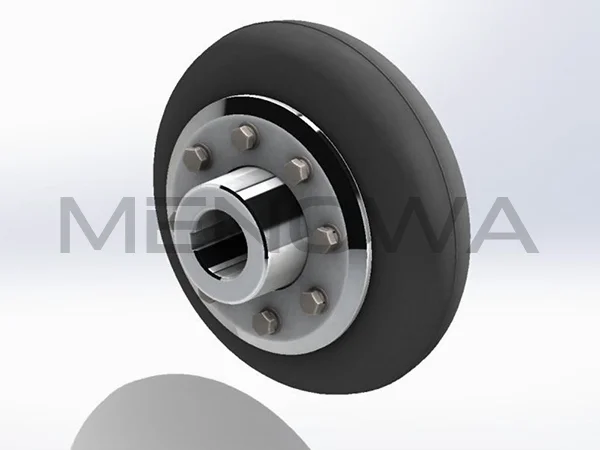
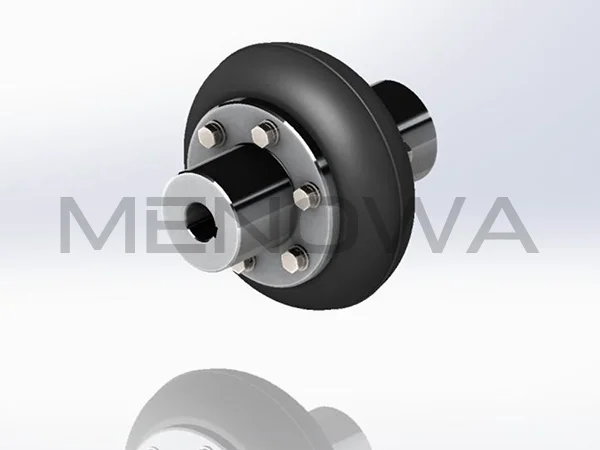
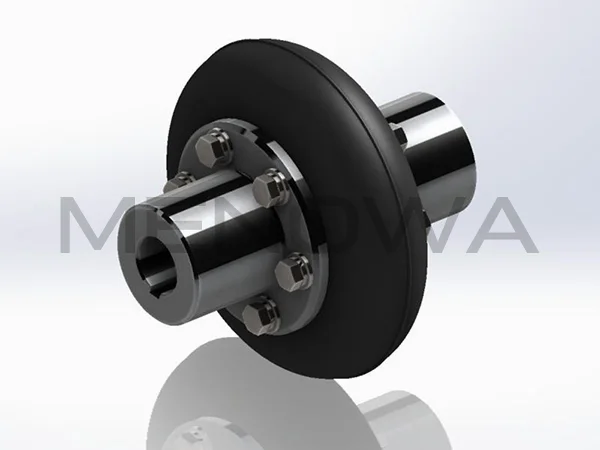
The overall structural composition of tire couplings is simple and reasonable, with no redundant complex mechanical parts, and the whole set of equipment is mainly composed of two symmetrical metal flanges and a central flexible rubber tire elastomer, supplemented by supporting bolt connection components and simple fastening parts. The metal flanges on both sides are the main force-bearing and connecting structural parts of the tire coupling, and are usually made of high-strength steel or cast iron materials processed by precision forging and machining processes. The selection of metal materials for the flanges fully considers the torque bearing capacity, structural rigidity and long-term wear resistance required for long-term industrial operation. After forging and finishing, the flanges have stable mechanical properties, good structural toughness and strong pressure resistance, and will not be easily deformed or damaged under long-term torque transmission and conventional load impact. The inner side of each metal flange is provided with a reserved connecting surface and bolt mounting holes arranged in a uniform circumferential distribution, which is convenient for the fixed assembly and connection with the rubber tire elastomer in the middle. At the same time, the inner hole structure of the flange can be processed and matched according to the actual shaft diameter specifications of different mechanical equipment, ensuring that the flange can be firmly sleeved and fixed on the driving shaft and the driven shaft respectively, forming a stable basic connection foundation for subsequent torque transmission work. The rubber tire elastomer located in the middle of the two flanges is the core functional component of the entire tyre coupling and the key part to realize flexible transmission, displacement compensation and vibration damping and shock absorption functions. The overall shape of the elastomer imitates the structural form of a vehicle tire, presenting a circular ring structure with a certain thickness and elastic deformation space inside. According to different structural design types and application scenarios, the interior of the rubber tire body can be embedded with a steel skeleton structure or nylon thread reinforced mesh skeleton processed by special technology, and the rubber material and the internal reinforcing skeleton are tightly bonded into an integrated structure through high-temperature vulcanization processing technology. This integrated processing method effectively combines the high elasticity and deformation recovery performance of rubber materials with the high tensile strength and tear resistance of metal or fiber skeletons, avoiding the problem of separation and damage between different material layers during long-term use, and greatly improving the overall structural stability and service durability of the tire coupling.
In the market and industrial practical application fields, tire couplings are mainly divided into two mainstream types according to the structural shape and internal design form, namely convex tire couplings and concave rubber tyre couplings, and each type can be further subdivided into different structural forms such as skeleton integral type, boneless integral type and radial incision type according to the internal reinforcement structure and processing technology. Different structural types of tire couplings have their own targeted application characteristics and applicable working condition scenarios, but the basic working principle and core functional attributes remain consistent. The assembly and connection mode of all tire couplings is basically the same. In the assembly process, the rubber tire elastomer is clamped and fixed between the two metal flanges on both sides, and the reserved bolt holes on the tire body and the flanges are aligned and locked and fixed by high-strength connecting bolts. After the assembly is completed, a complete and closed torque transmission whole is formed between the two flanges and the intermediate tire body. In the actual power transmission work, the driving shaft drives the connected side metal flange to rotate synchronously, and the torque is transmitted to the intermediate rubber tire elastomer through the fastening friction force and bolt connecting force between the flange and the tire body. Under the action of torque, the rubber tire body undergoes controllable torsional shear elastic deformation, and then the torque is stably transmitted to the metal flange on the other side through the elastic deformation and structural tension of the tire body, and finally drives the driven shaft connected with the other flange to rotate synchronously, realizing the whole process of mechanical power transmission.
The core working principle of tire couplings is based on the excellent elastic deformation performance and energy absorption characteristics of rubber elastic materials, and all functional advantages are derived from the reasonable utilization of material deformation and recovery characteristics. When the mechanical equipment is running stably and the load is stable and uniform, the torsional shear deformation of the rubber tire body is kept within a reasonable and small range, the torque transmission process is smooth and stable, and the rotation synchronization of the driving shaft and the driven shaft is well maintained without obvious vibration and impact. When sudden load changes, startup impact, shutdown braking and other working conditions occur, the instantaneous impact force and vibration generated by the equipment will be directly acted on the rubber tire body. At this time, the rubber material will produce moderate enhanced elastic deformation, and use the deformation process to absorb and buffer most of the impact energy and vibration energy, avoiding the direct action of impact load on the metal shaft body, bearings and other precision parts. At the same time, when various relative displacements and deviations occur between the two shafts due to equipment installation errors or operating deformation, the flexible tire body can automatically adapt to angular deviation, radial parallel displacement and axial displacement through its own elastic deformation, without generating additional mechanical stress inside the shaft system and connecting parts. This natural adaptive compensation function fundamentally solves the problem of equipment damage caused by shaft misalignment in traditional rigid transmission connections, and ensures that the mechanical equipment can still maintain normal and stable operating state even under the condition of unavoidable shaft system deviations.
The selection and formula design of rubber materials for the core tire elastomer of flexible tire couplings determine the basic performance level and service life of the entire coupling product to a great extent. Different industrial application scenarios have different requirements for the elasticity, wear resistance, aging resistance, temperature resistance and oil resistance of rubber materials, so the rubber formula of tire couplings will be appropriately adjusted and optimized according to the actual use environment and working load conditions. The conventional rubber materials used for producing tire couplings are all high-quality synthetic rubber with good comprehensive performance, which has excellent natural elasticity and deformation recovery ability, can withstand frequent torsional shear deformation for a long time without permanent deformation, and can quickly return to the original structural state after the load disappears. For tire couplings used in conventional indoor industrial production environments, the basic rubber formula can meet the daily use needs, with good vibration damping effect and moderate displacement compensation capacity, and the cost performance of overall application is high. For the working scenarios with harsh environmental conditions, such as long-term outdoor open-air operation, high-temperature workshop production environment, working environment with oil corrosion and chemical medium contact, and low-temperature cold region operation, special modified rubber materials are required. After special formula modification and processing, these modified rubber materials have enhanced high-temperature resistance, low-temperature resistance, oil corrosion resistance and anti-aging performance, can resist the adverse effects of external harsh environment on the tire body, avoid the problems of rubber aging, hardening, cracking and deformation failure in a short time, and ensure that the tire coupling can maintain stable performance for a long time in complex environments. In addition, the tire body reinforced with nylon thread mesh skeleton or steel skeleton can further improve the overall structural strength and torque bearing capacity of the coupling, making it suitable for heavy-duty mechanical transmission working conditions with large torque and frequent load changes, expanding the application range of tire couplings in heavy industrial fields.
Compared with other types of couplings commonly used in the mechanical transmission industry, flexible tyre couplings have many prominent comprehensive application advantages, which are also the important reasons why they are widely used in various industrial fields. First of all, tire couplings have excellent multi-dimensional displacement compensation capacity, and can adapt to angular deviation, radial parallel displacement and axial displacement between shafts at the same time, with a large allowable compensation range, far exceeding the compensation capacity of many traditional rigid couplings and ordinary flexible couplings. Even if the equipment foundation settles slightly or the shaft position changes slightly after long-term operation, the tire coupling can still adapt automatically without affecting the normal operation of the equipment, reducing the frequent shutdown and maintenance work caused by shaft misalignment. Secondly, the vibration damping and shock absorption effect of tire couplings is excellent. The rubber tire elastomer can effectively absorb mechanical vibration and impact load generated during equipment startup, operation and shutdown, reduce the vibration amplitude and operating noise of the entire mechanical equipment, improve the working stability of the equipment, and also create a better working environment for the on-site production operation personnel. Thirdly, the overall structure of tyre couplings is simple, the number of parts is small, and the assembly, installation, disassembly and replacement operations are very convenient. In the actual on-site equipment maintenance process, professional and complex installation tools and professional technical operation procedures are not required, and the maintenance personnel can complete the installation and replacement work in a short time, greatly shortening the equipment shutdown maintenance time and reducing the impact on the production progress.
In addition, tire couplings do not need regular lubrication and oil maintenance in the whole process of use, which is another major advantage different from gear couplings and other coupling products that need regular lubrication and maintenance. Many traditional mechanical couplings rely on lubricating oil to reduce internal friction and wear and ensure normal operation, which not only increases the daily maintenance workload and maintenance cost of the equipment, but also easily causes environmental pollution problems such as oil leakage during long-term use, and also has potential safety hazards in some production scenarios with strict requirements on environmental cleanliness. Tyre couplings rely entirely on the elastic deformation of rubber materials to realize power transmission and functional compensation, with no internal friction parts requiring lubrication, no need for regular oil injection and oil replacement maintenance, basically realizing maintenance-free operation in the daily use stage, effectively reducing the later operation and maintenance cost of industrial production enterprises. At the same time, the overall operation reliability of tire couplings is high, the failure rate in the long-term operation process is low, and the rubber tire body has good fatigue resistance, can withstand long-term repeated deformation and load cycle work, and the overall service life is long under normal use and regular simple inspection conditions. Even if the rubber tire body is aged and damaged after long-term use, the replacement cost of the parts is low, and the replacement operation is simple and fast, which will not bring excessive economic burden and production loss to the enterprise.
Tire couplings are widely applicable to various industrial mechanical transmission scenarios, covering light-duty, medium-duty and conventional heavy-duty mechanical equipment in multiple industries, and can adapt to different working speeds, load sizes and environmental conditions. In the industrial production field of material handling and logistics transportation, tyre couplings are widely used in various conveyor equipment, including belt conveyors, screw conveyors, roller conveyors and other supporting transmission equipment. This kind of conveyor equipment often has frequent startup and shutdown, unstable material transmission load, and certain vibration during operation. The vibration damping and shock absorption performance and displacement compensation capacity of tire couplings can well adapt to the working characteristics of conveyor equipment, ensure the stable operation of the conveyor transmission system, reduce the failure of conveyor shaft breakage, bearing damage and other faults caused by impact and vibration, and ensure the continuous and stable transportation of materials. In the field of industrial fan and pump equipment operation, large industrial fans, water pumps, oil pumps and other fluid conveying mechanical equipment have high requirements for the stability of the transmission system. Such equipment will generate certain vibration and axial displacement during long-term high-speed operation, and the foundation is prone to slight settlement after long-term use. The flexible connection performance of tire couplings can effectively buffer the vibration of fan and pump equipment, compensate for shaft displacement deviation, avoid the problem of equipment operation noise and efficiency reduction caused by vibration and misalignment, and maintain the efficient and stable operation of fluid conveying equipment.
In the field of metallurgy, chemical industry, building materials and other heavy industrial production, many production equipment are affected by harsh working environments such as high temperature, dust and slight corrosion, and the equipment load is large and the working operation is continuous. Tyre couplings with modified rubber materials and reinforced skeleton structures can adapt to such harsh working conditions, maintain stable torque transmission capacity and elastic compensation performance in high-temperature and dusty environments, resist the aging and corrosion damage of the tire body caused by external adverse factors, and ensure the long-term continuous operation of heavy-duty production equipment. In the field of mechanical processing and manufacturing, various machine tools, processing machinery and supporting transmission auxiliary equipment also need stable shaft connection components. The low vibration and stable transmission characteristics of tire couplings can ensure the stable operation precision of processing equipment, avoid the processing accuracy deviation of mechanical parts caused by equipment vibration, and improve the product processing quality and production qualification rate. In addition, tyre couplings are also widely used in agricultural machinery, construction machinery, packaging and printing machinery, textile machinery and other civilian production and processing machinery fields, covering almost all conventional mechanical transmission scenarios that require flexible connection, vibration damping and displacement compensation.
Although tire couplings have many excellent application performances and wide adaptability, in order to give full play to the comprehensive advantages of tyre couplings and extend their overall service life, standardized installation operation specifications and scientific and reasonable daily management and maintenance work must be followed in the actual application process. The installation quality of tire couplings directly affects the operating effect and service life of the entire coupling and even the entire mechanical equipment. Before the formal installation, the staff need to carefully check the appearance quality and dimensional specification of each part of the tire coupling, confirm that the metal flange has no deformation, crack and other casting and processing defects, the rubber tire body has no cracks, aging, damage and uneven thickness problems, and the connecting bolts and fastening parts are complete and meet the installation and use requirements. At the same time, it is necessary to clean the connecting surface of the flange, the inner hole of the shaft and the surface of the connecting bolts to remove oil stains, dust, iron filings and other sundries, ensure that the installation connecting surface is clean and flat, and avoid the installation deviation and poor fastening effect caused by sundries padding. In the formal installation process, it is necessary to ensure that the two metal flanges are respectively and firmly fixed on the driving shaft and the driven shaft, the coaxiality of the two shafts is adjusted to the optimal range as far as possible, reduce the initial installation misalignment of the shaft system, and then clamp and fix the rubber tire body between the two flanges, align the bolt holes in turn, and tighten the connecting bolts evenly and symmetrically according to the standard fastening torque. It is forbidden to tighten the bolts on one side excessively first, so as to avoid uneven stress on the tire body, resulting in local excessive deformation and accelerated wear and damage during subsequent operation.
After the installation of the tyre coupling is completed, it is necessary to carry out no-load test operation and load test operation in sequence to check the operating state of the coupling and the entire transmission system. During the no-load test operation, observe whether the coupling has abnormal vibration, abnormal noise and eccentric rotation, check whether the connection part has loose bolts and abnormal friction, and confirm that the no-load operation state is stable and free of faults before carrying out the load test operation. In the load test operation stage, gradually increase the operating load according to the normal production load standard, observe the operation changes of the coupling under different load states, check whether the torque transmission is stable, whether the vibration and shock absorption effect meets the production operation requirements, and ensure that there is no abnormal heating, obvious deformation and other abnormal phenomena of the tire coupling under rated load operation. After the test operation is qualified, the equipment can be put into formal long-term production and operation. In the daily operation and use stage, the daily management and maintenance of tire couplings do not need complex and tedious work, only regular visual inspection and simple state inspection are required. The inspection personnel can regularly check the appearance state of the rubber tire body during the daily equipment patrol inspection, observe whether there are surface cracks, local deformation, aging hardening, rubber peeling and other damage problems of the tire body, check whether the connecting bolts are loose or rusted, and timely fasten the loose bolts and replace the rusted and failed fastening parts.
In the regular maintenance work every quarter or every half year, the operation vibration state and temperature change of the tire coupling can be detected by simple detection tools, the deformation degree of the tire body during operation can be checked, and the aging degree of the rubber material can be evaluated according to the actual operation time and environmental conditions. For the tire couplings used in high-temperature, corrosive and other harsh environments, the frequency of regular inspection and maintenance should be appropriately increased to timely discover potential hidden dangers of equipment failure and avoid small defects evolving into large-scale equipment failures and production shutdown accidents. When the rubber tire body appears obvious aging, cracking, permanent deformation and other damage that cannot be used normally, it is necessary to replace the tire body parts in a timely manner. The replacement operation is simple and fast, and only the connecting bolts need to be removed, the old damaged tire body taken out, and the new qualified rubber tire body installed and fastened according to the installation specifications. After the replacement is completed, a simple test operation can be carried out to put the equipment into normal use again.
In the actual selection and matching application process of tire couplings, mechanical equipment designers and enterprise equipment management personnel need to carry out reasonable model selection and structural type matching according to the actual working conditions of the equipment, including the magnitude of the transmission torque, the operating speed of the shaft system, the size of shaft misalignment deviation, the operating environmental conditions and the load change frequency. It is necessary to avoid the problem that the coupling cannot bear the operating load and is damaged quickly due to the selection of specifications and models that are too small, and also avoid the waste of equipment configuration resources and increased unnecessary equipment investment costs caused by the blind selection of oversized models. For the working conditions with large transmission torque and frequent load impact, priority should be given to tyre coupling products with reinforced skeleton structure and high-strength modified rubber materials; for the working environments such as high temperature, low temperature and oil corrosion, special environmental resistant rubber formula products should be selected; for the conventional light and medium-load stable transmission working conditions, standard ordinary tire couplings can meet the use needs, realizing the matching of coupling performance and actual working conditions, and maximizing the application effect and service life of tire couplings.
With the continuous progress of modern industrial mechanical manufacturing technology and the continuous upgrading and optimization of industrial production equipment, the performance requirements of various mechanical transmission systems for supporting coupling components are also constantly improving, and tyre coupling technology is also constantly innovating and developing in material formula optimization, structural design upgrading and processing technology improvement. Modern tyre coupling production and manufacturing processes are more refined, the rubber material formula is more scientific and environmentally friendly, the structural design is more reasonable and efficient, and the overall performance such as displacement compensation capacity, vibration damping effect, aging resistance and fatigue resistance has been significantly improved compared with early products. At the same time, with the continuous expansion of industrial production scenarios and the diversification of equipment working conditions, the personalized and customized production and processing of tire couplings have gradually become a development trend. According to the special working condition needs of different enterprises and different equipment, targeted optimization and adjustment of coupling structure size, rubber material performance and skeleton reinforcement form can be carried out to meet the personalized application needs of special working conditions.
In the future development of the mechanical transmission industry, tire couplings will still rely on their unique structural advantages, excellent comprehensive performance and wide application adaptability to occupy an important position in the field of flexible mechanical connection. With the continuous improvement of industrial production efficiency and the continuous improvement of equipment operation stability requirements, the market demand for high-performance, long-life and low-maintenance tire couplings will continue to grow. Through continuous material innovation, structural optimization and process upgrading, tyre couplings will be more adaptable to various complex and harsh industrial working conditions, better protect the safe and stable operation of mechanical transmission equipment, reduce enterprise equipment operation and maintenance costs, and provide reliable basic guarantee for the stable development of various industrial production and manufacturing fields. As a simple, efficient and practical flexible connecting component, tire couplings will always maintain strong application vitality in the mechanical transmission industry, and continuously create stable and reliable transmission value for all types of industrial mechanical equipment operation.
 WeChat
 WhatsApp