Drum Coupling
Mechanical transmission systems form the fundamental backbone of all modern industrial production and engineering operation processes, serving as the critical link that connects power generation components, speed regulation equipment, and executive working mechanisms across diverse industrial scenarios. Within these intricate transmission setups, couplings occupy an irreplaceable core position, undertaking the basic task of transmitting rotational torque and rotational motion between adjacent shafts while simultaneously coordinating the operational stability of the entire mechanical equipment set. Among the numerous types of coupling structures developed and optimized for different working conditions and transmission demands, drum couplings have gradually become a mainstream configuration widely adopted in heavy-duty mechanical operation environments by virtue of their unique structural design, reliable torque transmission performance, and excellent axis deviation compensation capacity. These mechanical components are specially engineered to connect reducer output shafts, power drive shafts, and winding drum mechanisms in various industrial machinery, achieving stable power transmission while effectively adapting to various subtle and unavoidable misalignment phenomena that occur during long-term mechanical operation. In the actual operation of heavy industrial equipment, shaft misalignment between connected mechanical parts is an objective working condition that cannot be completely eliminated by precise installation and initial calibration alone. Factors such as long-term operational vibration, gradual structural deformation of mechanical frames under continuous heavy load, thermal expansion and contraction of metal components caused by changes in operating temperature, and subtle foundation settlement of equipment installation positions will all lead to different degrees of radial displacement, axial displacement, and angular deflection between the driving shaft and driven shaft of the transmission system. If the coupling used in the system lacks effective compensation capability for these deviations, it will directly cause excessive additional stress on the shaft body and connecting parts, accelerated wear of key transmission components, continuous increase in mechanical operation vibration and noise, and even lead to shaft deformation, component fracture, and sudden equipment shutdown in severe cases, bringing unnecessary operational risks and economic losses to industrial production and engineering construction. Drum couplings are precisely designed and manufactured to solve these practical pain points in heavy-duty transmission work, integrating the structural advantages of rigid transmission stability and flexible deviation adaptability, balancing high-efficiency torque transmission and mechanical operation buffering and shock absorption, and adapting to continuous heavy-load operation, frequent start-stop cycles, and complex and changeable on-site working environments that are common in the industrial field.
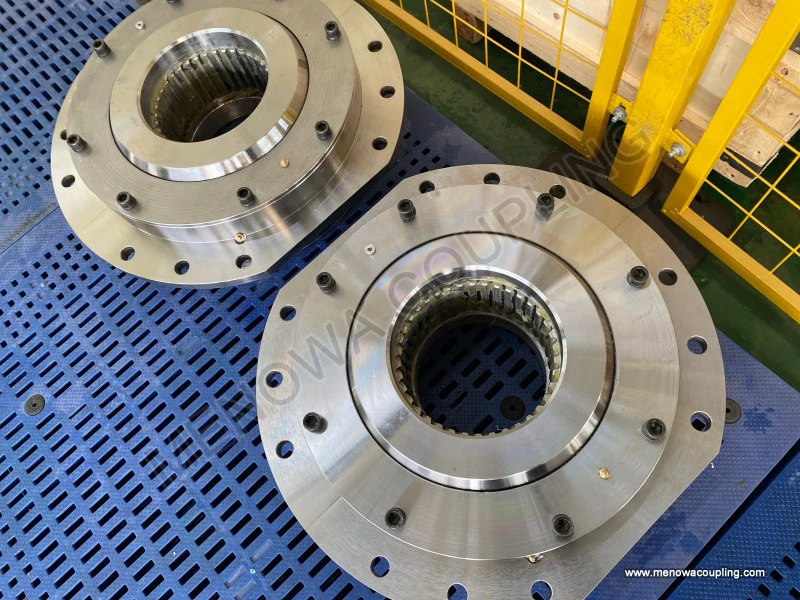
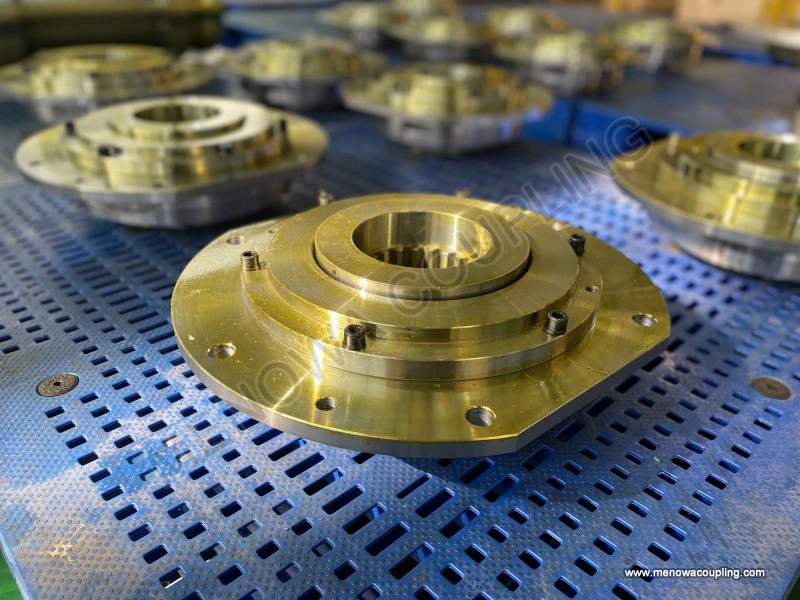
The overall structural composition of drum couplings follows a scientific and practical mechanical design logic, with each component designed and configured around the core goals of stable torque transmission, reliable deviation compensation, convenient assembly and disassembly, and long-term durable operation. The basic assembly of a standard drum coupling mainly includes outer gear shaft sleeves with specially processed drum-shaped tooth profiles, inner gear ring flanges used for fixed connection with winding drums and other executive components, spherical bearing rings with outer spherical surfaces, sealed end covers, high-performance sealing rings, and auxiliary structural parts such as lubricating oil filling holes and ventilation and heat dissipation holes. Each component has a clear division of labor and closely cooperates with each other, forming an integrated mechanical transmission structure that integrates power transmission, position limiting support, sealing protection, and lubrication maintenance. The outer gear shaft sleeve is the core power input component of the entire coupling structure, directly connected and fixed with the output shaft of the speed reduction equipment through precise shaft hole matching and fastening connection structures. The tooth part of the outer gear shaft sleeve adopts a unique drum-shaped tooth profile processing technology, which is the most critical structural feature that distinguishes drum couplings from traditional straight-tooth gear couplings. Different from the linear tooth side design of traditional straight gear structures, the tooth surface of the drum-shaped outer gear is processed into a gentle spherical curved surface, with the spherical center of the curved surface accurately located on the central axis of the connected transmission shaft. This special tooth profile processing design lays a solid structural foundation for the coupling to adapt to various shaft misalignment conditions and uniform load distribution during operation. The inner gear ring flange is the main power output and connection fixing component of the coupling, with an inner ring processed into an inner gear structure that meshes precisely with the outer drum-shaped gear, and an outer flange plate with reserved connection bolt holes for stable and firm fixed assembly with the end face of the industrial winding drum. The meshing fit between the inner gear ring and the outer gear shaft sleeve is the core torque transmission path of the entire coupling, relying on the precise engagement between gear teeth to efficiently and stably transmit rotational torque and rotational motion from the driving shaft to the driven winding drum mechanism.
The spherical bearing ring equipped inside the drum coupling is an important functional component that undertakes auxiliary support and accurate deviation coordination, matching with the inner spherical surface structure of the inner gear ring flange to form a flexible support fit structure. This spherical matching structure can effectively bear the radial load generated during the operation of the transmission system, and at the same time provide reliable structural support when relative angular deflection occurs between the two connected shafts, ensuring that the meshing position between the inner and outer gear teeth always maintains a reasonable fit state and avoiding rigid extrusion and abnormal stress concentration caused by shaft misalignment. The sealed end cover and supporting sealing rings are arranged at both ends of the coupling assembly, forming a fully enclosed internal working space for the meshing gear teeth and lubricating parts inside the coupling. The sealing structure can effectively block external dust, industrial debris, moisture, and other harmful impurities in the harsh industrial working environment from entering the internal meshing area, preventing abrasive wear and corrosion damage to the precision gear tooth contact surfaces. At the same time, the reliable sealing performance can also effectively lock the internal lubricating grease or lubricating oil inside the coupling cavity, avoiding lubricant leakage caused by long-term rotational operation, ensuring that the gear meshing parts and spherical matching parts can always maintain good lubrication conditions during the entire service cycle. The reserved lubricating oil holes and ventilation holes are designed for the daily maintenance and stable long-term operation of the coupling. The lubricating oil holes facilitate regular supplementary injection of professional lubricating media by maintenance personnel without disassembling the entire coupling assembly, reducing the difficulty and workload of daily maintenance work. The ventilation holes can balance the internal and external air pressure of the coupling closed cavity during continuous high-speed and heavy-load operation, avoid excessive internal air pressure caused by frictional heat generation, ensure normal heat dissipation inside the coupling, and prevent the deterioration of lubricating media performance caused by excessive temperature accumulation.
The working principle of drum couplings is based on the precise meshing transmission of drum-shaped gear pairs and the flexible coordination compensation of spherical matching structures, realizing dual functions of efficient torque transmission and automatic adaptation to shaft misalignment. When the industrial mechanical equipment starts to operate normally, the power output by the driving power equipment is transmitted to the reducer, and after the reducer adjusts the rotational speed and amplifies the torque, the power is transmitted to the outer gear shaft sleeve of the drum coupling through the output shaft. The outer gear shaft sleeve rotates synchronously with the driving shaft, and through the meshing contact between the drum-shaped outer gear teeth and the inner gear teeth of the inner gear ring flange, the rotational torque and rotational motion are stably transmitted to the inner gear ring flange, and then the torque is transmitted to the connected winding drum mechanism through the flange connection structure, driving the winding drum to perform stable rotational winding and unwinding operations. Under the ideal working condition where the driving shaft and the driven shaft are completely coaxial without any displacement or deflection deviation, the drum-shaped tooth surfaces of the outer gear and the inner gear teeth maintain central contact and uniform stress, each gear tooth meshes evenly to bear the transmission load, the operation process is stable and smooth, and the power transmission efficiency remains at a high level with low frictional resistance and small operation vibration. In the actual complex industrial operation process, various unavoidable shaft misalignment deviations will inevitably occur between the driving shaft and the driven shaft connected by the coupling, including radial displacement deviation caused by vertical and horizontal position offset, axial displacement deviation caused by thermal expansion and contraction and mechanical operation sliding, and angular deflection deviation caused by structural deformation and installation position offset.
When these different types of misalignment deviations occur, the unique drum-shaped tooth profile design of the coupling can play a good adaptive compensation role. Thanks to the curved surface characteristics of the drum-shaped gear teeth, the contact position between the outer gear teeth and the inner gear teeth can smoothly shift appropriately along the tooth surface with the relative displacement and angular deflection between the two shafts. Even in the state of shaft misalignment, the gear tooth contact part can always maintain the middle area of the tooth surface for meshing transmission, effectively avoiding the edge contact and sharp extrusion between gear teeth that are easy to occur in traditional straight-tooth couplings under misalignment conditions. This working mode fundamentally eliminates the problem of local stress concentration at the edge of gear teeth, reduces the wear degree of gear tooth contact surfaces, and ensures that the load borne by each meshing gear tooth is always distributed evenly and reasonably. The spherical bearing ring matching structure cooperates with the drum-shaped gear teeth to jointly bear the deviation compensation work. When angular deflection occurs between the two shafts, the spherical matching surface can produce gentle adaptive sliding coordination, buffer the additional mechanical stress generated by shaft deflection on the shaft body and coupling components, avoid rigid force transmission between mechanical parts, and protect the shaft system and key transmission components from damage caused by excessive alternating stress. In the whole torque transmission and deviation compensation process, the drum coupling does not rely on elastic deformation of flexible parts to achieve buffering like some elastic couplings, but relies on the optimized structural design of rigid gear meshing and spherical flexible matching to realize the integration of rigid transmission and flexible compensation. This working mechanism enables the coupling to not only have the high torque transmission capacity and high transmission efficiency of rigid couplings, but also have the misalignment adaptation and vibration buffering performance of flexible couplings, perfectly adapting to the heavy-load and continuous operation characteristics of industrial winding transmission equipment.
Compared with other common types of couplings used in industrial mechanical transmission systems, drum couplings show prominent comprehensive performance advantages in structural design, load-bearing capacity, operation stability, and environmental adaptability. In terms of structural layout, drum couplings adopt a compact integrated design, with small overall external dimension and compact occupied installation space, which is very suitable for mechanical equipment with limited internal installation space and high requirements for structural compactness. Many other types of heavy-duty couplings often require larger installation space and longer axial layout size due to their complex component matching structure, which is not conducive to the lightweight and compact overall design of mechanical equipment. The compact structural design of drum couplings not only saves the installation space of mechanical equipment, but also effectively reduces the overall rotational inertia of the transmission shaft system, making the equipment more sensitive and stable during start-stop operation and speed regulation adjustment. In terms of load-bearing performance and torque transmission capacity, the drum-shaped tooth surface contact mode adopted by drum couplings increases the actual contact area between meshing gear teeth compared with the linear contact mode of traditional straight-tooth couplings. The increase in contact area enables more gear teeth to participate in meshing and bearing loads at the same time, making the load distribution of the entire transmission structure more uniform and reasonable. Under the same overall structural dimension and installation specification, drum couplings can bear larger transmission torque and higher radial load, with stronger overload resistance, and can maintain stable transmission performance even under long-term heavy-load operation and instantaneous impact load conditions.
In terms of operation stability and noise and vibration control, the optimized meshing state of drum-shaped gear teeth makes the meshing process smoother and more gentle during the rotation operation of the coupling. There is no sudden impact and rigid collision between gear teeth during meshing, which effectively reduces the vibration amplitude and operation noise generated during the operation of the transmission system. Traditional straight-tooth couplings are prone to edge impact and uneven stress during meshing under slight misalignment conditions, resulting in obvious mechanical vibration and continuous operation noise, which not only affects the working environment of the production site, but also accelerates the fatigue wear of mechanical components. Drum couplings effectively avoid these adverse effects through structural optimization, ensuring that the mechanical equipment maintains low vibration and low noise operation state during long-term continuous operation, reducing the fatigue loss of the entire mechanical structure and prolonging the overall service life of the equipment. In terms of environmental adaptability and working condition tolerance, drum couplings rely on good sealing structure and durable metal manufacturing materials, and can work stably for a long time in various harsh industrial working environments. Whether it is outdoor engineering operation sites with large temperature changes, industrial production workshops with much dust and debris, or working scenarios with certain moisture and corrosive media, drum couplings can maintain stable working performance without being easily affected by external environmental factors. The internal fully enclosed sealing structure can well protect the internal precision meshing parts from external environmental erosion, and the high-strength metal materials used for overall manufacturing have good wear resistance, pressure resistance and structural stability, adapting to frequent start-stop, forward and reverse rotation, and continuous long-time operation working modes that are common in industrial production.
The installation, debugging and later maintenance work of drum couplings are designed to follow the principles of simplicity, convenience and high efficiency, which can effectively reduce the time cost and labor cost of equipment assembly and daily operation and maintenance. In the equipment assembly and installation stage, the installation work of drum couplings does not require extremely complex installation tools and highly professional installation and debugging skills. The overall split structure design enables workers to complete the positioning and assembly of each component in sequence according to the standard installation process. The shaft hole matching structure of the outer gear shaft sleeve and the driving shaft, and the flange connection structure of the inner gear ring flange and the winding drum all adopt standardized positioning and fastening design, which is convenient for quick positioning and accurate installation. During the installation and debugging process, only simple coaxiality calibration and gap debugging are needed to ensure that the coupling is in the best meshing and working state. Even for mechanical equipment with high transmission precision requirements, the calibration and debugging work of drum couplings can be completed in a short time, which will not affect the overall equipment assembly progress and production preparation cycle. In the daily operation and maintenance stage, the maintenance work of drum couplings is mainly concentrated on regular lubrication inspection and sealing state check. Routine maintenance only needs maintenance personnel to regularly observe the operation vibration and noise state of the coupling during equipment operation, check whether there is lubricant leakage at the sealing position, and regularly inject special lubricating media through the reserved lubricating oil holes according to the operation time and load conditions.
There is no need for frequent disassembly and inspection of the coupling during normal long-term operation, and the internal gear meshing parts and spherical matching parts will not fail easily under good lubrication and sealing conditions. Compared with some couplings that require frequent disassembly for maintenance and regular replacement of vulnerable flexible parts, drum couplings have lower daily maintenance workload and longer maintenance cycle, which greatly reduces the equipment operation and maintenance cost and the downtime loss caused by maintenance and parts replacement. In the long-term use process, even if individual parts are worn and need to be replaced due to ultra-long operation time or special working condition impact, the split structural design of drum couplings can realize quick disassembly and single-part replacement without replacing the entire coupling assembly. This partial replacement maintenance mode further reduces the later use cost and improves the economy of equipment long-term operation. In addition, the wear state of the gear meshing parts inside the drum coupling can be judged through the intuitive operation state of the equipment and simple detection means, which is convenient for maintenance personnel to find potential hidden dangers of equipment in advance, carry out preventive maintenance and maintenance work in advance, and avoid sudden equipment failure and production interruption caused by excessive component wear.
Drum couplings are widely used in multiple industrial fields and engineering construction scenarios involving winding transmission and heavy-duty mechanical transmission, playing an indispensable basic supporting role in the stable operation of various key mechanical equipment. In the field of port and terminal handling machinery, various container cranes, shore container handling equipment, and bulk cargo loading and unloading machinery all need to rely on winding drum mechanisms to complete the lifting and handling of goods. These port mechanical equipment often work in outdoor open-air environments, facing the influence of wind load, goods impact load, and alternating temperature changes, and the shaft misalignment deviation caused by long-term operation is obvious. Drum couplings are used to connect the reducer and winding drum of port handling machinery, stably transmit heavy lifting torque, adapt to various shaft deviation and impact load conditions, ensure the stable operation of goods lifting and handling work, and avoid equipment failure and operation safety hazards caused by transmission system problems. In the field of construction engineering machinery, various tower cranes, construction hoisting equipment, and foundation engineering winding machinery also take drum couplings as the core connection component of the winding transmission system. Construction engineering equipment has the characteristics of frequent start-stop operation, irregular load change, and complex on-site working conditions, which puts forward high requirements on the load-bearing capacity and operation stability of couplings. The excellent comprehensive performance of drum couplings can fully meet the operation needs of construction machinery, ensure the safety and stability of engineering hoisting and winding operations, and effectively guarantee the smooth progress of engineering construction.
In the field of metallurgical and mining industrial production, various mining winding equipment, metallurgical rolling auxiliary transmission machinery, and mineral processing handling machinery need to operate continuously under heavy-load and high-strength working conditions for a long time. The mechanical transmission system of metallurgical and mining equipment bears large torque and strong alternating load, and the working environment is accompanied by much dust and certain corrosive substances. Drum couplings adapt to the harsh working conditions of metallurgical and mining sites with their strong load-bearing capacity, good sealing performance and durable structural stability, maintain long-term stable transmission operation, reduce equipment failure rate and production downtime, and improve the overall production efficiency of metallurgical and mining enterprises. In the field of electric power and water conservancy engineering, various water conservancy gate hoisting equipment, power station auxiliary winding machinery, and large-scale mechanical adjustment equipment also widely use drum couplings for transmission connection. These equipment are related to the normal operation of water conservancy dispatching and power production, and the stability and reliability of the transmission system are extremely high. Drum couplings ensure the accurate and stable operation of water conservancy and power mechanical equipment with reliable torque transmission and stable operation performance, providing solid mechanical guarantee for the safe operation of water conservancy and power engineering. In addition, in the fields of chemical industry, building materials manufacturing, and heavy-duty logistics transportation machinery, drum couplings also have a large number of application scenarios, adapting to the winding transmission and heavy-load transmission needs of different industries, and providing basic reliable support for the stable operation of various industrial mechanical equipment.
In the actual selection and matching application process of drum couplings, it is necessary to comprehensively consider multiple key factors according to the actual working conditions and transmission parameters of mechanical equipment to ensure that the selected coupling can fully match the operation needs of the equipment and give full play to its comprehensive performance advantages. The first factor to be considered is the rated transmission torque required by the mechanical equipment. According to the power parameters and rotational speed of the driving power equipment, combined with the torque amplification ratio of the reducer and the actual load impact coefficient during equipment operation, the maximum torque that the coupling needs to bear in normal operation and instantaneous overload operation is accurately calculated, and the coupling specification with matching torque bearing capacity is selected to avoid insufficient load-bearing capacity of the coupling leading to overload damage and transmission failure. The second key factor is the installation space and structural size of the mechanical equipment. According to the reserved installation position and spatial size of the transmission shaft system inside the equipment, the drum coupling with appropriate external dimension and axial length is selected to ensure that the coupling can be smoothly installed in place without interference with other surrounding mechanical components, and the compactness and rationality of the overall mechanical structure are maintained. The third factor is the actual working condition characteristics of the equipment, including the operation mode of continuous operation or intermittent start-stop operation, the size of environmental temperature change, the degree of dust and corrosion in the working environment, and the frequency of load impact during operation. For equipment with frequent start-stop and large load impact, it is necessary to select drum couplings with enhanced load-bearing and buffering performance; for equipment working in high temperature or corrosive environments, it is necessary to select couplings made of high-temperature resistant and corrosion-resistant optimized materials to adapt to special working environment needs.
In addition, it is also necessary to consider the coaxiality deviation range of the driving shaft and driven shaft of the equipment, and select a drum coupling with corresponding deviation compensation capacity according to the maximum possible radial, axial and angular deviation of the shaft system, so as to ensure that the coupling can effectively compensate the shaft misalignment generated during equipment operation and avoid additional stress and component wear caused by uncompensated deviation. After the reasonable selection of the coupling, standardized installation and debugging and scientific daily management are also needed to ensure the long-term stable operation of the drum coupling. In the installation process, strict coaxiality calibration must be carried out in accordance with the installation specifications to minimize the initial installation deviation of the shaft system, reduce the compensation burden of the coupling in subsequent operation, and prolong the service life of the coupling. In the daily management process, a regular maintenance and inspection system should be established, the lubrication state and sealing effect of the coupling should be checked regularly, the lubricating media should be replaced and supplemented in a timely manner, and the abnormal vibration, noise and temperature rise of the coupling during operation should be monitored. Once abnormal operation conditions are found, timely inspection and troubleshooting should be carried out to avoid small faults evolving into large equipment failures. With the continuous progress of industrial mechanical manufacturing technology and the continuous upgrading of industrial production equipment, the structural design and manufacturing process of drum couplings are also constantly optimized and improved. New material processing technology, precision tooth profile manufacturing technology and optimized sealing protection design are continuously applied to the production and manufacturing of drum couplings, making the performance of drum couplings more excellent, the structure more durable, and the maintenance more convenient.
In the future development of modern industrial mechanical transmission systems, with the continuous improvement of industrial equipment towards high power, heavy load, high efficiency and long-life operation, drum couplings will still maintain irreplaceable application value and broad development space. As a key basic component connecting power transmission and winding operation mechanisms, drum couplings will continue to rely on their unique structural advantages and reliable working performance to provide stable and efficient transmission guarantee for various heavy-duty industrial mechanical equipment. Through continuous structural optimization, material upgrading and process improvement, drum couplings will further adapt to more complex and harsh industrial working conditions, reduce operation and maintenance costs for industrial enterprises, improve the overall operation efficiency and safety stability of mechanical equipment, and make important basic contributions to the stable operation and high-quality development of various industrial production and engineering construction fields. The reasonable application and scientific maintenance of drum couplings are not only related to the normal operation of a single mechanical equipment, but also affect the continuous and stable operation of the entire industrial production line and engineering project. Therefore, in the actual industrial production and mechanical equipment configuration work, full attention should be paid to the selection, installation, operation and maintenance management of drum couplings, giving full play to the comprehensive performance advantages of drum couplings, ensuring the long-term stable and efficient operation of industrial mechanical transmission systems, and laying a solid foundation for the sustainable and healthy development of modern industrial economy.
https://www.menowacoupling.com/industrial-coupling/drum-coupling.html
Tags
Related Articles
Drum Coupling Wholesale
Apr 25, 2026In the vast and intricate landscape of modern industrial mechanical transmission systems, every small component plays an irreplaceable role in maintaining the smooth operation of entire production lines and mechanical equipment. Among these core mechanical parts, drum couplings stand out as a vital connecting component …
 WeChat
 WhatsApp