Material of Grid Spring Coupling
Grid spring couplings are essential components in mechanical transmission systems, designed to connect two shafts and transmit torque while compensating for axial, radial, and angular misalignments, absorbing vibrations, and reducing shock loads. The performance, reliability, and service life of a grid spring coupling are largely determined by the materials used in its construction, as each component—from the grid spring itself to the hubs and covers—must withstand specific mechanical stresses, environmental conditions, and operational demands. Selecting the appropriate materials requires a comprehensive understanding of the coupling’s intended application, including factors such as torque requirements, operating temperature, speed, environmental exposure, and maintenance expectations. This article explores the various materials commonly used in grid spring couplings, their properties, processing techniques, and how they influence the overall performance of the coupling.
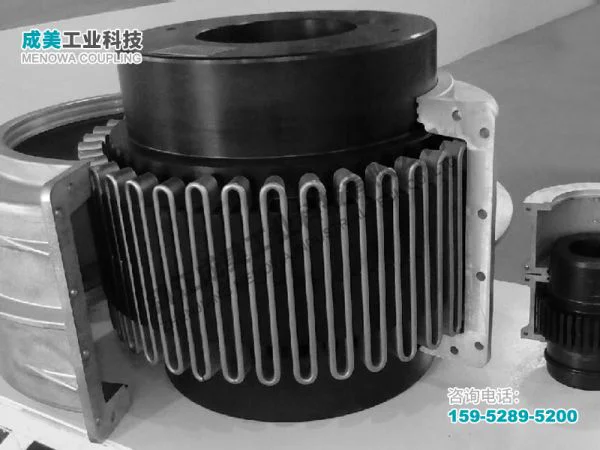
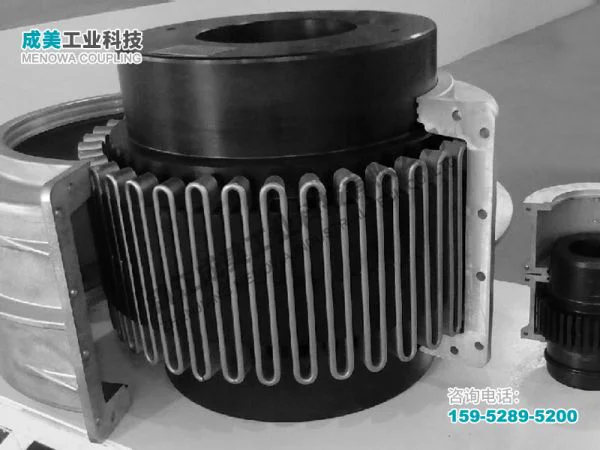
The core component of a grid spring coupling is the grid spring, a flexible element typically shaped like a serpentine or spiral, which is responsible for transmitting torque, absorbing vibrations, and accommodating misalignments. The material chosen for the grid spring must possess excellent elasticity, high fatigue strength, good wear resistance, and the ability to withstand repeated cyclic loads without permanent deformation or failure. Among the most widely used materials for grid springs are alloy spring steels, which offer an optimal balance of strength, elasticity, and cost-effectiveness. These steels are alloyed with elements such as silicon, manganese, chromium, and vanadium to enhance their mechanical properties, making them suitable for the dynamic and high-stress conditions that grid springs endure.
One of the most common alloy spring steels used for grid springs is 60Si2Mn, a medium-carbon steel alloyed with silicon and manganese. Silicon significantly improves the elastic limit and tempering stability of the steel, allowing it to maintain its elasticity even after repeated stress cycles, while manganese enhances hardenability, ensuring that the steel can be heat-treated to achieve the desired strength and toughness. After quenching and tempering, 60Si2Mn exhibits a tensile strength ranging from 1200 to 1600 MPa and a high elastic limit, making it ideal for applications where the grid spring must transmit moderate to high torques and absorb significant vibrations. This material is particularly suitable for industrial machinery such as crushers, reducers, and heavy-duty pumps, where the coupling is exposed to continuous cyclic loads and moderate operating temperatures.
Another popular material for grid springs is 50CrVA, a chromium-vanadium alloy spring steel that offers superior fatigue strength and toughness compared to 60Si2Mn. Chromium improves the steel’s hardenability and wear resistance, while vanadium enhances its strength and ductility, making it more resistant to shock loads and sudden torque spikes. 50CrVA is often used in grid springs for high-performance applications, such as in automotive transmissions, marine propulsion systems, and aerospace equipment, where reliability and durability are critical. This material can withstand higher operating temperatures than 60Si2Mn, typically up to 150°C, and exhibits excellent resistance to creep, ensuring that the grid spring maintains its shape and performance over long periods of operation.
In addition to alloy spring steels, stainless steel is also used for grid springs in applications where corrosion resistance is a primary concern. Austenitic stainless steels, such as 304 and 316, are commonly employed due to their excellent resistance to moisture, chemicals, and saltwater environments. 304 stainless steel offers good corrosion resistance in mild to moderate corrosive environments, while 316 stainless steel, which contains molybdenum, provides enhanced resistance to chloride corrosion, making it suitable for marine, chemical processing, and food processing applications. Stainless steel grid springs also offer good temperature resistance, with 304 stainless steel capable of operating at temperatures up to 870°C and 316 stainless steel up to 925°C. However, stainless steel has a slightly lower elastic modulus compared to alloy spring steels, which may affect the coupling’s torque transmission efficiency and vibration absorption capabilities, so it is typically used in applications where corrosion resistance is more important than maximum torque capacity.
For applications requiring exceptional precision and resistance to magnetic interference, beryllium copper alloys are sometimes used for grid springs. Beryllium copper, such as QBe2, is a copper-based alloy that combines high strength, excellent elasticity, and good electrical conductivity, along with non-magnetic properties. This material is ideal for use in precision instruments, aerospace equipment, and electronic devices, where even small magnetic fields can interfere with performance. Beryllium copper grid springs exhibit a tensile strength of 1100 to 1350 MPa and a wide operating temperature range from -200°C to 200°C, making them suitable for extreme temperature environments. However, beryllium copper is more expensive than alloy spring steels and stainless steel, which limits its use to high-end applications where its unique properties are essential.
The hubs of a grid spring coupling, which connect the coupling to the shafts, are another critical component that requires careful material selection. Hubs must be strong enough to transmit torque without deformation, rigid enough to maintain alignment, and resistant to wear at the interface with the grid spring. The most common materials for hubs are carbon steels and alloy steels, which offer high strength and durability at a reasonable cost. Carbon steels, such as 45# steel, are often used for hubs in low to moderate torque applications, as they are easy to machine and heat-treat to achieve the desired hardness. 45# steel is a medium-carbon steel that, when quenched and tempered, exhibits a tensile strength of 600 to 800 MPa, making it suitable for hubs in general industrial machinery.
For high-torque applications, alloy steels such as 40Cr are preferred for hubs. 40Cr is a chromium-alloyed steel that offers higher strength and hardenability than carbon steel, with a tensile strength of 800 to 1000 MPa after heat treatment. This material is more resistant to wear and deformation, making it suitable for hubs in heavy-duty equipment such as mining machinery, construction equipment, and large-scale industrial pumps. The use of alloy steel hubs also allows for tighter tolerances and better surface finish, which reduces friction between the hub and the grid spring, improving the coupling’s overall efficiency and service life.
In corrosive environments, hubs are often made from stainless steel, typically the same grade as the grid spring to ensure compatibility and uniform corrosion resistance. Stainless steel hubs are more expensive than carbon or alloy steel hubs but offer long-term durability in harsh environments, reducing maintenance costs and downtime. For applications where weight is a concern, such as in aerospace or automotive systems, aluminum alloys may be used for hubs. Aluminum alloys, such as 6061-T6, are lightweight, corrosion-resistant, and easy to machine, making them suitable for applications where reducing overall weight is critical. However, aluminum alloys have lower strength than steel, so they are limited to low to moderate torque applications.
The covers of grid spring couplings, which protect the grid spring and other internal components from dust, debris, and environmental contaminants, are typically made from materials that are lightweight, durable, and easy to manufacture. Sheet metal, such as cold-rolled steel or stainless steel, is commonly used for covers due to its low cost and ease of forming. Cold-rolled steel covers are suitable for general industrial applications, while stainless steel covers are used in corrosive environments. For applications where weight is a concern, aluminum sheet metal may be used, although it is less durable than steel. In some cases, plastic covers are used for lightweight, low-cost applications, although they are less resistant to impact and high temperatures than metal covers.
The selection of materials for grid spring couplings is also influenced by the processing techniques used to manufacture the components. For example, grid springs are typically formed using processes such as stamping, bending, or wire forming, followed by heat treatment to enhance their mechanical properties. Alloy spring steels require precise heat treatment—including quenching and tempering—to achieve the desired balance of strength and elasticity. Quenching involves heating the steel to a high temperature (typically 850 to 950°C) and then rapidly cooling it in oil or water to harden the material, while tempering involves reheating the steel to a lower temperature (200 to 400°C) to reduce brittleness and improve toughness. The heat treatment process must be carefully controlled to ensure consistent performance across all grid springs, as variations in temperature or cooling rate can lead to differences in strength and fatigue life.
Hubs are typically manufactured using machining processes such as turning, milling, and drilling, which allow for precise control of dimensions and surface finish. Heat treatment is also used for hubs made from carbon or alloy steels to improve their hardness and wear resistance. For example, hubs may be case-hardened to create a hard outer surface that resists wear, while maintaining a tough inner core that can withstand shock loads. Case hardening processes include carburizing, nitriding, and induction hardening, each of which offers different advantages depending on the material and application.
The performance of a grid spring coupling is not only determined by the materials used but also by the compatibility between the materials of different components. For example, the grid spring and hubs must have compatible hardness levels to prevent excessive wear—if the grid spring is too hard relative to the hub, it may wear down the hub’s teeth, while if the hub is too hard, it may cause the grid spring to fatigue and fail prematurely. Additionally, the materials must be compatible in terms of thermal expansion, as differences in thermal expansion coefficients can lead to internal stresses when the coupling is exposed to temperature changes, potentially causing deformation or failure.
Environmental factors also play a crucial role in material selection for grid spring couplings. In high-temperature environments, such as in power plants or industrial furnaces, materials must be able to withstand elevated temperatures without losing their strength or elasticity. Alloy spring steels such as 50CrVA and stainless steels are better suited for high-temperature applications than carbon steels, which may soften or deform at temperatures above 200°C. In cold environments, materials must remain ductile to prevent brittle fracture—beryllium copper and some stainless steels are capable of operating at temperatures as low as -200°C, making them suitable for cryogenic applications.
Corrosive environments, such as those in chemical processing plants, marine applications, or outdoor equipment, require materials with excellent corrosion resistance. Stainless steels, particularly 316, are highly resistant to corrosion from chemicals, saltwater, and moisture, making them ideal for these applications. In some cases, protective coatings may be applied to carbon or alloy steel components to improve their corrosion resistance—for example, zinc plating or powder coating can provide a barrier against moisture and chemicals, extending the service life of the coupling.
Vibration and shock loads are common in many mechanical systems, and the materials used in grid spring couplings must be able to absorb these loads without permanent deformation. Alloy spring steels are particularly effective at absorbing vibrations due to their high elasticity and fatigue strength, allowing the grid spring to flex and return to its original shape repeatedly. The damping properties of the material also play a role in reducing vibration transmission—some materials, such as certain polymer composites, offer better damping than metals, but they are typically less strong and durable, limiting their use to low-torque applications.
Advancements in material science have led to the development of new materials and composites that offer improved performance for grid spring couplings. For example, graphene-reinforced polymers have been shown to enhance both mechanical strength and damping properties, making them potential candidates for grid springs in applications where vibration reduction is critical. These composites combine the lightweight and damping properties of polymers with the high strength and stiffness of graphene, offering a balance of performance that is not achievable with traditional materials. However, these advanced materials are still relatively expensive and are currently limited to high-end applications.
Another area of innovation is the use of shape memory alloys (SMAs) for grid springs. SMAs, such as nickel-titanium alloys, have the ability to return to their original shape after being deformed, even after repeated cycles. This property makes them ideal for grid springs in applications where misalignments are frequent or large, as the spring can automatically adjust to compensate for misalignments without losing its performance. SMAs also offer good fatigue strength and corrosion resistance, although they are more expensive than traditional alloy spring steels and require specialized processing.
The maintenance requirements of grid spring couplings are also influenced by the materials used. Components made from corrosion-resistant materials such as stainless steel require less maintenance, as they are less likely to rust or degrade over time. In contrast, carbon steel components may require regular lubrication and inspection to prevent corrosion and wear. The choice of material can also affect the ease of maintenance—for example, aluminum hubs are lighter and easier to handle than steel hubs, making them easier to remove and replace during maintenance.
In conclusion, the selection of materials for grid spring couplings is a critical decision that impacts the coupling’s performance, reliability, and service life. Alloy spring steels such as 60Si2Mn and 50CrVA are the most commonly used materials for grid springs, offering an optimal balance of strength, elasticity, and cost-effectiveness. Hubs are typically made from carbon or alloy steels, with stainless steel used for corrosive environments and aluminum alloys for lightweight applications. Covers are usually made from sheet metal or plastic, depending on the application’s requirements. The choice of material must be based on a thorough understanding of the coupling’s intended use, including torque requirements, operating temperature, environmental conditions, and maintenance expectations. Advancements in material science continue to expand the range of available materials, offering opportunities to improve the performance and durability of grid spring couplings for a wide range of applications. By selecting the appropriate materials and ensuring proper processing and maintenance, grid spring couplings can provide reliable and efficient torque transmission, contributing to the overall performance and longevity of mechanical systems.
Post Date: May 13, 2026
https://www.menowacoupling.com/china-coupling/material-of-grid-spring-coupling.html
Supply
Related Articles
Grid Spring Coupling Production
Grid spring couplings are essential mechanical components widely used in various industrial applications to connect two rotating shafts, transmit torque, and compensate for axial, radial, and angular misalignments between them. Unlike rigid couplings that require precise alignment and offer no flexibility, grid spring c…Types of Grid Spring Coupling
Types of Grid Spring CouplingGrid spring couplings are essential components in mechanical power transmission systems, designed to connect two rotating shafts while accommodating misalignments, absorbing vibrations, and transmitting torque efficiently. Unlike rigid couplings that require precise alignment and offer no fl…Elastic Coupling Supply
In the realm of industrial power transmission, elastic couplings serve as a critical bridge between rotating shafts, enabling the smooth transfer of torque while mitigating the negative effects of misalignment, vibration, and shock loads. The supply of elastic couplings is a dynamic and essential component of modern man…Structure of Grid Spring Coupling
The grid spring coupling is a crucial component in industrial power transmission systems, designed to connect two rotating shafts while accommodating misalignments, absorbing vibrations, and protecting machinery from shock loads. Its unique structure combines the rigidity needed for efficient torque transmission with th…Grid Spring Coupling Vendor In China
In the global mechanical transmission industry, grid spring couplings play an indispensable role as key components that connect rotating shafts, transmit torque, and compensate for relative displacements between shafts. As one of the world’s largest manufacturing hubs, China has nurtured a large number of professional …Uses of Grid Spring Coupling
In the realm of mechanical power transmission, the grid spring coupling stands as a versatile and reliable component that plays a critical role in connecting rotating shafts across a wide range of industrial applications. Unlike rigid couplings that demand precise alignment and offer no flexibility, or flexible coupling…
 WeChat
 WhatsApp