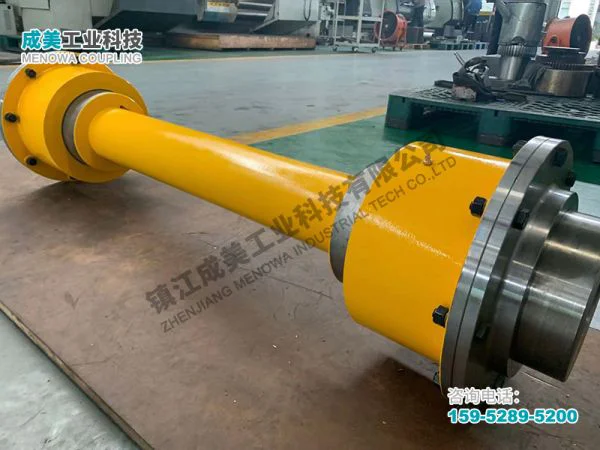
JSJ Grid Coupling
Menowa is a jsj grid coupling supplier from china, wholesale and direct sales jsj grid coupling at a reasonable price.
JSJ (connected with intermediate shaft) Grid coupling is a metal elastic coupling with advanced structure. The connection between the prime mover and the working machine is realized by embedding the serpentine spring axially into the tooth slots of the two halves of the coupling. Because of the special properties of the spring, the resonance between the prime mover and the working machine is largely avoided, so that the service life of the coupling is much longer than that of the coupling with nonmetallic elastic elements.
In the complex and interconnected system of modern industrial mechanical power transmission, the reliable connection between driving equipment and driven equipment serves as the fundamental guarantee for the stable and continuous operation of all production and processing procedures. Every mechanical device involved in power output, rotational speed conversion and torque transmission needs a reasonable connecting component to link adjacent rotating shafts, coordinate operating rhythms, and buffer various abnormal mechanical stresses generated during long-term cyclic operation. Among numerous flexible connecting components used for shaft connection and power transmission in the industrial field, grid coupling has always occupied a crucial and irreplaceable position in medium and heavy-duty mechanical transmission scenarios by virtue of its unique integrated design of metal flexible connection, excellent shock absorption and vibration damping performance, reliable misalignment compensation capability and stable long-cycle operating adaptability. Unlike rigid connecting components that pursue absolute transmission rigidity and zero displacement deviation, and different from elastomer flexible connecting parts that rely on non-metal materials for buffering and energy absorption, this type of coupling adopts a special metal grid elastic structure as the core force-transmitting and energy-buffering medium, perfectly balancing the dual core demands of high-efficiency torque transmission and mechanical stress flexible release in industrial operation, and adapting to various harsh working conditions with frequent load changes, unstable startup and shutdown processes and inevitable shaft installation deviation that are common in actual industrial production. The whole operation process of mechanical transmission is not only a simple process of torque and rotational speed transfer from the driving end to the driven end, but also a complex dynamic mechanical balance process involving mechanical stress transfer, vibration energy dissipation, displacement deviation adaptation and equipment operating protection. Any subtle defects or performance deficiencies in the connecting link will be gradually amplified with the extension of operating time, eventually leading to increased component wear, abnormal equipment vibration, shortened service life of driving and driven machinery, and even unexpected production shutdown and mechanical failure accidents in serious cases. Therefore, selecting a suitable shaft connecting component that matches the equipment power level, operating cycle and working condition characteristics is not only a key link in the initial design and supporting selection of mechanical equipment, but also an important part of the later stable operation and efficient maintenance of the entire production system.
The basic overall composition of grid coupling follows a mature and practical mechanical design logic, with a simple and compact structural layout, and all functional components are closely matched and coordinated to jointly complete the core functions of torque transmission, misalignment compensation and shock and vibration reduction. The main components of the coupling include two symmetrical shaft hubs processed with special curved tooth grooves, a flexible metal grid elastic component nested in the tooth grooves of the two hubs, and a split protective cover used for internal sealing, component protection and lubricant storage. Each component has its own independent functional positioning and structural design characteristics, and no redundant auxiliary structures are added in the overall design, which effectively reduces the overall structural volume of the coupling, lowers the additional load generated by self-weight on the rotating shaft during operation, and facilitates on-site installation, disassembly and daily maintenance work in industrial scenarios. The two shaft hubs are the basic connecting and force-bearing parts of the coupling, which are respectively fixedly installed on the driving shaft and the driven shaft that need to be connected for power transmission. The outer circumference of each hub is precisely processed with continuous curved tooth grooves with uniform spacing and special profile radian. The design of curved tooth grooves is not a simple straight groove structure, but adopts a gradual contact curved surface design. This special structural form lays an important foundation for the subsequent flexible force transmission, gradual load bearing and effective misalignment compensation of the coupling. The inner hole of the hub is processed according to the standard shaft diameter matching size, which can realize precise assembly and fixation with different types of rotating shafts, ensuring that no relative rotational displacement occurs between the hub and the shaft during high-speed rotation and torque transmission, avoiding transmission efficiency reduction and local component wear caused by shaft and hub slipping. The flexible metal grid component made of high-quality spring steel material is the core functional part of the grid coupling and the key to distinguish it from other types of rigid and flexible couplings. The grid is designed into an integrated continuous bending structure, which can be seamlessly embedded in the curved tooth grooves of the two hubs, forming a stable force transmission bridge between the driving hub and the driven hub. The metal grid has good elastic deformation performance and structural toughness, can produce slight reversible elastic deformation under the action of instantaneous impact load and alternating cyclic load, and can quickly recover to the original structural state after the load returns to normal levels, without permanent deformation or structural damage, ensuring the long-term repeated use stability of the core force transmission component. The split protective cover is usually made of high-strength cast metal material, adopting a horizontal split assembly structure, which can completely wrap the internal hub tooth grooves and metal grid components inside the cover body. On the one hand, the protective cover can prevent the metal grid from being thrown out under the action of centrifugal force during the high-speed rotation of the coupling, ensuring the personal safety of on-site operators and the surrounding production equipment safety. On the other hand, it can effectively isolate external dust, moisture, corrosive media and mechanical debris, prevent these harmful substances from entering the internal matching gap of the coupling and causing corrosion, wear and clamping stagnation of the grid and hub tooth grooves, and at the same time, it can store a certain amount of lubricating grease inside the cover body to provide long-term lubrication protection for the friction matching parts between the grid and the tooth grooves, reducing friction resistance and mechanical wear during operation.
The internal power transmission and energy buffering working principle of grid coupling is based on the elastic deformation characteristics of the metal grid and the gradual contact force transmission mode between the grid and the hub curved tooth grooves, forming a stable and efficient dynamic transmission mechanism different from other transmission connecting parts. When the industrial mechanical equipment starts to run normally, the driving shaft drives the connected driving hub to rotate synchronously, and the rotational torque is gradually transmitted to the flexible metal grid embedded in the tooth grooves through the contact action between the curved tooth grooves on the outer circumference of the driving hub and the metal grid. Then, the metal grid transmits the torque to the driven hub on the other side through the same contact matching mode, and finally the driven hub drives the driven shaft to rotate synchronously, realizing the basic power and torque transmission function between the driving equipment and the driven equipment. In the whole static and stable load operation state, the contact between the metal grid and the hub tooth grooves is uniform and stable, the elastic deformation of the grid is kept within a small and stable range, the torque transmission process is smooth and continuous, no obvious vibration and impact phenomenon occurs, and the transmission efficiency is maintained at a stable level for a long time. The core performance advantage of grid coupling is more prominent in the operation state with impact load, load fluctuation and shaft misalignment deviation. In actual industrial production, many mechanical equipment will inevitably generate instantaneous impact load during startup, shutdown, sudden load increase and decrease, and positive and negative rotation switching. Such instantaneous impact force will form a strong instantaneous stress peak on the transmission shaft and connecting components. If rigid couplings are used for connection, this impact stress will be directly transmitted to the driving and driven equipment without any buffering, resulting in great impact on the internal structure of the equipment, accelerating the wear of key components such as bearings and gears, and even causing structural fatigue damage of parts after long-term accumulation. When grid coupling is used, the flexible metal grid can effectively absorb and dissipate the instantaneous impact energy through its own elastic deformation. The gradual contact design between the curved tooth surface of the hub and the grid enables the contact area between the grid and the tooth groove to increase synchronously with the gradual increase of the load. The impact energy that originally acts instantaneously is dispersed and released in a longer time period, the peak value of instantaneous mechanical stress is significantly reduced, and the impact force borne by the driving and driven equipment is effectively weakened, so as to achieve the effect of protecting the main equipment and transmission components.
In addition to excellent shock absorption and buffering performance, grid coupling also has outstanding vibration damping capability, which can effectively reduce the mechanical vibration generated during the operation of mechanical transmission systems and optimize the overall operating stability of equipment. Mechanical vibration is an inevitable accompanying phenomenon in the operation of all rotating mechanical equipment. Unbalanced rotation of rotating parts, slight deviation of installation coaxiality, periodic alternating load and other factors will cause different degrees of mechanical vibration in the transmission system. Long-term excessive vibration will not only increase the operating noise of the equipment, affect the on-site production working environment, but also cause loosening of equipment fixing parts, accelerated fatigue wear of transmission components, and even affect the processing accuracy and production efficiency of production and processing equipment. The special structural design of grid coupling can effectively reduce the vibration amplitude of the transmission system by up to thirty percent compared with many other metal rigid transmission couplings. The metal grid elastic component in the coupling can play a role of a vibration damping spring in the transmission process. When the mechanical vibration is generated in the rotating shaft, the grid absorbs the vibration mechanical energy through its own elastic telescopic deformation, converts the vibration kinetic energy into internal energy and dissipates it slowly, avoids the continuous transmission and superposition of vibration between the driving shaft and the driven shaft, suppresses the resonance phenomenon of the transmission system within the common operating speed range, and keeps the equipment running smoothly and stably. At the same time, the good misalignment compensation performance of grid coupling is also an important reason for its wide application in industrial scenarios. In the actual on-site installation process of mechanical equipment, due to the limitation of installation space, installation accuracy of construction personnel, long-term foundation settlement of equipment and thermal deformation of components during equipment operation, it is difficult to ensure that the driving shaft and the driven shaft maintain absolute ideal coaxiality state. There are often different degrees of angular misalignment, parallel radial misalignment and axial displacement deviation between the two shafts. If the coupling used cannot effectively compensate for these misalignment deviations, additional bending stress and shear stress will be generated on the rotating shaft and key transmission components during operation, resulting in serious component wear and shortened equipment service life. The flexible metal grid structure of grid coupling can adapt to various slight misalignment deviations through its own flexible bending and telescopic deformation, without generating additional adverse stress on the shaft and equipment, ensuring that the torque transmission process is still smooth and stable under the condition of certain installation and operation deviation, and reducing the failure rate and maintenance frequency of the transmission system caused by misalignment problems.
Compared with other common types of industrial couplings widely used in the market, grid coupling shows unique comprehensive performance advantages in terms of load bearing capacity, flexible adaptation, service life cycle and later maintenance cost control, and has formed a clear performance differentiation in different application scenarios. Gear couplings, which also belong to high-load metal rigid transmission couplings, rely on interlocking gear teeth for torque transmission. Although they have strong torque transmission capacity and can adapt to high-power heavy-duty operation scenarios, their overall structural rigidity is high, the buffering and shock absorption effect for impact load is weak, the vibration damping performance is poor, and they cannot effectively adapt to frequent impact and fluctuating load working conditions. In addition, the matching precision requirements of gear teeth of gear couplings are high, the friction and wear between gear teeth are large during operation, the demand for lubrication conditions is high, and the later maintenance and replacement costs are relatively high. Elastomer couplings using non-metal elastic materials for buffering have good shock absorption and misalignment compensation effects, but their load bearing capacity and high temperature resistance are limited, and they are easy to aging, deform and damage under long-term high-load and high-temperature operating conditions, requiring frequent replacement of elastic components, which affects the continuous operation efficiency of production equipment. Disc couplings have stable transmission performance and high alignment accuracy, but their flexible deformation range is small, the compensation effect for large misalignment deviation is limited, and they are not suitable for working conditions with frequent impact load and severe vibration. Grid coupling integrates the high torque transmission capacity of metal rigid couplings and the flexible buffering and misalignment compensation advantages of elastomer flexible couplings. It not only meets the operation requirements of medium and heavy-duty high-power transmission scenarios, but also has excellent shock absorption, vibration damping and misalignment adaptation capabilities. The metal grid core component has strong structural durability, good high temperature resistance and fatigue resistance, and will not be easily damaged due to load fluctuation and temperature change. The overall structural design is simple and reasonable, and the daily maintenance and component replacement operations are more convenient and efficient.
The application scope of grid coupling covers almost all mainstream medium and heavy-duty industrial production fields involving mechanical power transmission, and it can maintain stable and reliable operating performance under different working condition characteristics and operating environments. In the mining industry with harsh working conditions and heavy load operation for a long time, various mining machinery and equipment such as ore crushing equipment, mineral conveying equipment and mining hoisting equipment need to bear huge torque load and frequent impact load during operation. The working environment is accompanied by a large amount of dust, moisture and corrosive substances, and the equipment needs to operate continuously for a long time with low failure rate. Grid coupling can reliably transmit high torque in these mining equipment, buffer the strong impact generated by ore crushing and mechanical startup and shutdown, reduce the vibration and wear of mining equipment, and adapt to the harsh on-site working environment, ensuring the long-term stable operation of mining production lines. In the industrial water treatment and pumping industry, various large water supply and drainage pumps, sewage treatment conveying pumps and circulating water pump equipment need to run continuously for a long time. The startup and shutdown of pump equipment will generate certain water hammer impact and load fluctuation, and the long-term continuous operation requires the transmission connecting components to have stable performance and low wear characteristics. Grid coupling can effectively buffer the water hammer impact generated during pump startup and shutdown, reduce the vibration and noise of pump operation, compensate for the slight misalignment deviation generated by long-term operation of the pump body and motor shaft, reduce the failure rate of pump equipment, and extend the overall service life of pumping units. In the metallurgical and steel industry with high operating temperature and continuous cyclic production, metallurgical rolling equipment, material conveying equipment and high-temperature processing equipment have high requirements on the high temperature resistance and structural stability of transmission couplings. The metal structure of grid coupling has good high temperature resistance, will not deform and fail due to high temperature operation, and can stably transmit torque in high-temperature working environment, buffer the alternating load generated by cyclic production, and ensure the continuous and efficient operation of metallurgical production processes.
In the building materials production industry such as cement and building materials processing, production equipment such as cement mixers, stone crushing equipment and building materials conveying machinery has the characteristics of heavy operating load, frequent startup and shutdown, and large vibration during operation. Grid coupling can well adapt to these working condition characteristics, effectively buffer mechanical vibration and impact, reduce the wear of mixer and crusher components, and ensure the stable operation of building materials production equipment. In the chemical industry with corrosive medium and complex working conditions, various chemical reaction kettles, chemical conveying pumps and chemical processing machinery need to operate in corrosive and humid environments for a long time. The sealed protective cover structure of grid coupling can effectively protect the internal core components from corrosion by external harmful media, maintain the stable performance of the coupling for a long time, and ensure the safe and reliable operation of chemical production equipment. In addition, in the logistics conveying industry, papermaking industry, textile industry and other light and medium-duty industrial fields, grid coupling also has a wide range of application space, adapting to different power transmission needs and working condition characteristics, and providing reliable connection guarantee for the stable operation of various mechanical equipment.
The daily installation, operation and maintenance management of grid coupling is simple and convenient, which will not bring complex operation difficulties and high maintenance cost pressure to industrial production enterprises, and is conducive to reducing the overall operation and maintenance cost of mechanical equipment and improving the economic benefit of production operation. In the initial installation and assembly stage of the coupling, the whole installation process can be completed only by fixing the two hubs on the driving shaft and the driven shaft respectively, embedding the metal grid into the hub tooth grooves, and fastening and installing the split protective cover in place. The installation process does not need complex professional equipment and complicated debugging procedures, and ordinary on-site mechanical maintenance personnel can complete the installation and assembly work efficiently, effectively shortening the equipment installation and commissioning cycle and reducing the equipment downtime caused by installation. In the daily normal operation process, grid coupling does not need frequent inspection and complex maintenance work. Due to the good wear resistance and fatigue resistance of the metal grid material and the internal lubrication protection provided by the protective cover, the coupling can maintain long-term stable operating state only by regular simple visual inspection of the overall operating state of the coupling and timely supplement of lubricating grease according to the operating cycle. The inspection work mainly includes observing whether the coupling has abnormal vibration and abnormal noise during operation, checking whether the protective cover is loose or damaged, and confirming whether there is leakage of internal lubricating grease. The inspection process is simple and efficient, and will not affect the normal continuous operation of production equipment.
When the grid coupling runs to the later stage of the service cycle or individual components are worn and aged and need to be replaced, the disassembly and replacement operation is also very convenient and fast. Only the fastening bolts of the split protective cover need to be removed, the protective cover taken down, and the worn metal grid directly replaced with a new grid component. The whole replacement process does not need to disassemble the driving and driven equipment and the connected rotating shaft, the replacement operation time is short, the equipment shutdown time is minimized, and the impact on the continuous production progress of the enterprise is reduced. Compared with other couplings that need to replace the whole body or disassemble a large number of parts for maintenance, the later maintenance and component replacement cost of grid coupling is lower, and the maintenance efficiency is higher, which is very suitable for industrial production scenarios that require continuous operation and low downtime management. In addition, the grid coupling also has a certain overload protection effect in the actual operation process. When the mechanical equipment is overloaded due to abnormal production conditions or sudden mechanical failure, the instantaneous overload torque will exceed the normal bearing range of the metal grid. The metal grid will first produce structural damage under the overload state, cutting off the torque transmission between the driving shaft and the driven shaft, avoiding the overload damage of key core equipment such as driving motors and driven mechanical hosts, playing a good safety protection role for important production equipment, reducing the maintenance cost and loss caused by major equipment failure, and providing an additional safety guarantee for industrial production operation.
In the long-term industrial practical application process, the service life and operating stability of grid coupling are affected by multiple factors, and reasonable selection matching and standardized use management can effectively extend the service cycle of the coupling and maintain its long-term stable performance. The first key factor is the reasonable type selection matching according to the actual operating working conditions of the equipment. Different industrial equipment has different torque transmission requirements, operating speed ranges, load fluctuation characteristics and misalignment deviation ranges. It is necessary to select the appropriate grid coupling specification and model according to the actual operating parameters of the equipment, avoiding the problem of insufficient bearing capacity and easy damage caused by blind selection of small-specification couplings, and also avoiding the waste of resources and increased self-weight load caused by excessive selection of large-specification couplings. The second important factor is the standardized installation and alignment operation during installation. Although the grid coupling has good misalignment compensation performance, excessive installation misalignment deviation will still increase the elastic deformation degree of the metal grid during operation, accelerate the fatigue wear of the grid, and reduce the service life of the coupling. Therefore, during the installation process, it is necessary to do a good job in the alignment calibration of the driving shaft and the driven shaft, control the misalignment deviation within the reasonable allowable range, and reduce the additional stress and wear of the coupling during operation.
The third influencing factor is the scientific and reasonable lubrication management. The friction matching between the metal grid and the hub tooth grooves needs long-term lubrication protection. Good lubrication conditions can reduce friction resistance and mechanical wear, avoid dry friction and high-temperature ablation of matching parts, and maintain the flexible deformation performance and torque transmission efficiency of the grid. It is necessary to select suitable lubricating grease according to the operating temperature and working environment, and regularly supplement and replace the lubricating grease according to the operating time to ensure the internal lubrication state of the coupling is always in good condition. The fourth influencing factor is the daily operation monitoring and timely troubleshooting. In the daily operation process, abnormal vibration, noise and temperature rise of the coupling should be found in a timely manner, and the root cause of the abnormality should be checked and dealt with immediately. Problems such as loose protective cover, insufficient lubrication, excessive misalignment and grid wear should be solved in time to avoid small faults evolving into large damage and affecting the service life of the coupling and the stable operation of the equipment. With the continuous upgrading and development of modern industrial mechanical equipment towards high power, high efficiency and long-cycle continuous operation, the requirements for the performance and stability of shaft connecting transmission components are constantly improving. Grid coupling, with its mature and reliable structural design, excellent comprehensive performance of shock absorption, vibration reduction, misalignment compensation and high-efficiency torque transmission, as well as the advantages of simple installation, convenient maintenance and long service life, will still maintain important application value in the field of industrial mechanical power transmission in the future. Continuously optimizing the structural design and material performance of grid coupling, and standardizing the selection, installation and maintenance management process, can further give full play to the performance advantages of grid coupling, provide more reliable guarantee for the stable and efficient operation of various industrial mechanical equipment, and create more stable operating conditions and economic benefits for industrial production and processing enterprises.
https://www.menowacoupling.com/js-flexible-grid-couplings/jsj-grid-coupling.html
 WeChat
 WhatsApp