Coaxiality of Grid Spring Coupling
Coaxiality is a critical geometric parameter that directly determines the performance, reliability, and service life of grid spring couplings, which are widely used in various industrial transmission systems to connect two rotating shafts and transmit torque while compensating for minor misalignments. In essence, coaxiality refers to the positional tolerance that controls the degree of misalignment between the measured axis and the reference axis of the coupling, ensuring that the two shafts connected by the coupling rotate around a common central axis during operation. For grid spring couplings, which rely on the flexibility of the grid spring to absorb vibrations and accommodate small deviations, maintaining proper coaxiality is particularly important, as even slight misalignment can lead to a series of problems, including increased vibration, accelerated wear, reduced efficiency, and even premature failure of the coupling or connected equipment. Understanding the principles, influencing factors, measurement methods, and adjustment techniques of coaxiality for grid spring couplings is essential for optimizing their performance and ensuring the stable operation of the entire transmission system.
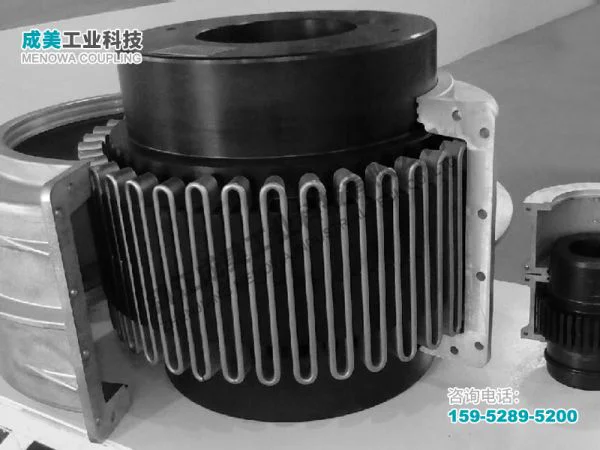
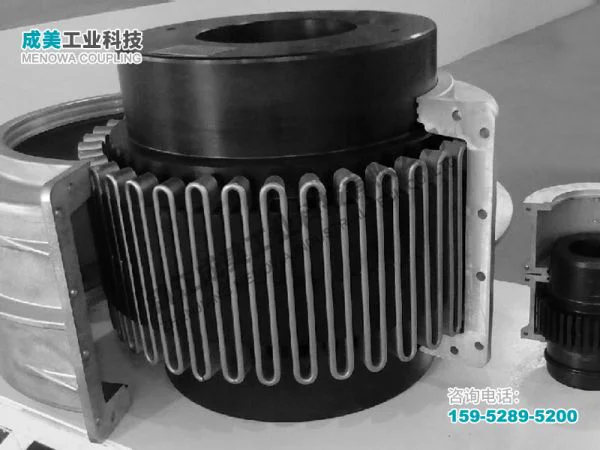
To fully grasp the significance of coaxiality in grid spring couplings, it is first necessary to clarify the basic concept of coaxiality and its specific manifestations in this type of coupling. Coaxiality tolerance is defined as the cylindrical zone with the reference axis as the center line, and the tolerance value is the diameter of this cylinder, which means that the measured axis must be within this cylindrical zone to meet the coaxiality requirement. In grid spring couplings, the reference axis is usually the axis of one of the half-couplings, and the measured axis is the axis of the other half-coupling; the grid spring, which is the core elastic component, is installed between the two half-couplings and is responsible for transmitting torque and compensating for minor coaxiality deviations. Unlike rigid couplings, which require almost perfect coaxiality, grid spring couplings have a certain degree of flexibility, allowing for small amounts of parallel misalignment, angular misalignment, or a combination of both. However, this flexibility is limited, and if the coaxiality deviation exceeds the allowable range, the grid spring will be subjected to uneven stress, leading to fatigue damage, and the coupling will fail to perform its intended functions effectively.
The importance of coaxiality in grid spring couplings cannot be overstated, as it is closely related to the overall performance and service life of the coupling and the entire transmission system. In normal operation, a grid spring coupling with good coaxiality can transmit torque stably, reduce the impact of vibration on the connected equipment (such as motors, pumps, and reducers), and ensure that the grid spring is evenly stressed, thereby extending its service life. On the contrary, poor coaxiality will cause a series of adverse effects. First, it will lead to increased vibration and noise during operation. When the two shafts are misaligned, the grid spring will be subjected to alternating bending and torsion forces during rotation, which will generate periodic vibration. This vibration will not only affect the stability of the coupling itself but also be transmitted to the connected equipment, causing premature wear of bearings, seals, and other components, and even affecting the accuracy of the equipment's work. Second, poor coaxiality will accelerate the wear and fatigue of the grid spring. The grid spring is usually made of high-quality alloy steel, which has good elasticity and fatigue resistance, but when it is subjected to uneven stress due to misalignment, the local stress will exceed the allowable limit, leading to fatigue cracks, deformation, or even breakage of the grid spring. Once the grid spring is damaged, the coupling will lose its ability to transmit torque, resulting in shutdown of the entire transmission system, which will bring huge economic losses to the enterprise. In addition, poor coaxiality will also reduce the transmission efficiency of the coupling, as part of the torque will be consumed to overcome the additional resistance caused by misalignment, resulting in energy waste.
There are many factors that affect the coaxiality of grid spring couplings, which can be roughly divided into two categories: manufacturing and processing errors, and installation and operation factors. Manufacturing and processing errors are inherent factors that exist during the production of the coupling, which directly affect the initial coaxiality of the coupling. For example, during the processing of the half-couplings, if the end face is not perpendicular to the axis, or the center of the bolt holes on the end face is not concentric with the journal, it will lead to the misalignment of the two half-couplings after assembly, thereby affecting the coaxiality of the entire coupling. In addition, the processing accuracy of the grid spring, such as its thickness, shape, and elastic coefficient, will also affect the coaxiality of the coupling, because the uneven elasticity of the grid spring will cause uneven force during operation, leading to the deviation of the axis. The manufacturing error of the coupling is a fixed error, which does not change with the operation time and working conditions, and can only be controlled by improving the processing technology and testing standards.
Installation and operation factors are acquired factors that occur during the installation and use of the coupling, which are more common and have a greater impact on the coaxiality. Installation errors are one of the main reasons for poor coaxiality of grid spring couplings. During installation, if the base of the connected equipment (such as motors and pumps) is not level, or the position of the equipment is not adjusted properly, it will lead to the misalignment of the two shafts. For example, if the motor base is tilted, the axis of the motor shaft will be at an angle to the axis of the pump shaft, resulting in angular misalignment of the coupling; if the motor is installed too far or too close, it will lead to parallel misalignment of the coupling. In addition, the installation method of the half-couplings also affects the coaxiality. If the half-couplings are not closely attached to the shaft shoulder, or the bolts are not tightened evenly, it will cause the half-couplings to be skewed, resulting in false coaxiality, that is, the measured coaxiality is qualified during installation, but the actual coaxiality is unqualified during operation. Another important installation factor is the thermal expansion of the equipment. During operation, the temperature of the connected equipment will rise, leading to thermal expansion of the shafts and the base. If the installation does not consider the thermal expansion margin, the coaxiality of the coupling will change after the equipment is heated, resulting in thermal misalignment. For example, the motor shaft will expand when heated, and if the installation position is fixed without considering this expansion, the axis of the motor shaft will deviate from the original position, leading to coaxiality deviation of the coupling.
Operation factors also have a significant impact on the coaxiality of grid spring couplings. During the operation of the transmission system, the vibration of the equipment, the uneven load, and the wear of the components will all lead to the change of coaxiality. For example, if the connected equipment is subjected to excessive load or impact load, the shafts will be deformed, leading to coaxiality deviation; the wear of the bearings will cause the shaft to deflect, resulting in the misalignment of the two shafts; the vibration of the equipment will make the bolts of the coupling loose, leading to the skewing of the half-couplings. In addition, the environmental factors, such as temperature changes, humidity, and dust, will also affect the coaxiality of the coupling. For example, large temperature changes will cause the deformation of the coupling and the connected equipment, leading to coaxiality deviation; dust accumulation on the coupling will affect the rotation of the shafts, leading to uneven stress and further affecting coaxiality.
Measuring the coaxiality of grid spring couplings accurately is the premise of ensuring their normal operation, and there are various measurement methods, each with its own characteristics and applicable scenarios. The choice of measurement method should be based on the accuracy requirements of the transmission system, the installation environment of the coupling, and the available measurement tools. Common measurement methods include the dial indicator method, the laser alignment method, and the coordinate measuring machine method.
The dial indicator method is the most commonly used measurement method, which is simple, convenient, and low-cost, and is suitable for the coaxiality measurement of most grid spring couplings in general industrial scenarios. The specific operation steps are as follows: first, fix the magnetic base of the dial indicator on one of the half-couplings (active end), and make the measuring head of the dial indicator contact the radial surface and axial end face of the other half-coupling (driven end) respectively, ensuring that the measuring head is perpendicular to the measuring surface and has a preload of 0.5-1mm. Then, mark a reference line on the coupling as the 0 position, and manually rotate the active shaft, measuring the radial deviation and axial deviation at 0°, 90°, 180°, and 270° positions respectively. The radial deviation reflects the parallel misalignment of the two shafts, and the axial deviation reflects the angular misalignment. After measuring the data at all positions, calculate the coaxiality error according to the formula: the radial coaxiality error is half of the difference between the maximum and minimum radial readings, and the angular coaxiality error is calculated according to the axial readings and the diameter of the half-coupling. The dial indicator method is easy to operate, but its measurement accuracy is limited, generally ±0.05mm, which is suitable for scenarios with low accuracy requirements.
The laser alignment method is a high-precision measurement method, which is suitable for grid spring couplings in high-speed, high-precision transmission systems, such as precision machinery, aerospace equipment, and high-speed pumps. This method uses laser emitters and receivers to measure the coaxiality deviation, with high measurement accuracy (up to ±0.01mm) and fast measurement speed. The specific operation steps are as follows: first, fix the laser emitter and receiver on the two half-couplings respectively, ensuring that the brackets are firm and free of vibration. Then, select the "coupling alignment" mode through the instrument menu, and input the parameters of the coupling, such as the shaft distance and the diameter of the half-coupling. Next, rotate the shaft to 0° and 180° positions, and the instrument will automatically collect laser data, calculate the radial and angular deviation values, and generate an adjustment plan, such as the thickness of the gasket that needs to be added or reduced at the front and rear feet of the motor. Finally, adjust the position of the equipment according to the prompt of the instrument until the deviation value is within the allowable range. The laser alignment method has the advantages of high accuracy, fast speed, and intuitive results, but the cost of the instrument is relatively high, and professional operation is required.
The coordinate measuring machine method is a precision measurement method suitable for the coaxiality measurement of grid spring couplings with complex structures or high precision requirements. This method uses a coordinate measuring machine to scan the surface of the coupling, collect the coordinate data of the measured axis and the reference axis, and then calculate the coaxiality error through the software. The coordinate measuring machine method has high measurement accuracy and can measure the coaxiality of multiple positions at the same time, but it is only suitable for laboratory or offline measurement, and cannot be used for online measurement of the coupling during operation. In addition, the measurement cost is high, and professional operators are required to operate the coordinate measuring machine.
When measuring the coaxiality of grid spring couplings, it is necessary to pay attention to some key points to ensure the accuracy of the measurement results. First, the measurement should be carried out in a stable environment, avoiding the influence of vibration, temperature changes, and other factors. For example, the measurement should not be carried out immediately after the equipment is shut down, because the shaft may be deformed due to thermal expansion and contraction, and the measurement should be carried out after the equipment cools down to room temperature. Second, the measurement tools should be calibrated regularly to ensure their accuracy. For example, the dial indicator should be calibrated before use to avoid measurement errors caused by the inaccuracy of the tool itself. Third, the coupling should be in a free state during measurement, and the bolts should not be tightened too tightly to avoid the deformation of the coupling caused by excessive force, which affects the measurement results. Finally, multiple measurements should be carried out, and the average value should be taken as the final coaxiality error to reduce the influence of accidental errors.
Adjusting the coaxiality of grid spring couplings is an important measure to solve the problem of poor coaxiality, and the adjustment method should be determined according to the type and degree of coaxiality deviation. The basic principle of adjustment is to first adjust the angular misalignment, then adjust the parallel misalignment, because the angular misalignment will affect the measurement result of the parallel misalignment. Common adjustment methods include adjusting the position of the equipment, adding or reducing gaskets, and correcting the deformation of the shaft.
Adjusting the position of the equipment is a common method to correct parallel misalignment and angular misalignment. For example, if the motor and the pump are misaligned in parallel, the position of the motor can be moved horizontally to make the axes of the two shafts parallel; if there is angular misalignment, the height of the motor base can be adjusted to make the axes of the two shafts coincide. When adjusting, it is necessary to use measurement tools to monitor the coaxiality deviation in real time, and stop adjusting until the deviation is within the allowable range. Adding or reducing gaskets is a simple and effective method to adjust the angular misalignment. Gaskets of different thicknesses can be added or reduced at the front and rear feet of the motor to adjust the angle of the motor shaft, so as to correct the angular misalignment between the motor shaft and the pump shaft. When adding or reducing gaskets, it is necessary to ensure that the gaskets are flat and free of deformation, and the thickness of the gaskets should be calculated accurately according to the measurement results to avoid over-adjustment or under-adjustment.
Correcting the deformation of the shaft is necessary when the coaxiality deviation is caused by the deformation of the shaft. If the shaft is slightly bent, it can be corrected by cold straightening or hot straightening; if the deformation is serious, the shaft needs to be replaced. In addition, if the coaxiality deviation is caused by the wear of the bearing, the bearing should be replaced in time to ensure that the shaft can rotate stably. When adjusting the coaxiality, it is also necessary to pay attention to the installation sequence of the coupling: the half-couplings should be initially fixed on the shaft first (the bolts are not tightened), and the coaxiality adjustment should be completed before tightening the bolts and installing the grid spring. This can avoid the grid spring being forced to compensate for excessive deviation, leading to uneven stress and damage.
In addition to regular measurement and adjustment, daily maintenance is also an important measure to maintain the coaxiality of grid spring couplings. Daily maintenance includes regular inspection of the coupling, cleaning the surface of the coupling, checking the tightness of the bolts, and lubricating the grid spring. Regular inspection can find the coaxiality deviation in time and take adjustment measures to avoid the problem from worsening; cleaning the surface of the coupling can prevent dust accumulation from affecting the rotation of the shaft; checking the tightness of the bolts can prevent the half-couplings from skewing due to loose bolts; lubricating the grid spring can reduce friction, ensure its flexibility, and avoid uneven stress caused by poor lubrication. In addition, it is also necessary to avoid overloading the transmission system, because excessive load will cause the shaft to deform and affect the coaxiality of the coupling. At the same time, the working environment of the coupling should be improved, avoiding large temperature changes and excessive dust, so as to reduce the impact of environmental factors on the coaxiality.
In practical industrial applications, the allowable coaxiality deviation of grid spring couplings is not a fixed value, but depends on various factors, such as the type of coupling, the rotating speed, the transmitted torque, and the accuracy requirements of the connected equipment. Generally speaking, the higher the rotating speed of the coupling, the smaller the allowable coaxiality deviation, because high-speed rotation will amplify the impact of misalignment, leading to more serious vibration and wear. For example, for a grid spring coupling with a rotating speed of more than 3000r/min, the allowable parallel misalignment is usually less than 0.1mm, and the allowable angular misalignment is less than 0.5°; for a coupling with a rotating speed of less than 1000r/min, the allowable parallel misalignment can be up to 0.3mm, and the allowable angular misalignment can be up to 1.5°. In addition, the allowable coaxiality deviation also has a certain relationship with the diameter of the coupling. The larger the diameter of the coupling, the higher the accuracy requirement of coaxiality, because the deviation of the same size will cause a larger swing at the edge of the coupling, leading to uneven stress.
It is worth noting that the grid spring coupling has a certain ability to compensate for coaxiality deviation, but this compensation ability is limited. The grid spring can only compensate for small amounts of misalignment, and if the deviation exceeds the allowable range, the grid spring will be damaged quickly. Therefore, it is not advisable to rely on the flexibility of the grid spring to compensate for excessive coaxiality deviation. Instead, it is necessary to ensure that the coaxiality of the coupling is within the allowable range through accurate measurement and adjustment, so as to ensure the stable operation of the coupling and the entire transmission system.
In conclusion, coaxiality is a key parameter that affects the performance and service life of grid spring couplings. The coaxiality of grid spring couplings is affected by many factors, including manufacturing and processing errors, installation errors, and operation factors. To ensure the coaxiality of the coupling, it is necessary to choose appropriate measurement methods to accurately measure the coaxiality deviation, and take corresponding adjustment measures according to the type and degree of deviation. At the same time, regular daily maintenance is also essential to maintain the coaxiality of the coupling and avoid the occurrence of failures. By paying attention to the coaxiality of grid spring couplings and taking effective measures to control and adjust it, the reliability and service life of the coupling can be improved, the stable operation of the transmission system can be ensured, and the economic benefits of the enterprise can be enhanced. With the continuous development of industrial technology, the requirements for the coaxiality of grid spring couplings will become higher and higher, which requires continuous improvement of measurement and adjustment technologies, and the development of more high-precision and efficient measurement tools and adjustment methods to meet the needs of different industrial scenarios.
Post Date: May 11, 2026
https://www.menowacoupling.com/china-coupling/coaxiality-of-grid-spring-coupling.html
Supply
Related Articles
Grid Spring Coupling Exporter
In the field of industrial power transmission, the role of couplings is irreplaceable. They serve as the critical connection between driving devices and driven equipment, ensuring the stable transfer of torque while compensating for alignment errors and reducing operational vibrations. Among the various types of couplin…Material of Grid Spring Coupling
Grid spring couplings are essential components in mechanical transmission systems, designed to connect two shafts and transmit torque while compensating for axial, radial, and angular misalignments, absorbing vibrations, and reducing shock loads. The performance, reliability, and service life of a grid spring coupling a…Maintenance of Grid Spring Coupling
Grid spring couplings are widely used in various industrial transmission systems, serving as a critical connection between driving and driven shafts to transmit torque while compensating for axial, radial, and angular misalignments. Their unique structure, which relies on grid springs embedded in the tooth grooves of tw…Diagram of Grid Spring Coupling
A grid spring coupling is a versatile mechanical device designed to transmit torque between two rotating shafts while accommodating misalignments, absorbing shock loads, and reducing vibration in various industrial applications. Its unique structural design, which combines rigidity with flexibility, makes it an indispen…Grid Spring Coupling Manufacture
Grid spring couplings are essential mechanical components widely used in industrial power transmission systems, serving as the critical connection between driving and driven shafts to transmit torque while accommodating misalignments and absorbing shocks. The manufacture of grid spring couplings requires precise enginee…Grid Spring Coupling Factory
In the complex ecosystem of industrial machinery, the role of grid spring couplings is often underestimated, yet they are the unsung heroes that ensure the smooth and efficient transmission of power between rotating shafts. These precision components are integral to a wide range of industrial applications, from heavy-du…
 WeChat
 WhatsApp