Components of Grid Spring Coupling
A grid spring coupling is a sophisticated mechanical device designed to transmit torque between two rotating shafts while accommodating misalignments, absorbing vibrations, and cushioning shock loads. Its robust yet flexible structure makes it indispensable in a wide range of industrial applications, from heavy machinery to precision equipment. To fully understand the functionality and performance of a grid spring coupling, it is essential to examine its core components, each of which plays a critical role in ensuring reliable power transmission, durability, and operational safety. Every component is engineered to work in harmony, contributing to the coupling’s overall ability to handle varying loads, compensate for shaft misalignments, and protect both the coupling itself and the connected equipment from damage. Unlike rigid couplings that offer no flexibility, grid spring couplings leverage the unique properties of their components to balance strength and resilience, making them suitable for environments where shafts may not be perfectly aligned or where shock and vibration are common occurrences.
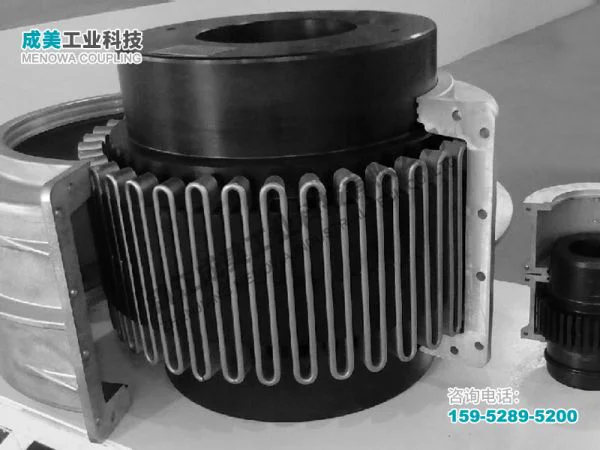
At the heart of every grid spring coupling lies the grid spring element, the component responsible for the coupling’s torsional flexibility, vibration damping, and shock absorption capabilities. This element is typically a serpentine or grid-like strip of high-tensile alloy steel, carefully formed into a curved shape that allows it to flex under load while maintaining structural integrity. The design of the grid spring is not arbitrary; its curved profile is engineered to engage with the teeth of the coupling hubs in a progressive manner, ensuring that as torque increases, more of the grid comes into contact with the hub teeth. This progressive contact mechanism is key to the coupling’s ability to absorb impact energy by spreading it out over time, thereby reducing the magnitude of peak loads and protecting the connected shafts and equipment. The grid spring is subjected to rigorous manufacturing processes to enhance its strength and durability: it is first formed into the desired shape, then hardened and tempered under controlled conditions to achieve optimal mechanical properties. Additionally, a shot-peening process is often applied to the grid spring, which compresses the surface molecules and creates a residual compressive stress. This process significantly increases the grid’s resistance to fatigue and wear, as any tensile stress applied during operation must first overcome the compressive forces from shot-peening, thereby extending the component’s service life.
The grid spring element cannot function in isolation; it relies on the hub assemblies to connect to the rotating shafts and transmit torque. Hub assemblies are precision-machined components that serve as the interface between the coupling and the shafts of the driving and driven equipment. Each grid spring coupling features two hub assemblies, one attached to the driving shaft and the other to the driven shaft. The hubs are typically made from high-strength alloy steel or cast iron, materials chosen for their ability to withstand high torque loads and resist wear. The inner diameter of each hub is machined to a precise tolerance to ensure a tight fit with the shaft, preventing slippage during operation. In many cases, the hub is equipped with keyways or set screws to further secure it to the shaft, ensuring that torque is transmitted efficiently without any relative movement between the hub and the shaft. The outer surface of each hub is designed with a series of curved teeth that mesh with the grid spring element. These teeth are precision-ground to a curved profile that matches the curvature of the grid spring, allowing for smooth engagement and disengagement as the coupling operates. The curved design of the hub teeth is critical for facilitating the progressive contact with the grid spring, enabling the coupling to adapt to varying torque loads and absorb shocks effectively. In some designs, the hub teeth may have a tapered profile to improve the grid’s ability to slide and rock within the teeth, enhancing the coupling’s capacity to compensate for misalignments.
To protect the grid spring element and hub teeth from external contaminants and to maintain proper lubrication, grid spring couplings are equipped with a split cover kit. This kit is a crucial component that ensures the longevity and reliable performance of the coupling by creating a sealed environment for the internal components. The split cover itself is typically composed of two halves that are fastened together around the coupling, forming a protective enclosure. The material used for the cover varies depending on the application: for standard industrial settings, die-cast aluminum is often used due to its lightweight properties and resistance to corrosion; for high-speed applications, stamped steel may be preferred for its greater strength and ability to withstand higher centrifugal forces. The split design of the cover allows for easy installation and maintenance, as the cover halves can be removed without disassembling the entire coupling or disconnecting the shafts. This feature is particularly valuable in applications where downtime must be minimized, as it allows for quick access to the grid spring element for inspection or replacement.
In addition to the cover halves, the split cover kit includes several other essential components that contribute to its functionality. Gaskets are placed between the two cover halves to create a tight seal, preventing lubricating oil from leaking out and external contaminants such as dust, dirt, and moisture from entering the coupling. These gaskets are typically made from flexible materials that can withstand the operating temperatures and pressures of the coupling, ensuring a reliable seal over time. Seals are another critical part of the split cover kit, installed at the points where the cover meets the hub assemblies. These seals prevent lubricant leakage along the shafts and further protect the internal components from external debris. The split cover kit also includes hardware such as bolts, nuts, and washers, which are used to fasten the cover halves together securely. These fasteners are designed to withstand the vibrations and centrifugal forces generated during operation, ensuring that the cover remains securely in place even under harsh conditions. In some cases, the hardware may be available in both metric and imperial sizes to accommodate different application requirements, enhancing the coupling’s versatility.
Lubrication is a vital aspect of grid spring coupling operation, and while not a physical component in the traditional sense, it is an integral part of the coupling’s system that cannot be overlooked. The grid spring element and hub teeth are in constant contact during operation, creating friction that can lead to wear and heat generation if not properly lubricated. Lubricating oil is used to reduce friction between these components, dissipate heat, and prevent corrosion. The type of lubricant used depends on the operating conditions of the coupling, including temperature, load, and speed. For standard applications, a high-quality mineral oil or grease is sufficient, while for high-temperature or high-load environments, specialized lubricants with enhanced thermal stability and load-carrying capacity may be required. The split cover kit plays a key role in retaining the lubricant within the coupling, ensuring that the internal components remain properly lubricated at all times. Regular lubrication maintenance is essential to ensure the longevity of the coupling, as insufficient or degraded lubricant can lead to increased wear, reduced performance, and premature component failure.
Some grid spring coupling designs include additional components to enhance their functionality for specific applications. One such component is the spacer, which is used in spacer-style grid couplings to separate the two hub assemblies. Spacers are particularly useful in pump applications or other scenarios where the driving and driven equipment are spaced apart, as they allow for easy access to the equipment for maintenance without disconnecting the coupling. The spacer is typically a cylindrical component that connects the two hub assemblies, with the grid spring element installed around it. Spacer-style couplings may also include additional components such as spacer hubs, which are used to attach the spacer to the main hub assemblies. These components are designed to maintain the same level of torque transmission and misalignment compensation as standard grid spring couplings while providing the added benefit of increased spacing between the shafts.
Another optional component found in some grid spring couplings is the brake disc, which is integrated into the coupling to provide braking functionality. This component is particularly useful in applications such as cranes and elevator drives, where space is limited and a compact braking solution is required. The brake disc is typically mounted to one of the hub assemblies and works in conjunction with an external brake system to stop the rotation of the shafts quickly and efficiently. The integration of a brake disc into the coupling eliminates the need for a separate braking device, saving space and reducing the complexity of the overall system. However, this design requires careful engineering to ensure that the brake disc does not interfere with the coupling’s flexibility or torque transmission capabilities.
The materials used in the construction of grid spring coupling components are carefully selected to ensure optimal performance and durability. The grid spring element is almost always made from high-tensile alloy steel, which offers excellent strength, flexibility, and resistance to fatigue. This material is capable of withstanding the repeated flexing and stress that the grid undergoes during operation, ensuring a long service life. The hub assemblies are typically made from alloy steel or cast iron, materials that provide high torque-carrying capacity and resistance to wear. The choice between alloy steel and cast iron depends on the specific application requirements: alloy steel is preferred for high-load applications, while cast iron is suitable for standard applications where cost-effectiveness is a consideration. The split cover is usually made from aluminum or steel, as mentioned earlier, with aluminum offering lightweight properties and steel providing greater strength for high-speed applications. The gaskets and seals are made from flexible materials such as rubber or synthetic elastomers, which can withstand the operating temperatures and pressures while maintaining a reliable seal.
The performance of a grid spring coupling is determined by the interaction of its components, each working together to achieve the desired functionality. The grid spring element provides the flexibility and damping capabilities, allowing the coupling to absorb vibrations and shock loads while compensating for misalignments. The hub assemblies transmit torque from the driving shaft to the grid spring and then to the driven shaft, ensuring efficient power transmission. The split cover kit protects the internal components from external contaminants and retains the lubricant, ensuring smooth operation and longevity. Lubrication reduces friction and wear, further extending the service life of the coupling. Optional components such as spacers and brake discs enhance the coupling’s versatility, allowing it to be adapted to a wide range of applications.
Misalignment compensation is one of the key functions of a grid spring coupling, and this capability is made possible by the design of its components. Shaft misalignment can occur in three forms: angular, parallel, and axial. Angular misalignment occurs when the shafts are not perfectly aligned along the same axis, resulting in a slight angle between them. Parallel misalignment happens when the shafts are parallel but offset from each other. Axial misalignment occurs when the shafts move along their axial direction relative to each other. The grid spring element, with its flexible design, is able to rock and slide within the curved teeth of the hub assemblies, accommodating all three types of misalignment within allowable limits. The progressive contact between the grid spring and the hub teeth ensures that the coupling can adapt to these misalignments without compromising torque transmission or causing excessive wear. This ability to compensate for misalignments is crucial in industrial applications, as perfect shaft alignment is often difficult to achieve and maintain, especially in large or complex machinery.
Vibration damping is another critical function of grid spring couplings, made possible by the grid spring element. In industrial operations, rotating machinery generates vibrations that can be transmitted through the shafts to other components, causing noise, wear, and premature failure. The grid spring element acts as a damper, absorbing these vibrations by flexing and dissipating the vibrational energy. This not only reduces noise levels but also protects the connected equipment, such as bearings, seals, and gears, from the damaging effects of vibrations. The shot-peening process applied to the grid spring enhances its damping capabilities by increasing its fatigue resistance, allowing it to withstand repeated vibrational loads without failing. Some grid spring couplings are capable of reducing vibrations by up to 30%, making them ideal for applications where vibration control is essential, such as in precision machinery or equipment with sensitive components.
Shock load cushioning is yet another important feature of grid spring couplings, provided by the grid spring element. Shock loads can occur during startup, shutdown, or when the machinery encounters unexpected resistance, and these loads can cause significant damage to the shafts and connected equipment. The grid spring element absorbs these shock loads by spreading the impact energy over time, reducing the magnitude of the peak loads. The progressive contact between the grid spring and the hub teeth ensures that the shock load is distributed evenly across the components, preventing localized stress concentrations that could lead to failure. In extreme cases of overload, the grid spring may break, acting as a sacrificial component that protects the more expensive shafts and equipment from damage. This sacrificial feature is a valuable safety mechanism, as replacing a grid spring is much more cost-effective than repairing or replacing a damaged shaft or piece of machinery.
The assembly and maintenance of grid spring couplings are facilitated by the design of their components. The split cover kit allows for easy access to the internal components, making inspection, lubrication, and replacement of the grid spring element straightforward. The grid spring itself is designed to be easily installed and removed, requiring only basic tools and minimal downtime. The hub assemblies are secured to the shafts using standard fasteners, making installation quick and simple. Regular maintenance typically involves inspecting the grid spring for signs of wear or fatigue, checking the lubricant level and condition, and ensuring that the cover is securely fastened and the seals are intact. By following proper maintenance procedures, the service life of a grid spring coupling can be significantly extended, ensuring reliable performance for many years.
In conclusion, the components of a grid spring coupling work in perfect harmony to provide a reliable, flexible, and durable solution for torque transmission in industrial applications. The grid spring element, hub assemblies, split cover kit, and optional components such as spacers and brake discs each play a critical role in the coupling’s functionality. The grid spring element is the heart of the coupling, providing flexibility, vibration damping, and shock absorption. The hub assemblies ensure efficient torque transmission and secure connection to the shafts. The split cover kit protects the internal components and maintains proper lubrication. Optional components enhance the coupling’s versatility, allowing it to be adapted to specific application requirements. By understanding the role of each component, it is possible to appreciate the complexity and effectiveness of grid spring couplings, and to select the right coupling for a given application. Whether used in heavy machinery, pumps, fans, or precision equipment, grid spring couplings continue to be a vital component in modern industrial transmission systems, thanks to their unique combination of strength, flexibility, and reliability.
Post Date: May 1, 2026
https://www.menowacoupling.com/china-coupling/components-of-grid-spring-coupling.html
Supply
Related Articles
Grid Spring Coupling Wholesale
In the complex ecosystem of industrial machinery, the role of coupling components cannot be overstated. They serve as the critical link between driving and driven shafts, ensuring the smooth transmission of power while accommodating misalignments, absorbing vibrations, and protecting expensive equipment from damage. Amo…What is Grid Spring Coupling
In the complex world of mechanical power transmission, the need to connect two rotating shafts efficiently, reliably, and with minimal wear has led to the development of various coupling devices. Among these, the grid spring coupling stands out as a versatile and robust solution, widely used in industrial applications w…Characteristics of Grid Spring Coupling
A grid spring coupling is a specialized mechanical component designed to transmit torque between two rotating shafts while accommodating various forms of misalignment and mitigating the effects of vibration and shock loads. Unlike rigid couplings that require precise alignment and offer no flexibility, grid spring coupl…Working Principle of Grid Spring Coupling
In the complex and dynamic field of mechanical power transmission, couplings serve as the critical link between driving and driven shafts, ensuring the smooth and efficient transfer of torque while accommodating inevitable misalignments and mitigating operational stresses. Among the diverse range of coupling types avail…Grid Spring Coupling Fabrication
Grid spring couplings are essential components in mechanical transmission systems, widely used in various industrial fields due to their unique combination of flexibility, torque transmission capacity, and durability. These couplings play a critical role in connecting two rotating shafts, compensating for misalignments,…Grid Spring Coupling Exporter
In the field of industrial power transmission, the role of couplings is irreplaceable. They serve as the critical connection between driving devices and driven equipment, ensuring the stable transfer of torque while compensating for alignment errors and reducing operational vibrations. Among the various types of couplin…
 WeChat
 WhatsApp