Material of Curved Tooth Coupling
Curved tooth couplings have emerged as one of the most reliable and versatile mechanical transmission components in the global industrial machinery sector, serving as a core connecting unit for shaft torque transmission in heavy-duty, high-speed, and misalignment-tolerant operating environments. The unique curved tooth profile design effectively eliminates edge contact stress during meshing, achieves uniform load distribution on each tooth surface, and delivers excellent shock absorption, vibration resistance, and misalignment compensation capabilities. In the global industrial chain, the performance, service life, and environmental adaptability of curved tooth couplings are fundamentally determined by their manufacturing materials, while reasonable material selection and standardized type selection are key prerequisites for stabilizing operational efficiency and reducing equipment maintenance costs. With the continuous upgrading of global industrial manufacturing, the market demand for high-performance, durable, and environment-adaptive curved tooth couplings has been expanding steadily across regions, driving iterative updates in material technology and standardized selection systems worldwide.
The material system of curved tooth couplings is mainly divided into metal structural materials and auxiliary composite materials, with metal materials dominating the main load-bearing components such as coupling hubs and tooth sleeves, which directly determine the mechanical strength and operational stability of the product. High-quality carbon steel is the most widely used basic material for general industrial curved tooth couplings, featuring low production cost, good forgeability, and excellent comprehensive mechanical properties after conventional heat treatment. It can meet the torque transmission and load-bearing requirements of conventional mechanical equipment under normal temperature, conventional load, and non-corrosive environments, occupying the mainstream market share in medium and low-end industrial scenarios globally. For medium and heavy-duty working conditions with high load, frequent start-stop, and strong impact load, chromium-molybdenum alloy steel has become the preferred material in the international market. This alloy material undergoes strict quenching and tempering heat treatment, with significantly improved surface hardness, core toughness, and wear resistance, effectively avoiding tooth surface wear, tooth root fracture, and fatigue failure under long-term high-strength operation. Its high thermal stability also enables stable operation in high-temperature working environments generated by high-speed rotation, making it widely adopted in heavy machinery, energy equipment, and engineering machinery fields worldwide.
In special extreme working environments, the material selection of curved tooth couplings shows obvious differentiated characteristics to adapt to diverse global industrial scenarios. In marine, chemical, and coastal humid environments with high salt spray and corrosive media, ordinary carbon steel and alloy steel are prone to oxidation and electrochemical corrosion, leading to tooth surface rusting, meshing jamming, and shortened service life. Therefore, high-strength stainless steel materials are mostly used in such scenarios, with excellent corrosion resistance, oxidation resistance, and low-temperature toughness, which can maintain stable mechanical properties in long-term humid and corrosive environments. For light-load, low-noise, and maintenance-free operating scenarios, composite materials represented by modified polyamide have gained increasing application in the global market. The composite material matched with metal hubs has low friction coefficient and good lubricity, realizing self-lubricating operation without additional lubricating oil, effectively reducing operational noise and maintenance frequency. This material combination also has outstanding resistance to common industrial media such as hydraulic oil, fuel, and organic solvents, adapting to the lightweight and low-maintenance development trend of modern industrial equipment.
The global market layout of curved tooth couplings presents a pattern of diversified regional demand and hierarchical material application, closely linked with the industrial development level of various regions. In European and North American industrial regions with mature high-end manufacturing industries, the market demand is concentrated on high-precision, high-load, and long-life curved tooth coupling products, driving the widespread application of high-grade alloy steel and special stainless steel materials. These regions have strict requirements for equipment operational stability and service life, and the iteration speed of material technology is fast, focusing on the optimization of material fatigue resistance and high-temperature stability to adapt to high-end equipment such as precision industrial machinery, power generation equipment, and large mining machinery. The market consumption is dominated by high-performance customized products, and the material upgrading and structural optimization of products are always in the leading position in the global industry.
The Asia-Pacific market has become the fastest-growing consumer market for curved tooth couplings in the world, benefiting from the rapid expansion of industrial manufacturing scale in emerging economies. The regional market presents a hierarchical demand structure: the mid-end industrial field with the largest market share mainly adopts high-quality carbon steel materials to meet the mass production and conventional operation needs of general machinery and equipment; the rapidly developing heavy industry, energy, and engineering machinery fields continuously increase the demand for alloy steel high-performance couplings, promoting the localized upgrading of material processing technology. In addition, with the continuous improvement of environmental protection and low-energy consumption requirements in the Asia-Pacific industrial market, lightweight composite material curved tooth couplings have achieved rapid market penetration in recent years, suitable for light industrial equipment, automated production lines, and new energy supporting equipment. The African and South American markets are still in the stage of expanding basic industrial construction, with market demand focusing on cost-effective conventional products, and carbon steel curved tooth couplings occupy the main market share, while the demand for special material products is relatively limited and grows steadily with the upgrading of local industrial facilities.
In actual global engineering applications, standardized type selection is essential to ensure the matching between curved tooth coupling performance and working conditions, and scientific calculation formulas provide core data support for type selection. The core basis for coupling selection is the rated transmission torque, and the basic torque calculation formula is universally applicable to global industrial selection standards. The basic calculation formula of required transmission torque is T=9550P/n, where T represents the theoretical transmission torque of the equipment shaft, with the unit of N·m; P represents the rated power of the driving equipment, with the unit of kW; n represents the rated working speed of the equipment, with the unit of r/min. Considering the complex and variable actual working conditions, the theoretical torque cannot directly guide the selection, and it is necessary to introduce the working condition coefficient for correction. The actual selection torque calculation formula is Tc=K×T, where Tc is the corrected rated torque required for coupling selection, and K is the working condition coefficient.
The value of the working condition coefficient K needs to be reasonably selected according to the equipment operation mode and load characteristics, which is a unified selection principle followed in global engineering practices. For stable load equipment with continuous uniform operation, such as conventional fans, water pumps, and general transmission machinery, the K value is selected in the range of 1.0 to 1.5; for equipment with intermittent operation and slight impact load, such as general processing machinery and conveying equipment, the K value is controlled between 1.5 and 2.0; for heavy-duty equipment with frequent start-stop, strong vibration, and obvious impact load, such as mining machinery, crushing equipment, and engineering machinery, the K value needs to be selected in the range of 2.0 to 3.0 to ensure that the coupling has sufficient load margin to avoid fatigue damage and structural failure during long-term operation. In addition to torque calculation, the allowable misalignment of the coupling also needs to be verified during selection, including angular misalignment, radial misalignment, and axial displacement, to ensure that the installation error of the equipment shaft is within the adaptive range of the curved tooth coupling, avoiding additional meshing stress caused by excessive misalignment and accelerating tooth surface wear.
Reasonable material matching and standardized selection specifications are important guarantees to expand the global application scope of curved tooth couplings, and different working scenarios have clear matching requirements for materials and product models. In the field of energy power, curved tooth couplings are mainly used in power generation equipment, fan and pump transmission systems, and long-term continuous stable operation is the core demand. Alloy steel materials with high fatigue resistance and stable heat resistance are mostly selected here, and the selection needs to ensure sufficient torque margin to adapt to long-term uninterrupted operation and slight load fluctuation. In the mining and metallurgy industry, the equipment has heavy load, strong impact, and harsh working environments with dust and vibration, so high-strength alloy steel curved tooth couplings with enhanced wear resistance and impact resistance are preferred, and the structural strength of the tooth surface and tooth root should be fully considered in the selection to resist periodic impact loads.
In the petroleum and chemical industry, equipment often operates in corrosive media and variable temperature environments, so stainless steel or anti-corrosion treated alloy steel materials are mainly selected to avoid material corrosion and performance degradation. At the same time, the sealing and lubrication adaptability of the coupling should be matched during selection to adapt to harsh chemical working conditions. In marine and port machinery scenarios, equipment is exposed to seawater erosion and humid salt spray environments for a long time, and high-corrosion-resistant stainless steel materials are used in priority, with strict verification of low-temperature toughness and structural stability to adapt to variable marine working conditions. In light industrial automation and new energy equipment fields, the operating load is relatively stable, and the requirements for noise control and maintenance-free performance are higher, so composite material matching structural steel couplings are widely selected to achieve lightweight, low-noise, and low-cost operation.
In the global market competition and engineering application process, there are key selection precautions that need to be universally followed to avoid selection mismatch and operational failure. First, material performance must be matched with the working environment, and temperature, humidity, corrosive media, and dust conditions must be fully evaluated. High-temperature environments need to prioritize materials with good thermal stability and high-temperature hardness; low-temperature scenarios need to focus on material low-temperature toughness to prevent brittle fracture; corrosive environments must eliminate ordinary carbon steel materials that are prone to corrosion. Second, the matching of rotating speed and structural rigidity should be considered. High-speed operating equipment needs to select couplings with high-precision processing and high-rigidity materials to reduce vibration and noise caused by unbalanced rotation and avoid tooth surface resonance wear.
Third, the installation space and structural size constraints should be fully considered. On the premise of meeting torque transmission requirements, compact structural models should be selected for limited installation space to avoid structural interference. Fourth, the later maintenance adaptability should be reserved in the selection. Metal curved tooth couplings need to match regular lubrication and maintenance cycles, while composite material couplings can reduce maintenance frequency, and the appropriate type should be selected according to the enterprise's operation and maintenance conditions. In addition, in the global cross-regional application, the consistency of processing precision and material standards should be guaranteed, and the dimensional tolerance and mechanical performance indicators of products should be unified to adapt to the assembly and operation requirements of different regional equipment.
Looking at the global development trend of curved tooth couplings, with the continuous progress of material science and industrial precision manufacturing technology, the industry is moving towards high strength, high corrosion resistance, lightweight, and low maintenance. The iterative upgrading of new alloy materials, modified composite materials, and surface treatment technologies will further expand the environmental adaptability and service life of curved tooth couplings. At the same time, with the continuous improvement of global industrial refinement requirements, the standardized and refined selection system will be more widely popularized, realizing the precise matching of materials, models, and working conditions. The diversified demand of the global industrial market will continue to drive the differentiated development of curved tooth coupling material systems and product specifications, providing more reliable transmission component support for the high-quality development of global mechanical manufacturing industry.
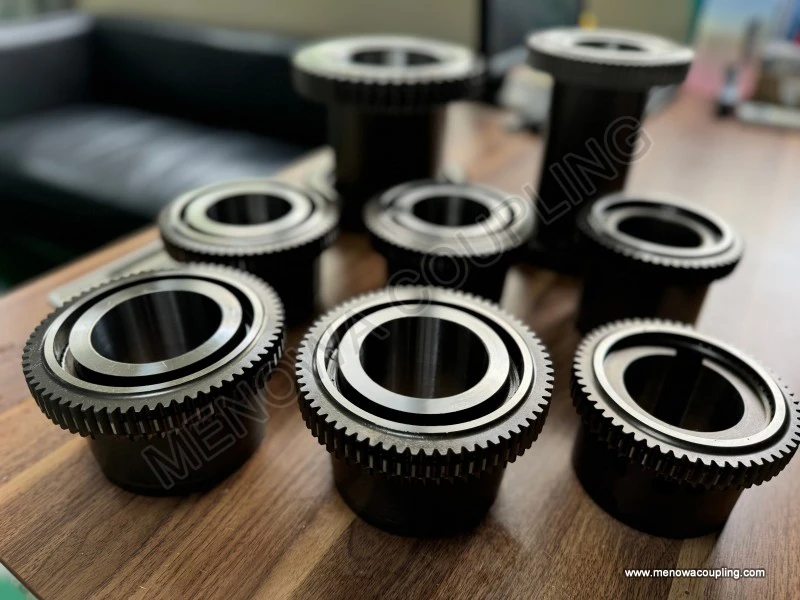
The material system of curved tooth couplings is mainly divided into metal structural materials and auxiliary composite materials, with metal materials dominating the main load-bearing components such as coupling hubs and tooth sleeves, which directly determine the mechanical strength and operational stability of the product. High-quality carbon steel is the most widely used basic material for general industrial curved tooth couplings, featuring low production cost, good forgeability, and excellent comprehensive mechanical properties after conventional heat treatment. It can meet the torque transmission and load-bearing requirements of conventional mechanical equipment under normal temperature, conventional load, and non-corrosive environments, occupying the mainstream market share in medium and low-end industrial scenarios globally. For medium and heavy-duty working conditions with high load, frequent start-stop, and strong impact load, chromium-molybdenum alloy steel has become the preferred material in the international market. This alloy material undergoes strict quenching and tempering heat treatment, with significantly improved surface hardness, core toughness, and wear resistance, effectively avoiding tooth surface wear, tooth root fracture, and fatigue failure under long-term high-strength operation. Its high thermal stability also enables stable operation in high-temperature working environments generated by high-speed rotation, making it widely adopted in heavy machinery, energy equipment, and engineering machinery fields worldwide.
In special extreme working environments, the material selection of curved tooth couplings shows obvious differentiated characteristics to adapt to diverse global industrial scenarios. In marine, chemical, and coastal humid environments with high salt spray and corrosive media, ordinary carbon steel and alloy steel are prone to oxidation and electrochemical corrosion, leading to tooth surface rusting, meshing jamming, and shortened service life. Therefore, high-strength stainless steel materials are mostly used in such scenarios, with excellent corrosion resistance, oxidation resistance, and low-temperature toughness, which can maintain stable mechanical properties in long-term humid and corrosive environments. For light-load, low-noise, and maintenance-free operating scenarios, composite materials represented by modified polyamide have gained increasing application in the global market. The composite material matched with metal hubs has low friction coefficient and good lubricity, realizing self-lubricating operation without additional lubricating oil, effectively reducing operational noise and maintenance frequency. This material combination also has outstanding resistance to common industrial media such as hydraulic oil, fuel, and organic solvents, adapting to the lightweight and low-maintenance development trend of modern industrial equipment.
The global market layout of curved tooth couplings presents a pattern of diversified regional demand and hierarchical material application, closely linked with the industrial development level of various regions. In European and North American industrial regions with mature high-end manufacturing industries, the market demand is concentrated on high-precision, high-load, and long-life curved tooth coupling products, driving the widespread application of high-grade alloy steel and special stainless steel materials. These regions have strict requirements for equipment operational stability and service life, and the iteration speed of material technology is fast, focusing on the optimization of material fatigue resistance and high-temperature stability to adapt to high-end equipment such as precision industrial machinery, power generation equipment, and large mining machinery. The market consumption is dominated by high-performance customized products, and the material upgrading and structural optimization of products are always in the leading position in the global industry.
The Asia-Pacific market has become the fastest-growing consumer market for curved tooth couplings in the world, benefiting from the rapid expansion of industrial manufacturing scale in emerging economies. The regional market presents a hierarchical demand structure: the mid-end industrial field with the largest market share mainly adopts high-quality carbon steel materials to meet the mass production and conventional operation needs of general machinery and equipment; the rapidly developing heavy industry, energy, and engineering machinery fields continuously increase the demand for alloy steel high-performance couplings, promoting the localized upgrading of material processing technology. In addition, with the continuous improvement of environmental protection and low-energy consumption requirements in the Asia-Pacific industrial market, lightweight composite material curved tooth couplings have achieved rapid market penetration in recent years, suitable for light industrial equipment, automated production lines, and new energy supporting equipment. The African and South American markets are still in the stage of expanding basic industrial construction, with market demand focusing on cost-effective conventional products, and carbon steel curved tooth couplings occupy the main market share, while the demand for special material products is relatively limited and grows steadily with the upgrading of local industrial facilities.
In actual global engineering applications, standardized type selection is essential to ensure the matching between curved tooth coupling performance and working conditions, and scientific calculation formulas provide core data support for type selection. The core basis for coupling selection is the rated transmission torque, and the basic torque calculation formula is universally applicable to global industrial selection standards. The basic calculation formula of required transmission torque is T=9550P/n, where T represents the theoretical transmission torque of the equipment shaft, with the unit of N·m; P represents the rated power of the driving equipment, with the unit of kW; n represents the rated working speed of the equipment, with the unit of r/min. Considering the complex and variable actual working conditions, the theoretical torque cannot directly guide the selection, and it is necessary to introduce the working condition coefficient for correction. The actual selection torque calculation formula is Tc=K×T, where Tc is the corrected rated torque required for coupling selection, and K is the working condition coefficient.
The value of the working condition coefficient K needs to be reasonably selected according to the equipment operation mode and load characteristics, which is a unified selection principle followed in global engineering practices. For stable load equipment with continuous uniform operation, such as conventional fans, water pumps, and general transmission machinery, the K value is selected in the range of 1.0 to 1.5; for equipment with intermittent operation and slight impact load, such as general processing machinery and conveying equipment, the K value is controlled between 1.5 and 2.0; for heavy-duty equipment with frequent start-stop, strong vibration, and obvious impact load, such as mining machinery, crushing equipment, and engineering machinery, the K value needs to be selected in the range of 2.0 to 3.0 to ensure that the coupling has sufficient load margin to avoid fatigue damage and structural failure during long-term operation. In addition to torque calculation, the allowable misalignment of the coupling also needs to be verified during selection, including angular misalignment, radial misalignment, and axial displacement, to ensure that the installation error of the equipment shaft is within the adaptive range of the curved tooth coupling, avoiding additional meshing stress caused by excessive misalignment and accelerating tooth surface wear.
Reasonable material matching and standardized selection specifications are important guarantees to expand the global application scope of curved tooth couplings, and different working scenarios have clear matching requirements for materials and product models. In the field of energy power, curved tooth couplings are mainly used in power generation equipment, fan and pump transmission systems, and long-term continuous stable operation is the core demand. Alloy steel materials with high fatigue resistance and stable heat resistance are mostly selected here, and the selection needs to ensure sufficient torque margin to adapt to long-term uninterrupted operation and slight load fluctuation. In the mining and metallurgy industry, the equipment has heavy load, strong impact, and harsh working environments with dust and vibration, so high-strength alloy steel curved tooth couplings with enhanced wear resistance and impact resistance are preferred, and the structural strength of the tooth surface and tooth root should be fully considered in the selection to resist periodic impact loads.
In the petroleum and chemical industry, equipment often operates in corrosive media and variable temperature environments, so stainless steel or anti-corrosion treated alloy steel materials are mainly selected to avoid material corrosion and performance degradation. At the same time, the sealing and lubrication adaptability of the coupling should be matched during selection to adapt to harsh chemical working conditions. In marine and port machinery scenarios, equipment is exposed to seawater erosion and humid salt spray environments for a long time, and high-corrosion-resistant stainless steel materials are used in priority, with strict verification of low-temperature toughness and structural stability to adapt to variable marine working conditions. In light industrial automation and new energy equipment fields, the operating load is relatively stable, and the requirements for noise control and maintenance-free performance are higher, so composite material matching structural steel couplings are widely selected to achieve lightweight, low-noise, and low-cost operation.
In the global market competition and engineering application process, there are key selection precautions that need to be universally followed to avoid selection mismatch and operational failure. First, material performance must be matched with the working environment, and temperature, humidity, corrosive media, and dust conditions must be fully evaluated. High-temperature environments need to prioritize materials with good thermal stability and high-temperature hardness; low-temperature scenarios need to focus on material low-temperature toughness to prevent brittle fracture; corrosive environments must eliminate ordinary carbon steel materials that are prone to corrosion. Second, the matching of rotating speed and structural rigidity should be considered. High-speed operating equipment needs to select couplings with high-precision processing and high-rigidity materials to reduce vibration and noise caused by unbalanced rotation and avoid tooth surface resonance wear.
Third, the installation space and structural size constraints should be fully considered. On the premise of meeting torque transmission requirements, compact structural models should be selected for limited installation space to avoid structural interference. Fourth, the later maintenance adaptability should be reserved in the selection. Metal curved tooth couplings need to match regular lubrication and maintenance cycles, while composite material couplings can reduce maintenance frequency, and the appropriate type should be selected according to the enterprise's operation and maintenance conditions. In addition, in the global cross-regional application, the consistency of processing precision and material standards should be guaranteed, and the dimensional tolerance and mechanical performance indicators of products should be unified to adapt to the assembly and operation requirements of different regional equipment.
Looking at the global development trend of curved tooth couplings, with the continuous progress of material science and industrial precision manufacturing technology, the industry is moving towards high strength, high corrosion resistance, lightweight, and low maintenance. The iterative upgrading of new alloy materials, modified composite materials, and surface treatment technologies will further expand the environmental adaptability and service life of curved tooth couplings. At the same time, with the continuous improvement of global industrial refinement requirements, the standardized and refined selection system will be more widely popularized, realizing the precise matching of materials, models, and working conditions. The diversified demand of the global industrial market will continue to drive the differentiated development of curved tooth coupling material systems and product specifications, providing more reliable transmission component support for the high-quality development of global mechanical manufacturing industry.
Post Date: Jun 26, 2026
https://www.menowacoupling.com/china-coupling/material-of-curved-tooth-coupling.html
Products
Tags
Supply
Related Articles
Maintenance of Curved Tooth Coupling
Curved tooth coupling, also widely known as crowned gear coupling, remains one of the most widely adopted positive-locking flexible transmission components across global heavy-duty industrial markets, thanks to its outstanding torque capacity, multi-directional misalignment compensation and stable torsional rigidity und…Gear Type Coupling Supplier
xIn the complex and interconnected system of modern industrial transmission machinery, gear type couplings stand out as one of the most indispensable core components, undertaking the critical task of torque transmission, shaft misalignment compensation, and mechanical operation stabilization for various heavy-duty and h…Structure of Gear Type Coupling
Gear type coupling is a widely used flexible mechanical transmission component designed to connect two rotating shafts in mechanical systems, realizing stable torque and rotational motion transmission while compensating for various shaft misalignments generated during equipment operation and installation. Its structural…Coaxiality of Gear Type Coupling
Gear type couplings serve as fundamental mechanical transmission components widely applied in industrial power transmission systems, primarily responsible for connecting two rotating shafts to transmit torque, rotational speed, and mechanical power between driving and driven equipment. Coaxiality, as a core geometric an…Characteristics of Curved Tooth Coupling
In the global industrial transmission equipment market, curved tooth couplings have emerged as a core universal transmission component, widely adopted in heavy-duty machinery, energy equipment, marine engineering, and mining industries across all regional markets. Differing from traditional straight tooth gear couplings…Gear Type Coupling Supply
Gear type couplings stand as one of the most reliable and high-performance mechanical components designed for torque transmission and shaft connection across diverse industrial mechanical systems. As a core component in power transmission machinery, these specialized couplings are engineered to connect two rotating shaf…
 WeChat
 WhatsApp