menowa@menowa.cn
+0086 159 5289 5200

China Coupling

You are here: Home > China Coupling > Types of Flexible Diaphragm Coupling
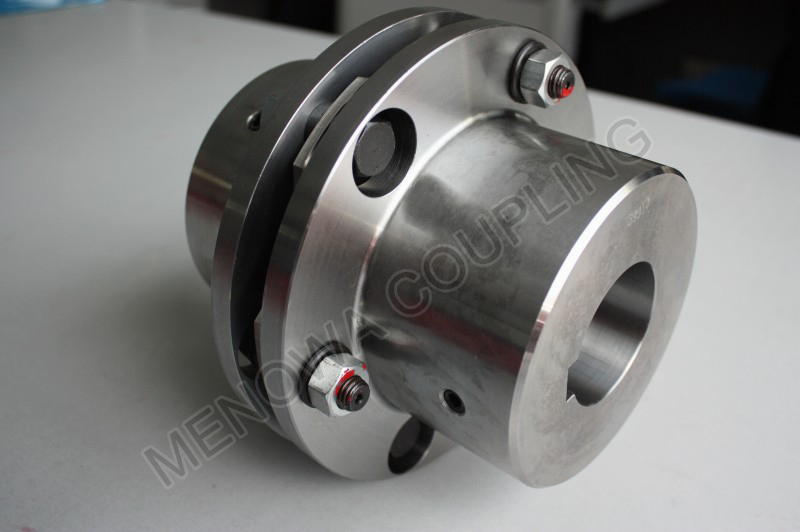
Types of Flexible Diaphragm Coupling

Types of Flexible Diaphragm Coupling
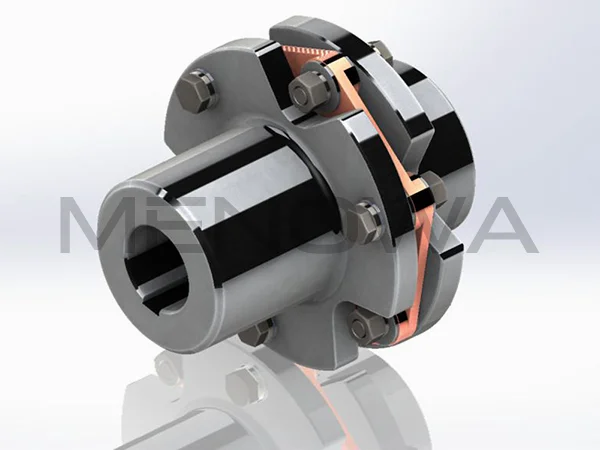
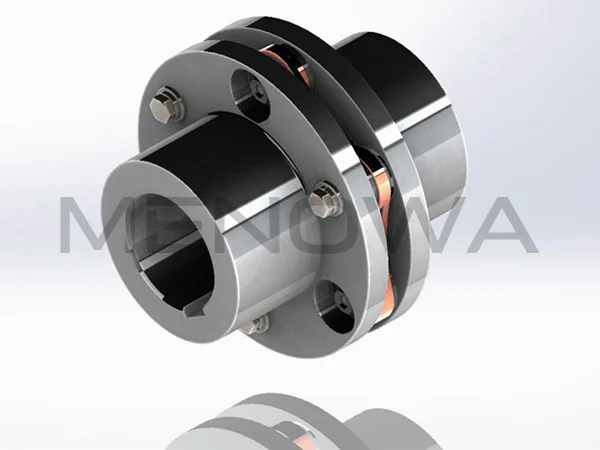
Flexible diaphragm couplings are essential mechanical transmission components designed to connect two rotating shafts while compensating for various forms of shaft misalignment, absorbing vibration, and ensuring precise and efficient torque transmission in mechanical systems. Unlike rigid couplings that lack adaptive deformation capacity and elastic couplings that rely on polymer materials with limited high-temperature resistance, metal flexible diaphragm couplings utilize the elastic deformation of thin metal diaphragms to achieve flexibility, combining high transmission accuracy, excellent structural stability, and strong environmental adaptability. They have become core components in high-speed, high-precision, and high-reliability industrial transmission systems, widely applied in energy equipment, industrial pumps, fan systems, precision machine tools, and automated production lines. Based on structural differences, diaphragm design forms, and functional characteristics, flexible diaphragm couplings can be divided into multiple core types, each with unique structural advantages, performance boundaries, and applicable working scenarios, which determine their differentiated application value in complex industrial environments.
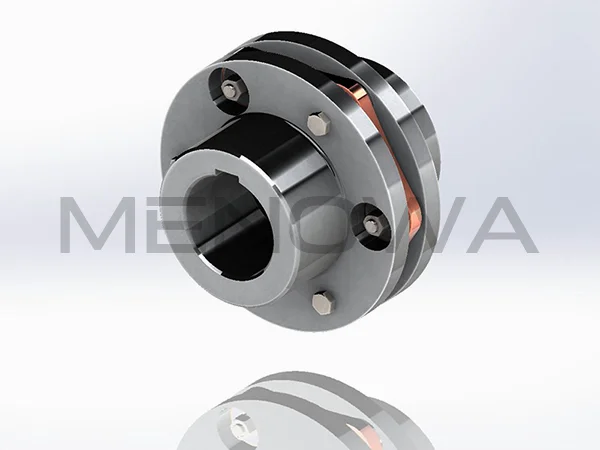
The single diaphragm coupling is the most basic and structurally simplified type of flexible diaphragm coupling, serving as the foundational design prototype for all diaphragm coupling structures. This type of coupling mainly consists of two shaft hubs and a single integral metal diaphragm, with the diaphragm fixed to the two hubs through evenly distributed bolt holes on its surface. The core working principle relies on the tiny elastic deformation of the single metal diaphragm to realize torque transmission and slight misalignment compensation between the driving shaft and the driven shaft. The structural simplicity of the single diaphragm design brings prominent advantages, including fewer assembly parts, compact overall size, lightweight body, and low mechanical inertia, which enables it to respond quickly in high-frequency rotating operations. In terms of transmission performance, the single diaphragm coupling achieves nearly zero backlash torque transmission with extremely high transmission efficiency, ensuring synchronous rotation accuracy of the connected shafts and avoiding rotational speed deviation during power transmission.
However, the functional characteristics of single diaphragm couplings are also restricted by their single-piece diaphragm structure. Due to the limited deformation range of a single metal sheet, this coupling can only adapt to small-scale axial displacement, minor angular deviation, and trace radial misalignment between shafts. It cannot bear large offset loads or frequent alternating deformation, making it unsuitable for working conditions with severe shaft misalignment or complex dynamic loads. In long-term operation, excessive misalignment will cause concentrated stress on the local area of the diaphragm, leading to accelerated fatigue wear and shortened service life. Therefore, single diaphragm couplings are mostly used in low-eccentricity, stable-operation scenarios, such as small-power industrial pumps, low-speed fan equipment, and ordinary precision mechanical transmission systems with fixed shaft positions and small operating load fluctuations. Its outstanding cost performance and stable basic performance make it a mainstream choice for conventional low-load precision transmission scenarios.
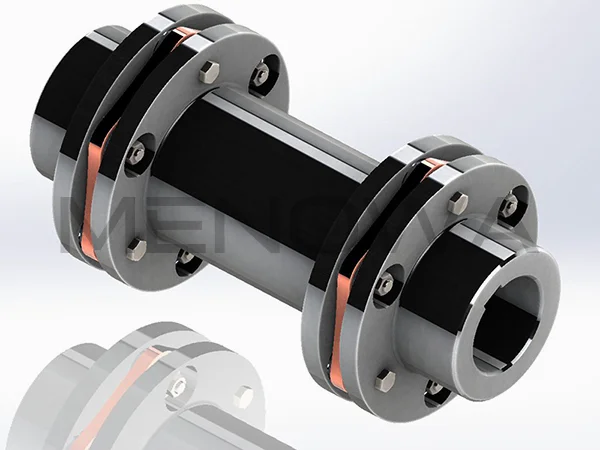
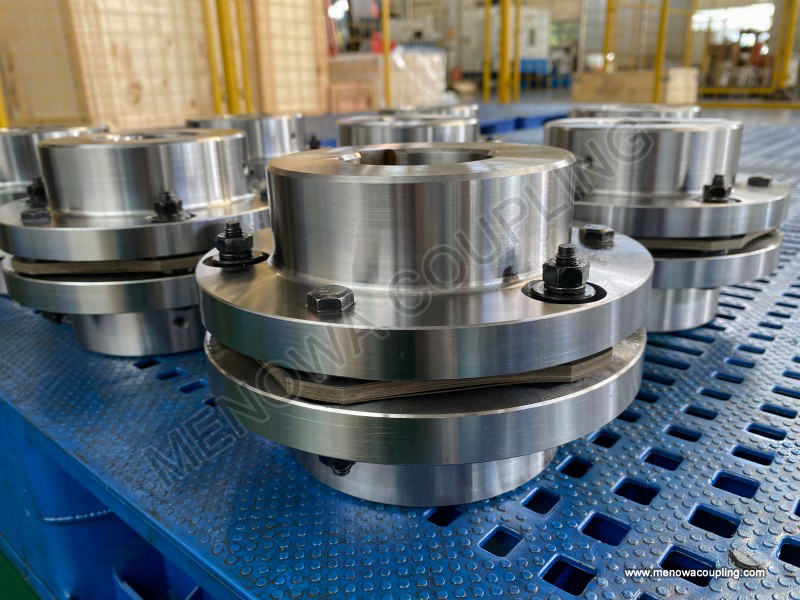
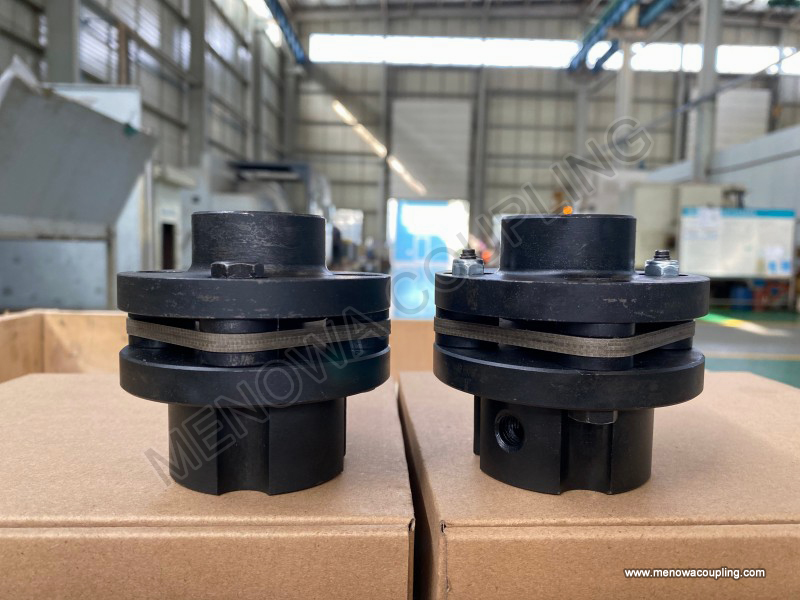
Derived from the single diaphragm structure, the double diaphragm coupling optimizes and upgrades the flexible deformation and misalignment compensation capacity by adopting a double-layer diaphragm combined structure, which is one of the most widely used flexible diaphragm coupling types in modern industrial equipment. The overall structure of the double diaphragm coupling adds an intermediate connecting sleeve between the two shaft hubs, with one metal diaphragm installed at each end of the sleeve, forming an independent flexible deformation unit at both ends of the transmission structure. The two sets of diaphragms cooperate with each other through synchronous elastic deformation, effectively solving the defect of limited compensation range of single diaphragm structures. Compared with single diaphragm couplings, the angular displacement compensation capability of double diaphragm couplings is significantly improved, capable of adapting to medium-scale shaft deflection and offset, and it can simultaneously and independently compensate for axial, radial, and angular three-dimensional misalignment generated during shaft operation.
In terms of operational performance, the double-layer diaphragm dispersion deformation design effectively disperses the stress generated by shaft misalignment, avoiding local stress concentration of a single diaphragm, greatly improving the fatigue resistance and structural durability of the coupling. The intermediate sleeve also increases the axial spacing between the two groups of flexible units, further optimizing the stress distribution state during torque transmission and enabling the coupling to bear larger torque loads and more frequent dynamic impact loads. While maintaining the advantages of zero backlash, high efficiency, and high-precision transmission, the double diaphragm coupling breaks through the application limitations of single diaphragm structures and can adapt to medium and high-speed operating conditions. It is widely applied in medium-power industrial transmission equipment, including medium-sized centrifugal pumps, industrial ventilation fans, general turbomachinery, and conventional automated mechanical transmission systems, becoming a universal type that balances performance and applicability in flexible diaphragm couplings.
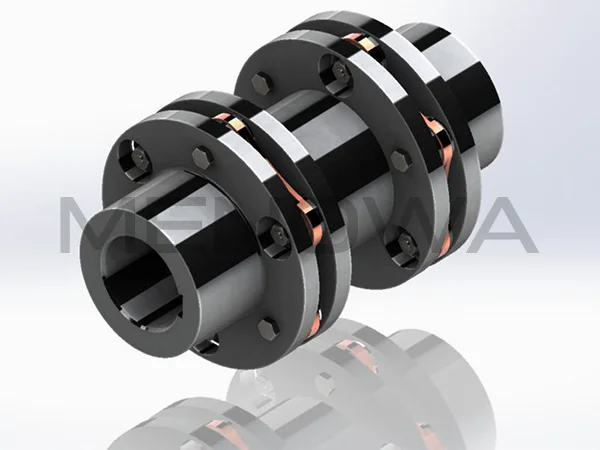
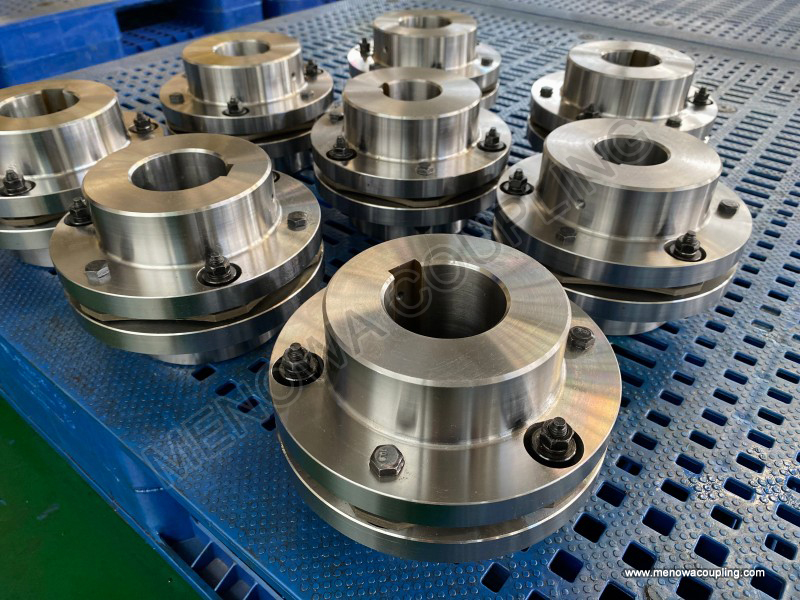
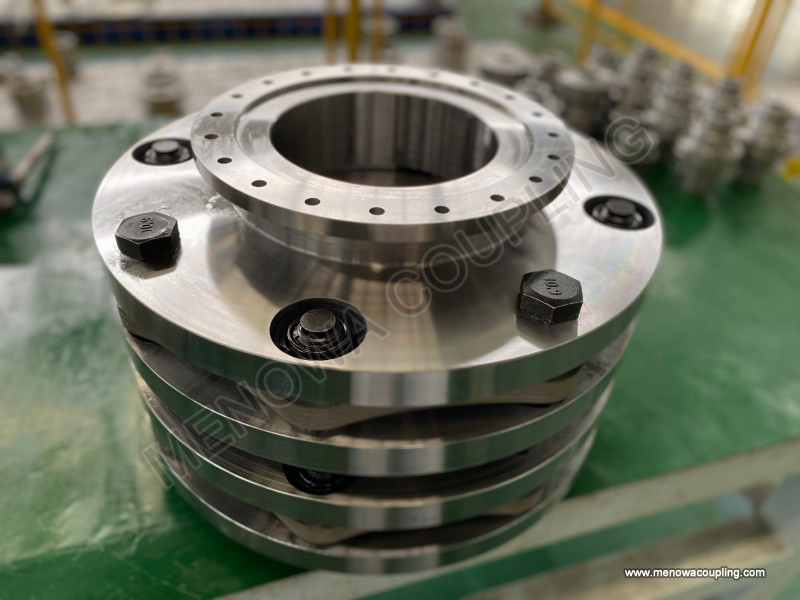
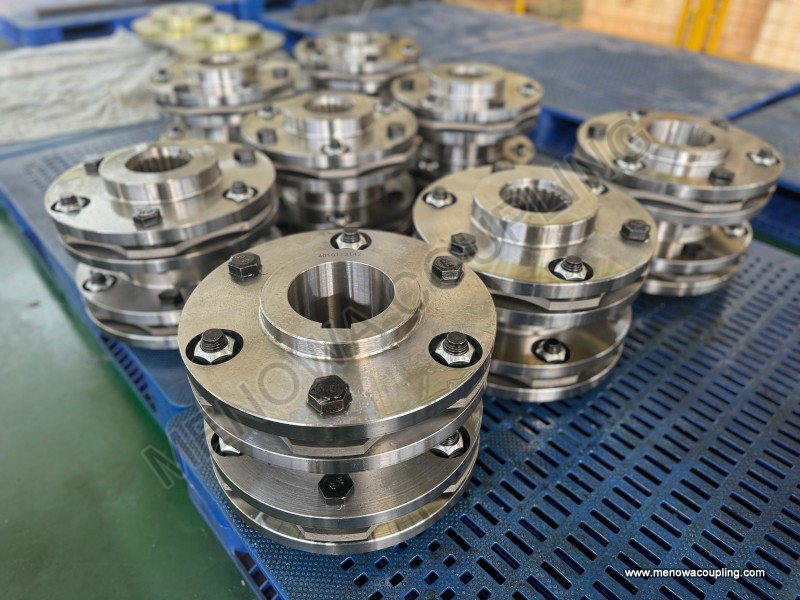
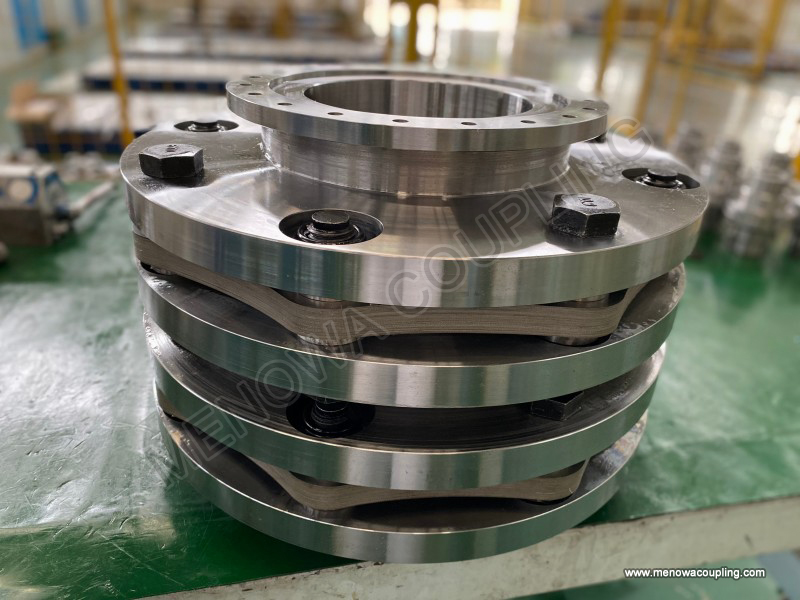
Stacked diaphragm couplings, also known as multi-layer diaphragm couplings, are high-performance derivative types formed by stacking multiple thin metal diaphragms in parallel, representing an important innovation in diaphragm structure optimization. Different from single and double integral diaphragm structures, the flexible core of this coupling is composed of a group of superposed thin metal diaphragms with consistent specifications, which are fixed as a whole through bolt groups and matched with hubs and intermediate connecting structures. The core design advantage of the stacked structure lies in the graded deformation and stress dispersion mechanism. Each thin diaphragm independently undergoes micro elastic deformation during operation, and the superposition of multiple diaphragms realizes large overall flexible deformation while controlling the deformation amount of each single sheet within a safe range.
This structural feature endows stacked diaphragm couplings with extremely strong comprehensive misalignment compensation capability, far exceeding single and double diaphragm products in terms of allowable axial displacement, radial offset, and angular deflection. Meanwhile, the multi-layer stacked structure effectively improves the overall rigidity and torque bearing capacity of the coupling, enabling it to transmit large torque stably under high-speed operating conditions. In terms of fatigue resistance, the shared load of multiple diaphragms reduces the alternating stress borne by a single diaphragm, effectively delaying metal fatigue aging and greatly extending the service life under long-term high-load and high-frequency operation. In addition, the stacked diaphragm design has good fault tolerance; when individual diaphragms have minor fatigue damage, the remaining diaphragms can still maintain basic transmission performance, avoiding sudden equipment shutdown failures and improving the operational stability of mechanical systems.
Due to its excellent comprehensive performance, stacked diaphragm couplings are mainly used in high-end industrial fields with strict requirements on transmission accuracy, load resistance, and operational stability, such as large centrifugal compressors, high-speed turbine equipment, precision aerospace transmission mechanisms, and heavy-duty automated production equipment. It is particularly suitable for working conditions with frequent load changes, slight shaft offset fluctuations, and long-term continuous operation, solving the problem that ordinary single and double diaphragm couplings are difficult to adapt to high-load and high-precision complex working environments.
Contoured diaphragm couplings are a special optimized type in flexible diaphragm coupling series, which abandon the traditional flat diaphragm structure and adopt curved, domed or profiled integral diaphragm design. Different from flat diaphragms that produce rigid concentrated deformation at the bolt connection points when stressed, the special geometric shape of contoured diaphragms enables uniform stress distribution during elastic deformation. The curved structure allows the diaphragm to deform freely along the stress direction under misalignment and torque load, eliminating the stress concentration phenomenon at the edge of bolt holes and connection parts that is common in flat diaphragm couplings.
The performance advantages of contoured diaphragm couplings are mainly reflected in fatigue durability and high-speed stability. The uniform stress distribution greatly reduces the fatigue loss caused by alternating deformation, making the diaphragm have longer service life under long-term high-frequency operation. At the same time, the streamlined curved structure reduces the wind resistance and vibration resistance of the coupling during high-speed rotation, effectively suppressing high-speed resonance and micro-vibration of the transmission system, and maintaining ultra-high transmission stability and accuracy. In terms of misalignment compensation, the profiled diaphragm has more flexible deformation characteristics, which can adapt to irregular tiny misalignment generated by equipment operation, installation errors, and thermal expansion and contraction, ensuring continuous and stable power transmission.
Contoured diaphragm couplings are mostly used in ultra-high-speed, ultra-precision industrial scenarios, such as high-speed precision machine tool spindles, laboratory precision testing equipment, high-speed laser processing equipment, and miniature high-precision transmission systems. For mechanical equipment that requires micron-level transmission accuracy and extremely low vibration noise, the adaptive deformation performance of contoured diaphragm couplings can fully meet the strict operational requirements, which is irreplaceable by traditional flat diaphragm coupling products.
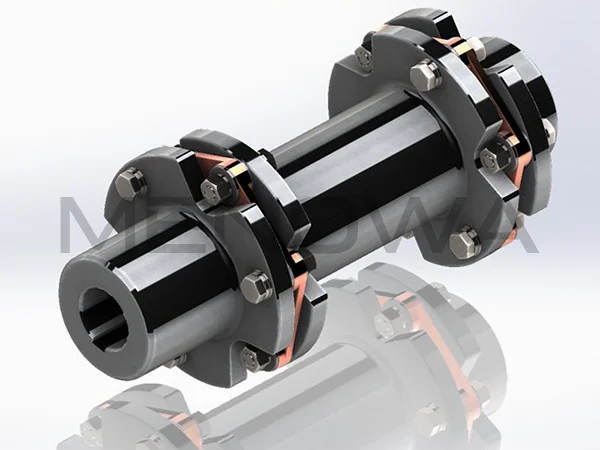
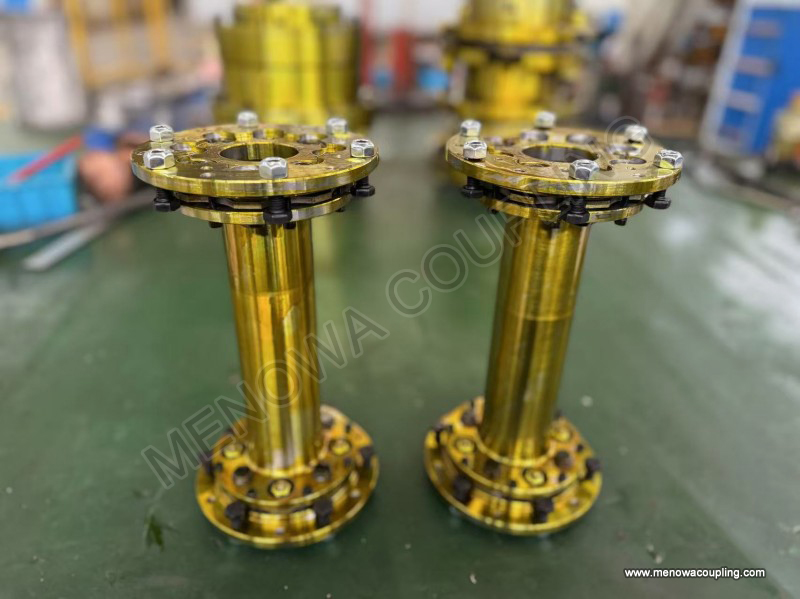
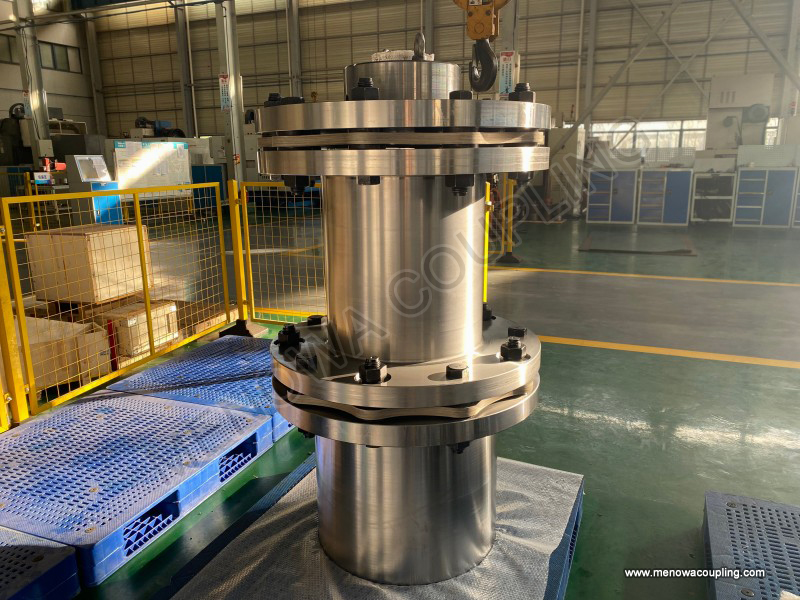
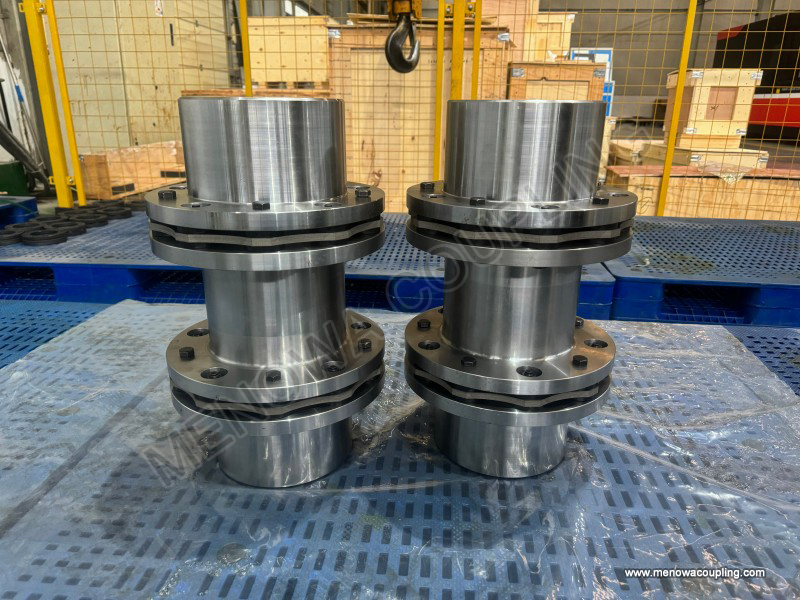
Long-span diaphragm couplings are a structural special type designed for long-distance shaft transmission working conditions, evolved on the basis of double diaphragm structure. This type of coupling adopts an ultra-long intermediate connecting shaft sleeve to connect two groups of independent diaphragm flexible units, greatly increasing the center distance between the driving shaft and the driven shaft. The core design purpose is to solve the transmission problem of long-span spaced shafts in large mechanical equipment, avoiding the problems of insufficient compensation capacity and easy structural vibration of ordinary short-span couplings in long-distance transmission.
In terms of performance, the long-span structure further enhances the angular misalignment and axial displacement compensation capacity of the coupling. The two groups of diaphragms at both ends can independently adapt to the offset deformation of the shafts at both sides, and the long intermediate sleeve can buffer the vibration and torque fluctuation generated during long-distance power transmission, effectively reducing the torsional vibration amplitude of the transmission system. In large-scale industrial equipment, the shaft spacing of power transmission structures is often large, and the installation deviation, foundation settlement, and thermal deformation of the equipment will cause obvious shaft misalignment. Ordinary couplings are difficult to adapt to such working conditions, while long-span diaphragm couplings can stably realize long-distance precise torque transmission and offset compensation.
Long-span diaphragm couplings are mainly applied in large industrial complete sets of equipment, such as large wind power transmission systems, long-distance conveyor equipment, large boiler fan systems, and petrochemical fluid transmission equipment. They provide reliable transmission guarantees for large mechanical systems with scattered shaft positions and long transmission distances, ensuring the stable operation of equipment under complex installation and operating environments.
Reverse mounting diaphragm couplings are a structurally optimized special type designed for limited installation space of equipment shaft heads. Different from the traditional forward bolt fixing mode, this coupling adopts a reverse assembly structure of shaft sleeves and diaphragms, which optimizes the spatial layout of the connecting parts, greatly reducing the axial occupied space of the coupling. The structural innovation of reverse mounting does not change the elastic deformation principle of the diaphragm; it still relies on the flexible deformation of metal diaphragms to complete torque transmission and misalignment compensation, retaining the basic advantages of high precision and zero backlash of diaphragm couplings.
The biggest advantage of reverse mounting diaphragm couplings is their compact installation adaptability. In some precision mechanical equipment and miniature transmission systems, the shaft head operating space is extremely limited, and traditional forward-mounted couplings cannot be installed normally due to excessive axial size. The reverse mounting structure effectively solves the space constraint problem, while ensuring that the misalignment compensation and load-bearing performance are not significantly reduced. This type of coupling is mostly divided into single-sleeve reverse mounting and double-sleeve reverse mounting structures, which can adapt to different space constraints and load levels respectively. It is widely used in precision automation equipment, miniature mechanical transmission mechanisms, and industrial equipment with compact shaft end layout, providing a flexible and reliable connection solution for space-limited transmission scenarios.
In practical industrial applications, the selection of different types of flexible diaphragm couplings needs to comprehensively consider multiple factors such as equipment operating speed, transmission torque, shaft misalignment degree, installation space, and operating environment. Single diaphragm couplings are suitable for low-load, low-eccentricity, and cost-sensitive conventional scenarios; double diaphragm couplings are the preferred universal type for medium-speed and medium-load general industrial equipment; stacked diaphragm couplings are oriented to high-load, high-speed, and high-reliability heavy-duty working conditions; contoured diaphragm couplings focus on ultra-precision and low-vibration high-end transmission scenarios; long-span diaphragm couplings solve the pain point of long-distance shaft transmission; reverse mounting diaphragm couplings adapt to space-limited special installation environments.
As a whole, all types of flexible diaphragm couplings inherit the core advantages of metal flexible transmission, including no wear during operation, no need for lubrication, long service life, high transmission efficiency, and strong environmental adaptability, avoiding the aging and failure problems of elastic couplings using non-metal materials. The structural differentiation of different types expands the application boundary of diaphragm couplings, enabling them to cover almost all precision mechanical transmission scenarios from miniature low-power equipment to large heavy-duty industrial systems. With the continuous upgrading of industrial manufacturing technology, the structural design of flexible diaphragm couplings is also constantly optimized, and various derivative types are further improving in terms of deformation flexibility, load-bearing capacity, and operational stability, providing more reliable core support for the efficient and stable operation of modern mechanical transmission systems.

Types of Flexible Diaphragm Coupling

The single diaphragm coupling is the most basic and structurally simplified type of flexible diaphragm coupling, serving as the foundational design prototype for all diaphragm coupling structures. This type of coupling mainly consists of two shaft hubs and a single integral metal diaphragm, with the diaphragm fixed to the two hubs through evenly distributed bolt holes on its surface. The core working principle relies on the tiny elastic deformation of the single metal diaphragm to realize torque transmission and slight misalignment compensation between the driving shaft and the driven shaft. The structural simplicity of the single diaphragm design brings prominent advantages, including fewer assembly parts, compact overall size, lightweight body, and low mechanical inertia, which enables it to respond quickly in high-frequency rotating operations. In terms of transmission performance, the single diaphragm coupling achieves nearly zero backlash torque transmission with extremely high transmission efficiency, ensuring synchronous rotation accuracy of the connected shafts and avoiding rotational speed deviation during power transmission.

However, the functional characteristics of single diaphragm couplings are also restricted by their single-piece diaphragm structure. Due to the limited deformation range of a single metal sheet, this coupling can only adapt to small-scale axial displacement, minor angular deviation, and trace radial misalignment between shafts. It cannot bear large offset loads or frequent alternating deformation, making it unsuitable for working conditions with severe shaft misalignment or complex dynamic loads. In long-term operation, excessive misalignment will cause concentrated stress on the local area of the diaphragm, leading to accelerated fatigue wear and shortened service life. Therefore, single diaphragm couplings are mostly used in low-eccentricity, stable-operation scenarios, such as small-power industrial pumps, low-speed fan equipment, and ordinary precision mechanical transmission systems with fixed shaft positions and small operating load fluctuations. Its outstanding cost performance and stable basic performance make it a mainstream choice for conventional low-load precision transmission scenarios.

Derived from the single diaphragm structure, the double diaphragm coupling optimizes and upgrades the flexible deformation and misalignment compensation capacity by adopting a double-layer diaphragm combined structure, which is one of the most widely used flexible diaphragm coupling types in modern industrial equipment. The overall structure of the double diaphragm coupling adds an intermediate connecting sleeve between the two shaft hubs, with one metal diaphragm installed at each end of the sleeve, forming an independent flexible deformation unit at both ends of the transmission structure. The two sets of diaphragms cooperate with each other through synchronous elastic deformation, effectively solving the defect of limited compensation range of single diaphragm structures. Compared with single diaphragm couplings, the angular displacement compensation capability of double diaphragm couplings is significantly improved, capable of adapting to medium-scale shaft deflection and offset, and it can simultaneously and independently compensate for axial, radial, and angular three-dimensional misalignment generated during shaft operation.

In terms of operational performance, the double-layer diaphragm dispersion deformation design effectively disperses the stress generated by shaft misalignment, avoiding local stress concentration of a single diaphragm, greatly improving the fatigue resistance and structural durability of the coupling. The intermediate sleeve also increases the axial spacing between the two groups of flexible units, further optimizing the stress distribution state during torque transmission and enabling the coupling to bear larger torque loads and more frequent dynamic impact loads. While maintaining the advantages of zero backlash, high efficiency, and high-precision transmission, the double diaphragm coupling breaks through the application limitations of single diaphragm structures and can adapt to medium and high-speed operating conditions. It is widely applied in medium-power industrial transmission equipment, including medium-sized centrifugal pumps, industrial ventilation fans, general turbomachinery, and conventional automated mechanical transmission systems, becoming a universal type that balances performance and applicability in flexible diaphragm couplings.

Stacked diaphragm couplings, also known as multi-layer diaphragm couplings, are high-performance derivative types formed by stacking multiple thin metal diaphragms in parallel, representing an important innovation in diaphragm structure optimization. Different from single and double integral diaphragm structures, the flexible core of this coupling is composed of a group of superposed thin metal diaphragms with consistent specifications, which are fixed as a whole through bolt groups and matched with hubs and intermediate connecting structures. The core design advantage of the stacked structure lies in the graded deformation and stress dispersion mechanism. Each thin diaphragm independently undergoes micro elastic deformation during operation, and the superposition of multiple diaphragms realizes large overall flexible deformation while controlling the deformation amount of each single sheet within a safe range.

This structural feature endows stacked diaphragm couplings with extremely strong comprehensive misalignment compensation capability, far exceeding single and double diaphragm products in terms of allowable axial displacement, radial offset, and angular deflection. Meanwhile, the multi-layer stacked structure effectively improves the overall rigidity and torque bearing capacity of the coupling, enabling it to transmit large torque stably under high-speed operating conditions. In terms of fatigue resistance, the shared load of multiple diaphragms reduces the alternating stress borne by a single diaphragm, effectively delaying metal fatigue aging and greatly extending the service life under long-term high-load and high-frequency operation. In addition, the stacked diaphragm design has good fault tolerance; when individual diaphragms have minor fatigue damage, the remaining diaphragms can still maintain basic transmission performance, avoiding sudden equipment shutdown failures and improving the operational stability of mechanical systems.

Due to its excellent comprehensive performance, stacked diaphragm couplings are mainly used in high-end industrial fields with strict requirements on transmission accuracy, load resistance, and operational stability, such as large centrifugal compressors, high-speed turbine equipment, precision aerospace transmission mechanisms, and heavy-duty automated production equipment. It is particularly suitable for working conditions with frequent load changes, slight shaft offset fluctuations, and long-term continuous operation, solving the problem that ordinary single and double diaphragm couplings are difficult to adapt to high-load and high-precision complex working environments.

Contoured diaphragm couplings are a special optimized type in flexible diaphragm coupling series, which abandon the traditional flat diaphragm structure and adopt curved, domed or profiled integral diaphragm design. Different from flat diaphragms that produce rigid concentrated deformation at the bolt connection points when stressed, the special geometric shape of contoured diaphragms enables uniform stress distribution during elastic deformation. The curved structure allows the diaphragm to deform freely along the stress direction under misalignment and torque load, eliminating the stress concentration phenomenon at the edge of bolt holes and connection parts that is common in flat diaphragm couplings.

The performance advantages of contoured diaphragm couplings are mainly reflected in fatigue durability and high-speed stability. The uniform stress distribution greatly reduces the fatigue loss caused by alternating deformation, making the diaphragm have longer service life under long-term high-frequency operation. At the same time, the streamlined curved structure reduces the wind resistance and vibration resistance of the coupling during high-speed rotation, effectively suppressing high-speed resonance and micro-vibration of the transmission system, and maintaining ultra-high transmission stability and accuracy. In terms of misalignment compensation, the profiled diaphragm has more flexible deformation characteristics, which can adapt to irregular tiny misalignment generated by equipment operation, installation errors, and thermal expansion and contraction, ensuring continuous and stable power transmission.

Contoured diaphragm couplings are mostly used in ultra-high-speed, ultra-precision industrial scenarios, such as high-speed precision machine tool spindles, laboratory precision testing equipment, high-speed laser processing equipment, and miniature high-precision transmission systems. For mechanical equipment that requires micron-level transmission accuracy and extremely low vibration noise, the adaptive deformation performance of contoured diaphragm couplings can fully meet the strict operational requirements, which is irreplaceable by traditional flat diaphragm coupling products.

Long-span diaphragm couplings are a structural special type designed for long-distance shaft transmission working conditions, evolved on the basis of double diaphragm structure. This type of coupling adopts an ultra-long intermediate connecting shaft sleeve to connect two groups of independent diaphragm flexible units, greatly increasing the center distance between the driving shaft and the driven shaft. The core design purpose is to solve the transmission problem of long-span spaced shafts in large mechanical equipment, avoiding the problems of insufficient compensation capacity and easy structural vibration of ordinary short-span couplings in long-distance transmission.

In terms of performance, the long-span structure further enhances the angular misalignment and axial displacement compensation capacity of the coupling. The two groups of diaphragms at both ends can independently adapt to the offset deformation of the shafts at both sides, and the long intermediate sleeve can buffer the vibration and torque fluctuation generated during long-distance power transmission, effectively reducing the torsional vibration amplitude of the transmission system. In large-scale industrial equipment, the shaft spacing of power transmission structures is often large, and the installation deviation, foundation settlement, and thermal deformation of the equipment will cause obvious shaft misalignment. Ordinary couplings are difficult to adapt to such working conditions, while long-span diaphragm couplings can stably realize long-distance precise torque transmission and offset compensation.

Long-span diaphragm couplings are mainly applied in large industrial complete sets of equipment, such as large wind power transmission systems, long-distance conveyor equipment, large boiler fan systems, and petrochemical fluid transmission equipment. They provide reliable transmission guarantees for large mechanical systems with scattered shaft positions and long transmission distances, ensuring the stable operation of equipment under complex installation and operating environments.

Reverse mounting diaphragm couplings are a structurally optimized special type designed for limited installation space of equipment shaft heads. Different from the traditional forward bolt fixing mode, this coupling adopts a reverse assembly structure of shaft sleeves and diaphragms, which optimizes the spatial layout of the connecting parts, greatly reducing the axial occupied space of the coupling. The structural innovation of reverse mounting does not change the elastic deformation principle of the diaphragm; it still relies on the flexible deformation of metal diaphragms to complete torque transmission and misalignment compensation, retaining the basic advantages of high precision and zero backlash of diaphragm couplings.

The biggest advantage of reverse mounting diaphragm couplings is their compact installation adaptability. In some precision mechanical equipment and miniature transmission systems, the shaft head operating space is extremely limited, and traditional forward-mounted couplings cannot be installed normally due to excessive axial size. The reverse mounting structure effectively solves the space constraint problem, while ensuring that the misalignment compensation and load-bearing performance are not significantly reduced. This type of coupling is mostly divided into single-sleeve reverse mounting and double-sleeve reverse mounting structures, which can adapt to different space constraints and load levels respectively. It is widely used in precision automation equipment, miniature mechanical transmission mechanisms, and industrial equipment with compact shaft end layout, providing a flexible and reliable connection solution for space-limited transmission scenarios.

In practical industrial applications, the selection of different types of flexible diaphragm couplings needs to comprehensively consider multiple factors such as equipment operating speed, transmission torque, shaft misalignment degree, installation space, and operating environment. Single diaphragm couplings are suitable for low-load, low-eccentricity, and cost-sensitive conventional scenarios; double diaphragm couplings are the preferred universal type for medium-speed and medium-load general industrial equipment; stacked diaphragm couplings are oriented to high-load, high-speed, and high-reliability heavy-duty working conditions; contoured diaphragm couplings focus on ultra-precision and low-vibration high-end transmission scenarios; long-span diaphragm couplings solve the pain point of long-distance shaft transmission; reverse mounting diaphragm couplings adapt to space-limited special installation environments.

As a whole, all types of flexible diaphragm couplings inherit the core advantages of metal flexible transmission, including no wear during operation, no need for lubrication, long service life, high transmission efficiency, and strong environmental adaptability, avoiding the aging and failure problems of elastic couplings using non-metal materials. The structural differentiation of different types expands the application boundary of diaphragm couplings, enabling them to cover almost all precision mechanical transmission scenarios from miniature low-power equipment to large heavy-duty industrial systems. With the continuous upgrading of industrial manufacturing technology, the structural design of flexible diaphragm couplings is also constantly optimized, and various derivative types are further improving in terms of deformation flexibility, load-bearing capacity, and operational stability, providing more reliable core support for the efficient and stable operation of modern mechanical transmission systems.

Post Date: May 25, 2026

https://www.menowacoupling.com/china-coupling/types-of-flexible-diaphragm-coupling.html

Related Articles

  • Types of Diaphragm Coupling

    Diaphragm couplings stand as a vital category of flexible metal couplings widely utilized in modern mechanical power transmission systems, designed to connect driving and driven shafts while delivering stable torque transfer and accommodating various forms of shaft misalignment through the elastic deformation of metal d…
  • Structure of Flexible Diaphragm Coupling

    Flexible diaphragm coupling serves as a vital mechanical transmission component widely applied in high-precision and high-speed mechanical transmission systems, relying on elastic deformation of metal diaphragm components to realize torque transmission and shaft misalignment compensation. Different from traditional flex…
  • Coaxiality of Flexible Diaphragm Coupling

    Coaxiality is a critical geometric parameter that directly determines the performance, reliability, and service life of flexible diaphragm couplings. As a high-performance flexible coupling widely used in various industrial fields, the flexible diaphragm coupling relies on the elastic deformation of the diaphragm to com…
  • Flexible Diaphragm Coupling Supplier

    In the realm of mechanical power transmission, flexible diaphragm couplings stand out as a critical component that ensures efficient, reliable, and precise torque transfer between rotating shafts. As a dedicated supplier of these essential mechanical parts, we focus on delivering high-quality flexible diaphragm coupling…
  • Characteristics of Flexible Diaphragm Coupling

    A flexible diaphragm coupling is a high-performance flexible coupling that uses metal elastic elements to connect two rotating shafts in industrial machinery, enabling efficient torque transmission while accommodating various types of misalignment between the shafts. Unlike many other coupling types that rely on rubber …
  • What is Shim Pack Coupling

    In the vast and interconnected field of mechanical power transmission systems, the reliable connection between rotating shafts stands as one of the most foundational and functionally critical elements for the stable operation of all types of industrial machinery and mechanical equipment. Every rotating mechanical device…
  • Components of Flexible Diaphragm Coupling

    A flexible diaphragm coupling is a high-performance mechanical component widely used in various industrial applications to connect two shafts and transmit torque while compensating for relative displacements between them. Unlike rigid couplings that require precise alignment, flexible diaphragm couplings utilize the ela…
  • Flexible Diaphragm Coupling Price

    In the realm of industrial power transmission, flexible diaphragm couplings stand out as a critical component, valued for their ability to connect two rotating shafts while compensating for misalignments, absorbing minor vibrations, and ensuring efficient torque transfer. As businesses across various industries—from ma…
  • Size Chart of Flexible Diaphragm Coupling

    The size chart of flexible diaphragm coupling is an essential reference tool for engineers, procurement personnel, and maintenance technicians in various industrial fields, as it provides precise dimensional parameters and matching guidelines to ensure the coupling can perfectly adapt to different equipment and working …
  • Types of Shim Pack Coupling

    Shim pack couplings stand as a vital category of metal flexible transmission components widely applied in modern industrial mechanical shaft connection systems, serving the core purpose of stable torque transmission between driving and driven equipment while effectively absorbing and compensating for various minor misal…