Double Diaphragm Coupling
In the complex and interconnected operating system of modern industrial mechanical transmission equipment, the connection and power transmission components between driving equipment and driven equipment undertake the core basic task of realizing stable torque transmission, rotational speed synchronization and dynamic operation coordination of the entire mechanical system. Among various types of transmission connection components developed and applied in the industrial field over the years, diaphragm couplings have gradually become a key configuration widely adopted in high-precision transmission, high-speed operation and heavy-load working condition scenarios by virtue of their unique metal elastic deformation transmission mode, compact structural layout and reliable long-term operation performance. As an optimized and upgraded structural form of the basic diaphragm coupling series, double diaphragm coupling further optimizes the stress distribution state, multi-dimensional misalignment compensation capacity and overall operation stability of the product on the basis of retaining all the excellent basic characteristics of single diaphragm coupling, and effectively makes up for the structural performance limitations of single diaphragm configuration in coping with complex installation deviations, long-term alternating load impact and continuous high-strength operation working conditions. This type of coupling relies on two sets of independent diaphragm elastic components matched with intermediate connecting structures to realize flexible torque transmission and multi-directional displacement compensation, abandoning the traditional rigid connection mode that is prone to rigid impact and component wear, and avoiding the performance defects of flexible coupling products using non-metal elastic materials that are easy to aging, deform and fail under extreme temperature and long-term load cycling. With the continuous upgrading of industrial manufacturing technology and the continuous improvement of mechanical equipment operation precision requirements, double diaphragm coupling has been gradually applied in more industrial subdivisions, covering precision numerical control processing equipment, large metallurgical rolling production lines, petrochemical fluid delivery equipment, mining heavy-duty transmission machinery, papermaking and textile continuous production equipment and many other core industrial fields, and has become an indispensable basic guarantee for the stable and efficient operation of modern mechanical transmission systems.
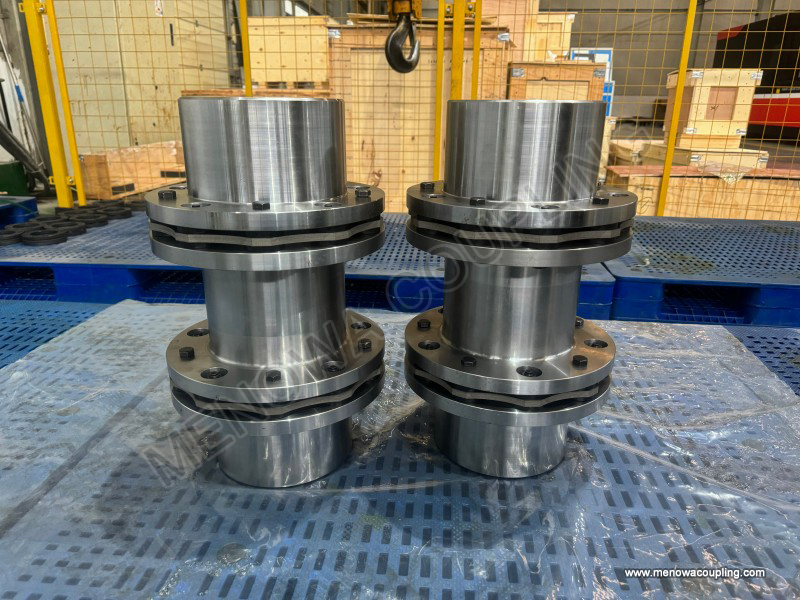
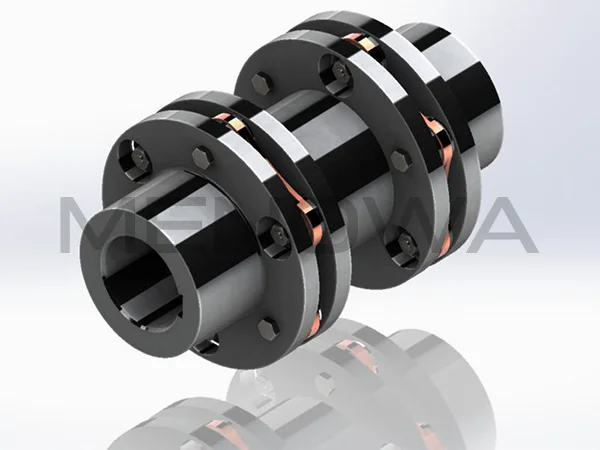
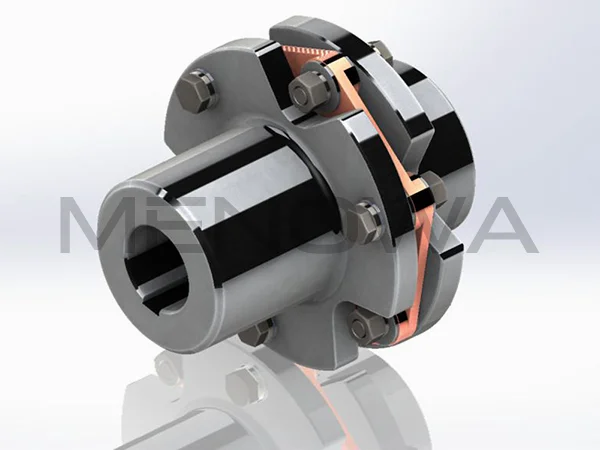
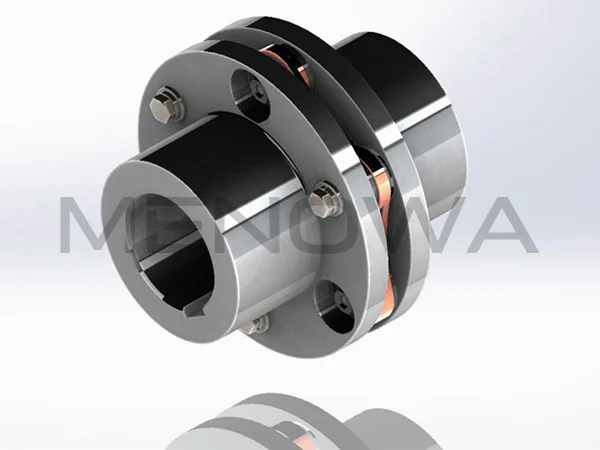
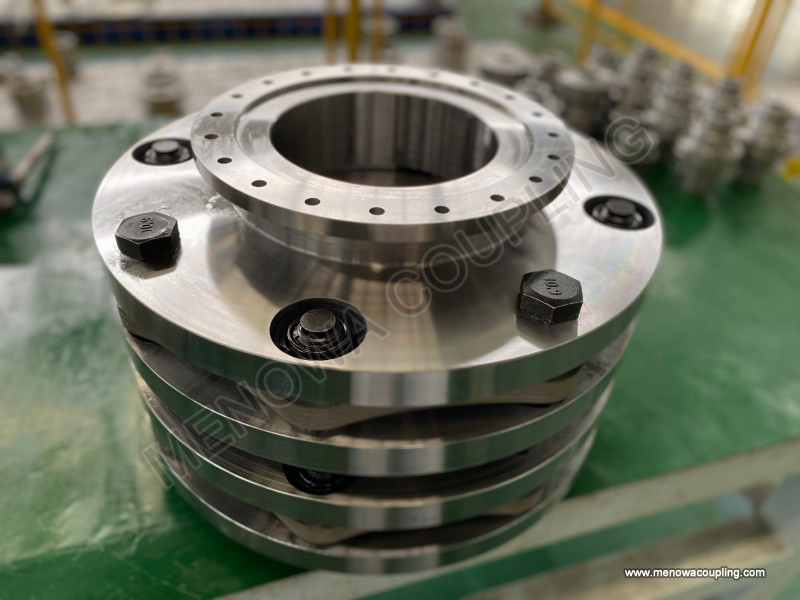
The basic structural composition of double diaphragm coupling follows the design concept of symmetrical balance and modular assembly, and each component is designed and processed with precise dimensional tolerance and mechanical performance matching to ensure the coordination and stability of the whole structure in the process of torque transmission and deformation compensation. The core functional components that constitute the main body of the double diaphragm coupling mainly include two groups of metal diaphragm elastic components with laminated superposition structure, two precision connecting flanges connected with the driving shaft and driven shaft respectively, a middle spacing connecting sleeve arranged between the two groups of diaphragms, and high-strength fastening bolt assemblies and matching buffer and limit auxiliary parts used for connecting and fixing all structural parts. Each component has clear functional division and mutual coordination and restriction, and there is no redundant structural design in the overall layout, which not only ensures the compact overall structure of the coupling and small overall installation space occupation, but also realizes the reasonable distribution of structural stress and the effective play of elastic deformation performance. The metal diaphragm group, as the core elastic force-bearing and deformation functional part of the double diaphragm coupling, is usually made of high-quality stainless steel thin plate materials with excellent comprehensive mechanical properties, and multiple thin steel plates are stacked and combined according to the actual transmission torque demand and working condition characteristics to form an integrated diaphragm assembly. This laminated stacking structure design can effectively disperse the concentrated stress generated during torque transmission and misalignment deformation, avoid local stress concentration and single-point fatigue damage of a single thin plate, and greatly improve the overall fatigue resistance and repeated deformation resistance of the diaphragm group in long-term cyclic operation. The shape of the diaphragm is designed with a special geometric profile through mechanical simulation and stress calculation, which can ensure that the diaphragm can produce uniform and regular elastic deformation under the action of torque and various installation misalignments, without abnormal local deformation or stress accumulation, and maintain the stability of transmission performance under different deformation degrees.
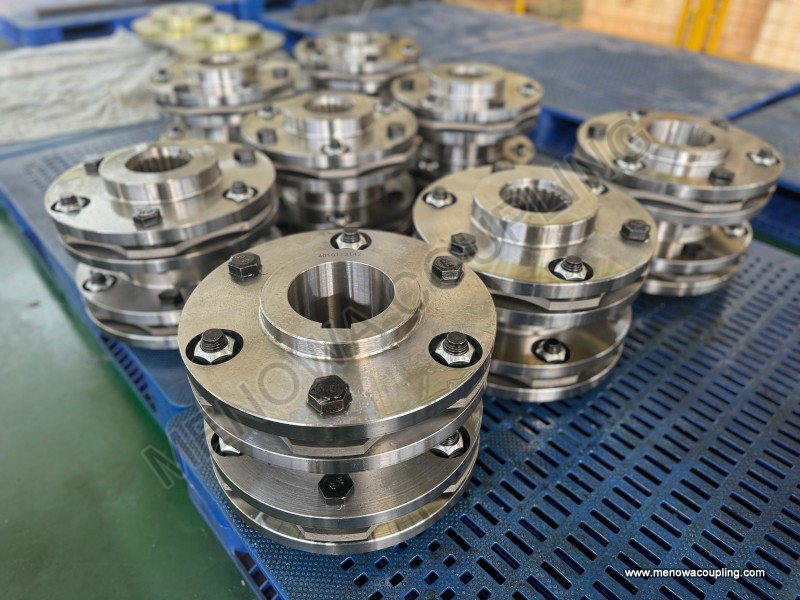
The connecting flanges on both sides of the double diaphragm coupling are processed by high-precision integral forging and cutting process, with high structural rigidity and dimensional machining accuracy. The inner hole of the flange is designed to match the shaft diameters of the driving equipment and driven equipment, and the matching connection structure is processed according to the actual installation and transmission needs, realizing the stable assembly and fixation between the coupling and the equipment shaft. The middle spacing sleeve between the two groups of diaphragms is an important structural part that distinguishes the double diaphragm coupling from the single diaphragm coupling and undertakes the key function of stress balance and deformation coordination. The setting of the middle spacing sleeve can separate the two groups of diaphragm elastic components at a reasonable distance, so that each group of diaphragms can independently produce elastic deformation according to the actual misalignment state of the shaft body on one side, and the deformation coordination between the two groups of diaphragms is realized through the intermediate connecting sleeve, effectively dispersing the axial force, bending moment and shear force generated by installation misalignment and torque transmission. This structural arrangement fundamentally avoids the problem that the single diaphragm coupling bears all the deformation stress and bending moment by a single group of diaphragms, reduces the load pressure of a single elastic component, and significantly prolongs the service life of the coupling under long-term continuous operation. The high-strength fastening bolt assemblies used for connection and fixation are processed according to strict mechanical strength standards, and the tightening torque during assembly is accurately calculated and controlled to ensure the stable connection between flanges, diaphragms and intermediate sleeves, preventing structural loosening, relative displacement and connection failure caused by vibration impact and alternating load during high-speed operation. All connecting bolt holes are processed with high precision to ensure the close fit between bolts and hole walls, reduce assembly gaps, and maintain the zero-backlash transmission state of the coupling in the torque transmission process.
The core working principle of double diaphragm coupling is based on the elastic deformation characteristics of metal diaphragm materials and the symmetrical stress balance mechanism of double diaphragm structure, realizing flexible transmission of rotational torque and automatic compensation of multi-dimensional shaft misalignment in mechanical transmission systems. In the actual operation process of mechanical equipment, due to the influence of various objective factors such as mechanical equipment manufacturing errors, installation and construction deviations, thermal expansion and contraction of components during equipment operation, slight vibration and displacement during long-term load operation, it is impossible to achieve absolute coaxial alignment between the driving shaft and the driven shaft of the transmission system, and different degrees of axial misalignment, angular misalignment and radial misalignment will inevitably occur between the two shafts. These misalignment deviations will produce additional bending moment, shear force and radial tension and compression load on the rigid connection parts of the transmission system. If these additional loads cannot be effectively buffered and compensated, they will directly act on the driving equipment bearings, shaft bodies and transmission components, causing accelerated wear of parts, increased equipment operation vibration, aggravated transmission noise, and even early fatigue damage and failure of key components in severe cases, affecting the normal and stable operation of the entire mechanical system. The double diaphragm coupling can well solve this common problem in mechanical transmission, relying on the good elastic deformation ability of the two groups of metal diaphragms, when various misalignments occur between the driving shaft and the driven shaft, the diaphragms will produce corresponding micro elastic deformation along with the relative displacement between the shafts, and absorb and offset the additional stress and mechanical load generated by the misalignment through the elastic deformation of the metal materials itself.
In the process of torque transmission, the rotational power output by the driving equipment is transmitted to the driving side flange of the double diaphragm coupling through the shaft body, and then the torque is sequentially transmitted to the intermediate spacing sleeve through the deformation coordination of the driving side diaphragm group, and then transmitted to the driven side flange and the driven equipment shaft through the driven side diaphragm group, realizing the synchronous rotation and stable power transmission of the driving and driven shafts. In this whole transmission process, the double diaphragm structure will not produce any rigid friction and collision between components, and there is no relative sliding between all connecting parts, realizing zero-backlash torque transmission, ensuring the synchronization and accuracy of rotational speed and torque transmission, and meeting the high-precision operation requirements of various precision mechanical equipment. When the equipment runs at high speed or under alternating load, the symmetrical double diaphragm layout can balance the centrifugal force generated by the rotating structure and the alternating bending moment generated by load fluctuation, avoid the unbalanced vibration problem caused by asymmetric stress distribution, and maintain the smooth operation state of the coupling and the whole transmission system. Compared with the single diaphragm coupling, the double diaphragm structure can bear larger deformation range and more complex combined misalignment deviations, and the stress generated by deformation is shared by two groups of diaphragms, so the stress borne by each single diaphragm group is significantly reduced, the structural fatigue damage probability is effectively reduced, and the operation stability and service life under long-term cyclic load are greatly improved.
Double diaphragm coupling has excellent comprehensive performance characteristics in many aspects, which makes it show outstanding application advantages compared with traditional gear couplings, chain couplings, rubber flexible couplings and other types of coupling products, and adapts to more complex and harsh industrial operation working conditions. First of all, this type of coupling has high torsional rigidity and stable transmission accuracy, the metal diaphragm elastic component has good structural rigidity in the torque transmission direction, will not produce excessive torsional deformation during torque transmission, can maintain accurate torque and rotational speed transmission ratio, and will not cause transmission power loss and rotational speed synchronization deviation due to elastic deformation. At the same time, the zero-backlash transmission characteristic ensures that there is no transmission hysteresis and clearance impact in the forward and reverse rotation switching process of the equipment, which is particularly suitable for precision transmission equipment that requires frequent forward and reverse operation and high positioning accuracy. Secondly, the double diaphragm coupling has excellent multi-dimensional misalignment compensation ability, which can effectively compensate axial displacement, angular displacement and radial displacement between the driving and driven shafts simultaneously. The double diaphragm matching intermediate sleeve structure makes its angular compensation performance far better than that of single diaphragm coupling and traditional rigid couplings, and can cope with large installation deviations and shaft displacement changes caused by thermal deformation of equipment during operation. The compensation process relies entirely on the elastic deformation of metal materials, without additional energy consumption and component wear, and the compensation effect is stable and durable.
In terms of environmental adaptability and operation durability, double diaphragm coupling adopts all-metal structural design, without any non-metal vulnerable parts such as rubber and plastic, so it can work normally in a wide temperature range, and is not affected by high temperature heat radiation, low temperature cold brittleness, humid humidity, dust corrosion and other harsh environmental factors in industrial production workshops. The metal diaphragm material has good corrosion resistance and aging resistance, and will not deteriorate in performance or deform and fail due to long-term exposure to harsh working environments. The whole structure does not need to be filled with lubricating grease and other lubricating materials during operation, realizing maintenance-free long-term operation, avoiding the equipment shutdown maintenance and lubricant replacement work required by gear couplings and other products, reducing the daily operation and maintenance cost of industrial equipment and improving the overall operation efficiency of the production line. In addition, the double diaphragm coupling has low moment of inertia due to its compact structural design and lightweight component configuration, which can adapt to high-speed rotation operation working conditions, will not produce large centrifugal force and unbalanced vibration during high-speed operation, and has good vibration damping and noise reduction effects. The elastic deformation of the diaphragm can absorb part of the vibration impact generated by equipment load fluctuation and mechanical operation, reduce the vibration and noise of the entire transmission system, and create a more stable operating environment for mechanical equipment.
In the actual industrial installation and application process, the correct installation operation and reasonable working condition matching are important prerequisites to ensure the stable performance and long service life of double diaphragm coupling. Although the product itself has excellent misalignment compensation ability, excessive installation deviation beyond the allowable deformation range of the diaphragm will still cause long-term overload deformation of the diaphragm group, resulting in accelerated fatigue damage and shortened service life. Therefore, in the equipment installation and debugging stage, construction and maintenance personnel need to strictly carry out coaxial alignment calibration according to the installation technical specifications, minimize the initial installation misalignment between the driving shaft and the driven shaft, and control all kinds of displacement deviations within the optimal compensation range of the double diaphragm coupling. In the assembly process of the coupling components, the fastening bolts need to be tightened evenly in accordance with the specified torque sequence and tightening standard, to avoid uneven bolt tightening force leading to local stress concentration of the diaphragm and flange deformation, affecting the assembly accuracy and transmission stability. After the installation is completed, it is necessary to conduct no-load test operation and load debugging operation of the equipment, check whether the coupling has abnormal vibration, abnormal noise and local heating during operation, confirm that the deformation and stress state of the coupling are normal, and then put it into formal production and operation.
In the daily operation and maintenance management of double diaphragm coupling, due to its all-metal maintenance-free structural design, the daily maintenance work is relatively simple and convenient, without regular replacement of wearing parts and supplementary lubricating materials. The regular maintenance work only needs to regularly check the overall operation state of the coupling, observe whether there is abnormal vibration and noise during equipment operation, check whether the connecting bolts have loosening signs, and confirm whether the diaphragm group has abnormal deformation, corrosion and damage. For equipment operating in harsh working environments such as high dust and strong corrosion, regular surface cleaning and anti-corrosion protection treatment can be carried out on the outer surface of the coupling to avoid long-term accumulation of dust and corrosive media affecting the structural performance of the components. In the long-term operation process, with the increase of service time and the accumulation of alternating load cycles, the diaphragm group will produce slight fatigue aging inevitably. Therefore, during the regular equipment overhaul cycle, the diaphragm components should be inspected for fatigue deformation and micro damage, and the aging and failed diaphragm groups should be replaced in a timely manner to ensure the continuous and safe operation of the transmission system. Scientific and standardized installation debugging and daily maintenance management can give full play to the performance advantages of double diaphragm coupling, extend its effective service life, and create stable and reliable basic conditions for the long-term operation of industrial mechanical equipment.
Double diaphragm coupling has been widely used in many core industrial production fields due to its excellent structural performance, stable transmission effect, strong environmental adaptability and low maintenance cost, and has become the preferred transmission connection configuration for many high-precision, high-speed and heavy-load mechanical equipment. In the field of precision mechanical processing and manufacturing, such as numerical control machine tools, precision grinding equipment and automated processing production lines, the high-precision zero-backlash transmission characteristic of double diaphragm coupling can ensure the precise synchronization of spindle rotation and feed transmission, meet the high-precision processing and positioning requirements of mechanical parts, avoid processing errors and product quality problems caused by transmission clearance and speed deviation. In the metallurgical industry, large rolling mills, steel transmission equipment and metal forging machinery need to bear heavy load torque and frequent load impact during operation, the double diaphragm coupling can stably transmit heavy torque, buffer load impact, and compensate the shaft displacement caused by thermal expansion and contraction of metallurgical equipment during high-temperature operation, ensuring the continuous and stable operation of the metallurgical rolling production line.
In the petrochemical industry, various fluid delivery pumps, compressors, chemical reaction kettle transmission equipment and pipeline pressurization equipment often work in harsh environments such as high temperature, high pressure and corrosive media, the all-metal structure of double diaphragm coupling can adapt to these harsh working conditions, without aging and failure of non-metal parts, realizing long-term maintenance-free operation and reducing the shutdown maintenance time of petrochemical production equipment. In the mining and heavy machinery industry, mining conveyors, crushing machinery and hoisting transmission equipment have the characteristics of heavy transmission load, complex working conditions and large equipment vibration, the double diaphragm coupling can effectively buffer vibration impact, compensate installation and operation misalignment, and ensure the safe and reliable transmission of power under heavy load conditions. In the papermaking, textile, food processing and other light industrial continuous production fields, the continuous operation requirements of production equipment are high, and the stable operation of the transmission system directly affects the production efficiency and product quality, the double diaphragm coupling provides stable power transmission and low failure rate operation guarantee for these continuous production equipment.
With the continuous progress of industrial manufacturing technology and the rapid development of intelligent manufacturing and high-end equipment manufacturing industry, the performance requirements for mechanical transmission components in various industrial fields are constantly improving, and the development trend of double diaphragm coupling is also moving towards more optimized structural design, higher transmission accuracy, stronger load-bearing capacity and longer service life. Through the continuous optimization of diaphragm material formula and processing technology, the mechanical properties and fatigue resistance of the core elastic components are further improved, and the adaptability of the product to more extreme working conditions is enhanced. Through the refined optimization of structural design and stress simulation analysis, the structural stress distribution is more reasonable, the overall weight of the coupling is reduced on the premise of ensuring transmission performance, and the dynamic operation balance is improved. At the same time, with the popularization and application of intelligent equipment monitoring technology, the operation state of double diaphragm coupling can be monitored in real time in the future, realizing early warning of fatigue damage and abnormal operation faults, further improving the operation safety and management level of the transmission system. As a key basic component in modern mechanical transmission systems, double diaphragm coupling will continue to rely on its unique performance advantages to play an important role in more industrial fields, provide solid basic support for the efficient, stable and safe operation of modern industrial mechanical equipment, and continuously meet the growing high-standard application needs of industrial production and equipment manufacturing.
Post Date: Apr 26, 2026
https://www.menowacoupling.com/coupling-supplier/double-diaphragm-coupling.html
Products
Related Articles
Parts of Flexible Diaphragm Coupling
A flexible diaphragm coupling stands as a vital mechanical transmission component widely adopted in high-precision and high-speed industrial transmission systems, serving the core purpose of connecting driving and driven shafts to achieve stable torque transmission while compensating for diverse shaft misalignments gene…Flexible Diaphragm Coupling Wholesale
In the realm of industrial power transmission, the flexible diaphragm coupling stands out as a critical component that bridges the gap between rotating shafts, ensuring efficient, reliable, and precise power transfer across a wide range of applications. As industries continue to evolve and demand higher performance from…Flexible Diaphragm Coupling Exporter
In the global industrial transmission system, flexible diaphragm couplings have become an indispensable core component, widely used in various fields that require high-precision, high-reliability torque transmission. As a professional exporter focusing on flexible diaphragm couplings, we are committed to providing high-…Specification of Flexible Diaphragm Coupling
Flexible diaphragm couplings represent a pivotal category of metal elastic transmission components widely adopted in high-precision mechanical power transmission systems, serving the core function of connecting driving and driven shafts to achieve stable torque transmission while accommodating inevitable shaft misalignm…Classification of Flexible Diaphragm Coupling
Flexible diaphragm couplings are essential components in modern mechanical transmission systems, designed to connect two shafts while compensating for relative displacements caused by manufacturing errors, installation deviations, thermal expansion, or operational vibrations. Unlike rigid couplings that require precise …Flexible Diaphragm Coupling Factory
A flexible diaphragm coupling factory is a specialized manufacturing facility dedicated to producing high-performance flexible diaphragm couplings, which are essential mechanical components used to connect two rotating shafts in various industrial applications. These couplings play a critical role in transmitting torque…Flexible Diaphragm Coupling Manufacture
Flexible diaphragm couplings stand as critical components in modern power transmission systems, bridging driving and driven shafts while accommodating misalignment, absorbing vibration, and ensuring efficient torque delivery across diverse industrial scenarios. The manufacture of these precision components integrates ma…Types of Diaphragm Coupling
Diaphragm couplings stand as a vital category of flexible metal couplings widely utilized in modern mechanical power transmission systems, designed to connect driving and driven shafts while delivering stable torque transfer and accommodating various forms of shaft misalignment through the elastic deformation of metal d…Structure of Flexible Diaphragm Coupling
Flexible diaphragm coupling serves as a vital mechanical transmission component widely applied in high-precision and high-speed mechanical transmission systems, relying on elastic deformation of metal diaphragm components to realize torque transmission and shaft misalignment compensation. Different from traditional flex…Coaxiality of Flexible Diaphragm Coupling
Coaxiality is a critical geometric parameter that directly determines the performance, reliability, and service life of flexible diaphragm couplings. As a high-performance flexible coupling widely used in various industrial fields, the flexible diaphragm coupling relies on the elastic deformation of the diaphragm to com…
 WeChat
 WhatsApp