Diaphragm Type Coupling
In the entire field of mechanical power transmission, the connection and coordination between rotating shafts of various mechanical equipment directly determine the stable operation state, transmission stability and long-term service cycle of the whole mechanical system. Various types of coupling components undertake the core task of connecting driving shafts and driven shafts, transmitting rotational torque and power, and buffering and adapting to various inevitable displacements and deformations generated during equipment operation. Among numerous coupling categories derived according to different structural forms, transmission principles and application scenarios, diaphragm type coupling has gradually become a mainstream connecting component widely used in medium and high-speed operation conditions, high-precision transmission systems and harsh industrial working environments by virtue of its unique metal elastic deformation transmission mode, compact overall structural layout and excellent comprehensive mechanical properties. Different from traditional gear couplings, sleeve couplings and elastomer flexible couplings that rely on friction transmission, sliding meshing or rubber elastic element deformation to achieve power transmission, diaphragm type coupling takes metal diaphragm groups as the core force-bearing and deformation buffer components, and realizes torque transmission through the rigid bearing part of the diaphragm while relying on the controllable elastic deformation of the diaphragm itself to compensate various misalignment deviations between the two connected shafts. This special working mechanism makes it avoid many inherent defects of traditional coupling products in actual operation, such as friction and wear of contact parts, need for regular lubrication maintenance, easy aging and failure of non-metal elastic materials, and large vibration and noise during high-speed rotation, and can maintain stable and reliable transmission performance for a long time under complex working conditions including high temperature, low temperature, corrosion interference and frequent load fluctuation.
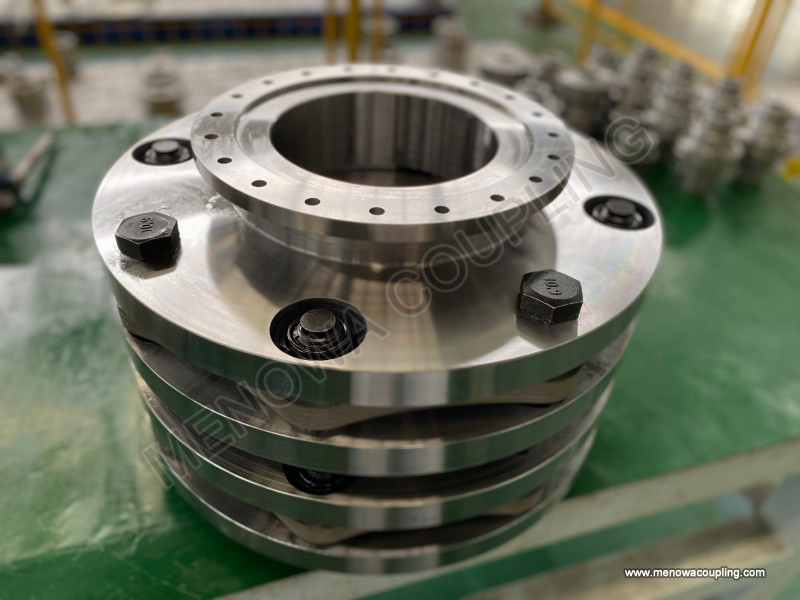
The basic working mechanism of diaphragm type coupling is built on the elastic mechanics characteristics of high-strength metal materials and the reasonable structural stress distribution design of diaphragm components. In the actual assembly and use state, the coupling is installed between the driving end shaft body connected with power equipment and the driven end shaft body connected with load equipment, and the two half-coupling hubs are firmly fixed on the corresponding shaft sections respectively through precision assembly structures. When the power equipment starts to operate and output rotational torque, the torque is first transmitted to the half-coupling hub at the driving end, and then evenly transferred to the multi-group metal diaphragms clamped and fixed between the two half-couplings through the connecting fasteners. The metal diaphragms bear cyclic shear force and tensile force in the circumferential direction during the rotation process, and rely on the rigid structural part to stably transmit the rotational torque to the half-coupling hub at the driven end, so as to drive the load equipment to operate synchronously and realize the continuous transmission of mechanical power. In this whole power transmission process, there is no relative sliding, friction contact or meshing collision between any internal parts of the coupling, and all power transmission links are completed through the internal force transmission and elastic deformation coordination of the metal diaphragm itself. More importantly, due to the inevitable installation deviation in the assembly process of mechanical equipment, as well as the axial displacement, radial offset and angular deflection between the two shafts caused by equipment operation vibration, thermal expansion and contraction of metal components, and slight foundation settlement during long-term operation, the diaphragm group can produce micro elastic deformation corresponding to the displacement deviation in multiple directions. This passive elastic deformation does not affect the basic torque transmission efficiency, but can effectively offset the adverse effects of shaft misalignment on the transmission system, avoid additional bending stress and shear stress concentration at the shaft connection, reduce the vibration amplitude of the rotating shaft system, and protect the shaft body, bearing parts and core components of driving and driven equipment from fatigue damage caused by long-term eccentric operation.
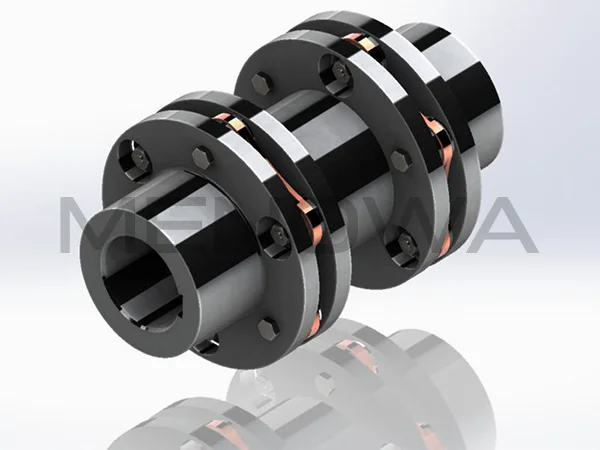
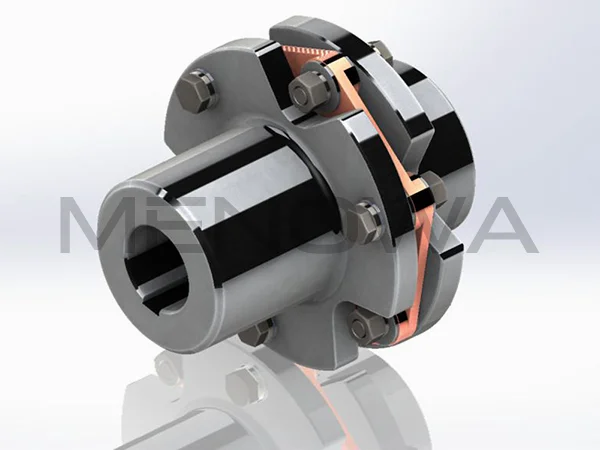
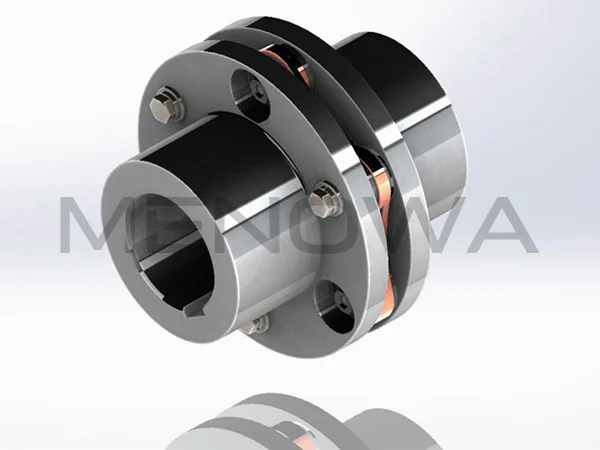
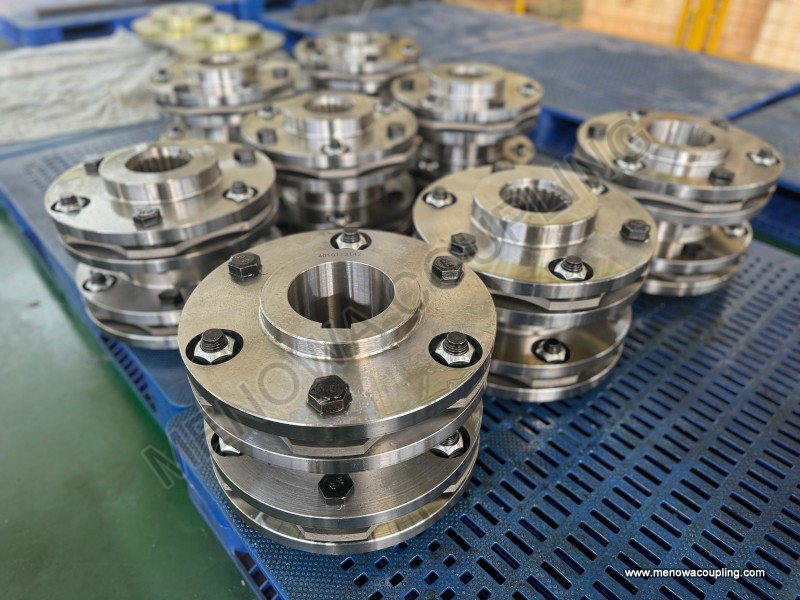
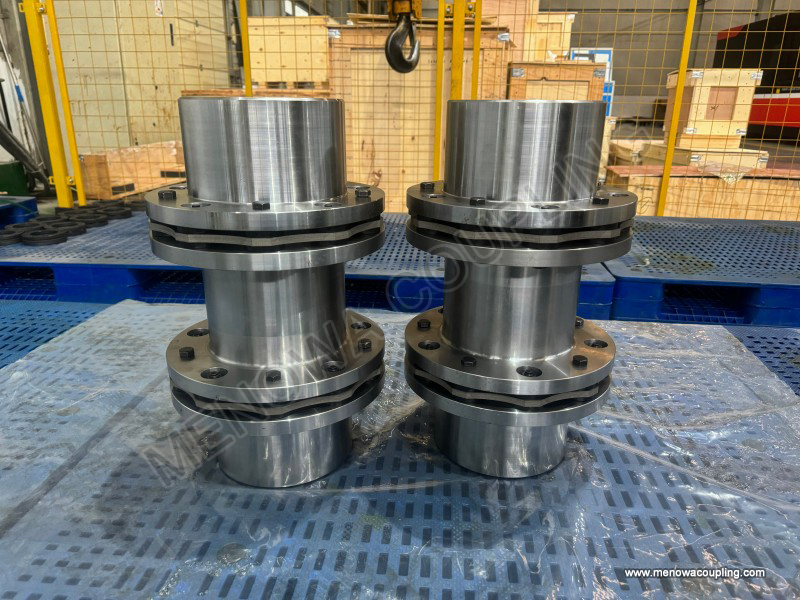
The overall structural composition of diaphragm type coupling follows the design concept of compact integration and modular assembly, and the whole equipment is mainly composed of two symmetrical half-coupling hubs, intermediate connecting sleeve (set in partial double-diaphragm structural forms), multi-group stacked metal diaphragm components, high-strength connecting bolts and locking fastening parts, without any additional auxiliary transmission parts or vulnerable wearing parts. The half-coupling hubs, as the basic connecting matrix of the coupling and the equipment shaft, are usually processed and manufactured with high-strength alloy steel materials through integral forging and precision finishing. The internal shaft hole of each hub is processed with high-precision matching structures such as keyways or interference assembly surfaces, which can ensure a close and reliable fit between the hub and the equipment shaft body, effectively prevent relative rotation or loosening displacement between the coupling and the shaft during high-load and high-speed operation, and avoid transmission failure caused by connection slipping. The machining precision of the hub directly affects the coaxiality of the coupling after assembly and the uniformity of torque transmission in the operation process, so the surface finish and dimensional tolerance of the matching surface need to be strictly controlled in the production and processing process to ensure the stability of the assembly state. The metal diaphragm group is the most core functional component of the diaphragm type coupling, and is generally formed by stacking multiple thin metal sheets according to the load demand and transmission specification. The diaphragm materials are mostly selected from high-quality stainless steel or special alloy steel with excellent fatigue resistance, high-temperature resistance and corrosion resistance, which can withstand repeated cyclic elastic deformation for a long time without plastic deformation or fatigue fracture. Different diaphragm profile designs are adopted according to different stress requirements in actual use, including linear profile, conical profile and curved profile. Each profile has unique stress distribution characteristics, among which conical profile can realize uniform centrifugal stress distribution, and curved profile is conducive to uniform shear stress bearing, which can effectively improve the overall deformation coordination ability and fatigue life of the diaphragm under different working conditions.
According to the different number of diaphragm groups and internal structural layout, diaphragm type coupling can be divided into two main structural types: single diaphragm coupling and double diaphragm coupling, and each structural type has its own applicable working condition range and performance characteristics to meet the differentiated power transmission needs of various industrial scenarios. Single diaphragm coupling adopts a single set of diaphragm components to connect two half-coupling hubs, with an extremely simple overall structure, small overall volume and light weight, and convenient on-site assembly and disassembly operations. This structural form is more suitable for working conditions with low misalignment deviation between shafts, relatively stable load and medium and low-speed operation requirements. In the actual operation process, the single diaphragm can complete basic torque transmission and a certain range of axial and angular displacement compensation, but due to the limitation of structural layout, its radial displacement compensation capacity is relatively limited, and it is mostly used in conventional mechanical transmission systems with low requirements for shaft deviation adaptation. Double diaphragm coupling is composed of two sets of independent diaphragm groups and an intermediate connecting sleeve, the two diaphragm groups are respectively connected with the two half-coupling hubs and the intermediate sleeve, and the two sets of diaphragms cooperate with each other through synchronous elastic deformation to realize multi-directional comprehensive displacement compensation. The angular displacement compensation capacity of this structural form is significantly improved compared with the single diaphragm structure, and it can effectively adapt to axial, radial and angular multi-dimensional misalignment deviations generated during equipment operation. The intermediate connecting sleeve can further balance the stress distribution of the two diaphragm groups, reduce the local stress concentration of a single diaphragm, and improve the overall operation stability and service life of the coupling. Double diaphragm coupling is more suitable for high-speed operation, high-load transmission and working conditions with large shaft misalignment deviation, and has stronger adaptability to complex and changeable industrial operation environments.
The selection of manufacturing materials for diaphragm type coupling determines its core mechanical properties, environmental adaptability and long-term operation reliability, and different components adopt targeted material matching design according to their respective stress characteristics and functional requirements. For the half-coupling hubs and intermediate connecting sleeves that mainly bear rigid torque transmission and external structural load, high-strength alloy steel materials with high hardness, good rigidity and strong impact resistance are generally selected. These materials have excellent mechanical strength and structural stability, will not produce deformation or damage under long-term high torque transmission and instantaneous impact load, and can maintain the assembly precision and connection stability of the coupling for a long time. For the core diaphragm components that need frequent elastic deformation and bear cyclic fatigue load, special stainless steel or nickel-based alloy materials with excellent fatigue resistance, low-temperature toughness and high-temperature stability are preferred. These metal materials can maintain stable elastic performance in a wide temperature range, will not undergo material performance attenuation or structural brittle failure in high-temperature working environments up to hundreds of degrees or low-temperature cold environments close to minus zero degrees, and also have good corrosion resistance to conventional chemical corrosive media such as acid and alkali humid gas in industrial production workshops. The connecting bolts and locking fasteners used for assembly and fixing are made of high-strength alloy materials with high tensile strength and shear resistance, and strict heat treatment processes are adopted in the production process to ensure that the fasteners will not loosen, break or deform under long-term vibration and cyclic load, and always maintain the clamping tightness and structural integrity of the coupling assembly. The scientific matching of these different materials enables the diaphragm type coupling to give full play to the advantages of rigid torque transmission and flexible deformation compensation, and realize the organic unity of high transmission efficiency and strong environmental adaptability.
In terms of actual operation performance, diaphragm type coupling has obvious comprehensive advantages compared with other types of flexible couplings, and these performance advantages make it widely promoted and applied in many key industrial fields. Firstly, the torque transmission efficiency of diaphragm type coupling is extremely high, and the power loss in the torque transmission process is extremely low due to the all-metal rigid transmission structure without friction and sliding links. The efficient transmission characteristics ensure that most of the power output by the driving equipment can be accurately transmitted to the driven load equipment, avoiding energy waste in the transmission process, and meeting the high-efficiency operation requirements of energy-saving and consumption reduction in modern industrial production. Secondly, the all-metal structural design enables the coupling to have excellent temperature adaptability, and can operate stably for a long time in both high-temperature production environments such as industrial furnace supporting equipment, thermal power generation auxiliary machinery and metallurgical rolling equipment, and low-temperature working conditions such as cold storage refrigeration equipment and low-temperature fluid delivery systems. The metal materials will not aging, soften or harden and brittle due to temperature changes, and the transmission performance will not fluctuate with ambient temperature changes. Thirdly, the operation process of diaphragm type coupling has no friction, no collision and no wear of internal parts, so there is no need for regular lubrication, oil replacement or replacement of vulnerable wearing parts in the whole service cycle. The maintenance-free operation feature greatly reduces the daily maintenance workload and later operation cost of mechanical equipment, avoids equipment shutdown and production interruption caused by coupling maintenance and parts replacement, and improves the continuous operation efficiency of the whole production line.
In addition to the above core performance advantages, diaphragm type coupling also has good vibration damping and noise reduction effects in actual operation. The elastic deformation of the metal diaphragm can absorb and buffer the small vibration and impact load generated during the start-up, shutdown and load fluctuation of the equipment, reduce the vibration transmission between the driving shaft and the driven shaft, avoid the resonance phenomenon of the rotating shaft system, and reduce the overall vibration amplitude of the mechanical equipment. At the same time, due to the absence of relative movement and friction collision between internal parts, the coupling will not generate additional mechanical noise during high-speed rotation, which can effectively improve the on-site working environment and meet the noise control requirements of industrial production places with high environmental protection standards. Moreover, the overall structure of diaphragm type coupling is compact in size and reasonable in space occupation, and the assembly and disassembly process is simple and convenient. The installation and maintenance operations can be completed without moving the driving and driven equipment, which greatly reduces the difficulty of on-site construction and later maintenance. The structural rigidity of the coupling is stable, and the torsional rigidity matches well with various mechanical transmission systems, which can ensure the precise synchronous rotation of the driving shaft and the driven shaft, maintain the high-precision transmission state of the equipment, and meet the operation requirements of precision mechanical equipment with high requirements for rotation synchronization and position accuracy.
Diaphragm type coupling has a wide range of industrial application scenarios, covering almost all mechanical equipment fields that require medium and high-speed power transmission, high-precision shaft connection and harsh environment operation. In the field of power generation equipment, diaphragm type coupling is used for the shaft connection between various power generation host auxiliary equipment such as fans, water pumps and compressors and power motors. These power generation auxiliary equipment needs to operate continuously for a long time with stable load and high operation speed, and the maintenance-free performance and high-efficiency transmission characteristics of diaphragm type coupling can ensure the long-term stable operation of the equipment, reduce the failure rate of auxiliary equipment, and guarantee the continuous and stable power supply of the power generation system. In the field of petrochemical and chemical industry production, most production equipment operates in corrosive, high-temperature and humid working environments, and the transmission equipment such as chemical pumps, stirring mixers and compression units need couplings with corrosion resistance and high temperature resistance. The all-metal corrosion-resistant material design of diaphragm type coupling can adapt to the corrosive working environment of chemical production, avoid coupling failure caused by material corrosion and aging, and ensure the safe and reliable operation of chemical production equipment.
In the field of metallurgical and mineral processing machinery, the production equipment such as rolling mills, crushers and conveyor machinery often bears instantaneous impact load and frequent load fluctuation during operation, and the shaft connection parts need couplings with strong impact resistance and fatigue resistance. Diaphragm type coupling can buffer instantaneous impact load through the elastic deformation of the diaphragm, reduce the impact damage of load fluctuation to the shaft and bearing components, and adapt to the harsh working conditions of heavy load and frequent impact in metallurgical and mineral processing production. In the field of fan and water pump general machinery, various large and medium-sized fans and water pumps are widely used in industrial ventilation, water supply and drainage, environmental protection dust removal and other links. These equipment have high operation speed and long continuous operation time, and require couplings with stable operation, low vibration and low noise. Diaphragm type coupling can effectively compensate the shaft misalignment deviation caused by installation and operation vibration, reduce equipment vibration and noise, and improve the operation stability and service life of fan and water pump equipment. In the field of marine and offshore engineering equipment, the mechanical equipment on ships and offshore platforms is in humid, salt spray corrosive and wave vibration working environment for a long time, and the shaft connection components need to have strong corrosion resistance and vibration resistance. Diaphragm type coupling can adapt to the marine harsh environment, resist salt spray corrosion and vibration fatigue, and ensure the reliable operation of marine mechanical power transmission system.
In the field of precision mechanical transmission and automated production equipment, diaphragm type coupling is used for the shaft connection of precision transmission parts such as servo motors, precision reducers and automated processing machinery. These precision equipment have extremely high requirements for transmission synchronization, position accuracy and operation stability, and any slight shaft misalignment and transmission vibration will affect the processing accuracy and operation effect of the equipment. The high torsional rigidity and precise displacement compensation performance of diaphragm type coupling can ensure the synchronous and accurate rotation of the driving and driven shafts, eliminate the transmission error caused by shaft deviation, and meet the high-precision operation requirements of automated precision production equipment. In the field of new energy equipment manufacturing, including wind power supporting machinery and new energy power equipment auxiliary transmission machinery, diaphragm type coupling is also widely used. The new energy equipment has high requirements for long-term operation reliability and low maintenance cost, and the maintenance-free and long-life characteristics of diaphragm type coupling can adapt to the long-term unattended operation mode of new energy equipment, reduce the later operation and maintenance cost of new energy projects, and help the stable development of the new energy industry.
In the process of practical application and installation and commissioning of diaphragm type coupling, standardized installation operation and scientific use and maintenance management are important prerequisites to give full play to its performance advantages and extend its service life. Although the coupling itself has maintenance-free operation characteristics, the installation accuracy directly affects the stress state and deformation effect of the diaphragm group in operation. Before installation, the coaxiality of the driving shaft and the driven shaft must be strictly calibrated to minimize the initial installation misalignment deviation, avoid excessive elastic deformation of the diaphragm in the initial operation stage, and prevent local stress concentration of the diaphragm caused by excessive deviation, which leads to accelerated fatigue damage. In the installation process, the fastening torque of each connecting bolt must be evenly controlled to ensure that the clamping force of the diaphragm group is uniform and consistent, avoid the problem of uneven stress on the diaphragm caused by inconsistent bolt fastening degree, and ensure the uniform force and stable deformation of each diaphragm in the operation process. After the installation is completed, it is necessary to conduct trial operation and vibration detection of the equipment, check the vibration amplitude and operation state of the coupling in the rotating process, and fine-tune the shaft alignment state if abnormal vibration is found, so as to ensure that the coupling operates within the optimal displacement compensation range.
In the daily use process, although the diaphragm type coupling does not need regular lubrication and replacement of wearing parts, regular visual inspection and operation state monitoring should be carried out regularly. The inspection content mainly includes checking whether there is obvious deformation, crack or corrosion on the surface of the diaphragm, whether the connecting bolts are loose or rusted, and whether the coupling has abnormal vibration and noise during operation. For the equipment operating in high corrosion and high load working conditions, the inspection cycle can be appropriately shortened to timely find potential hidden dangers of coupling failure and avoid equipment shutdown accidents caused by sudden coupling damage. In the long-term operation process, if the equipment is overhauled or the shaft position is adjusted, the coaxiality of the two shafts should be recalibrated and the fastening state of the connecting bolts should be checked again to ensure that the coupling always maintains a good assembly matching state. Scientific installation calibration and daily state monitoring can not only ensure that the diaphragm type coupling gives full play to its excellent transmission performance, but also effectively extend its overall service life, reduce the replacement frequency of components, and create stable and reliable basic conditions for the long-term continuous operation of mechanical equipment.
With the continuous progress of modern mechanical manufacturing technology and the continuous upgrading of industrial production equipment, the performance requirements for various basic mechanical parts such as couplings are constantly improving, and diaphragm type coupling is also constantly optimized and upgraded in structural design, material application and processing technology to adapt to the increasingly complex industrial working conditions and higher standard transmission requirements. In terms of structural design, through finite element stress analysis and simulation optimization technology, the diaphragm profile and structural size are continuously optimized to further improve the displacement compensation capacity and fatigue resistance of the coupling, reduce the overall structural weight on the premise of ensuring transmission rigidity, and realize the lightweight and high-performance design of the coupling. In terms of material application, with the continuous research and development of new high-strength corrosion-resistant alloy materials, more high-performance and long-life new materials are applied to the production and manufacturing of diaphragms and coupling hubs, which further improves the high-temperature resistance, corrosion resistance and fatigue life of the coupling, and expands its applicable working condition range. In terms of processing technology, the adoption of precision CNC machining and fine surface treatment technology further improves the dimensional machining accuracy and surface finish of coupling components, ensures the assembly accuracy and matching performance of the coupling, and improves the stability and synchronization of torque transmission.
In the future development of mechanical power transmission field, diaphragm type coupling will still rely on its unique all-metal flexible transmission principle, excellent comprehensive performance and wide environmental adaptability, and continue to be popularized and applied in more emerging industrial fields. With the rapid development of intelligent manufacturing, automated production and high-end equipment manufacturing industry, the demand for high-precision, high-reliability and low-maintenance transmission components will continue to grow, and diaphragm type coupling, as a mature and high-performance flexible coupling product, will play an increasingly important role in ensuring the stable operation of high-end mechanical equipment and improving the efficiency of industrial production and operation. At the same time, with the continuous innovation of design technology and manufacturing process, the comprehensive performance of diaphragm type coupling will be further improved, the application scenarios will be continuously expanded, and it will provide more reliable basic guarantee for the efficient and stable operation of various mechanical transmission systems in the industrial field.
Post Date: Apr 26, 2026
https://www.menowacoupling.com/coupling-supplier/diaphragm-type-coupling.html
Products
Related Articles
What is Flexible Diaphragm Coupling
Flexible diaphragm coupling is a high-performance metal flexible transmission component widely used in modern mechanical shafting systems, designed to connect driving and driven shafts while achieving efficient torque transmission and adaptive compensation of shaft misalignment. Unlike traditional rigid couplings that r…Gap Chart of Flexible Diaphragm Coupling
The gap chart of flexible diaphragm couplings serves as a core technical reference that quantifies the spatial clearance parameters between key structural components under diverse operating conditions, laying a foundational role in installation calibration, operational condition monitoring, and service life prediction o…Flexible Diaphragm Coupling For Sale
When it comes to transmitting power between two shafts in industrial machinery, the choice of coupling plays a crucial role in ensuring smooth operation, efficiency, and long-term reliability. Among the various types of couplings available in the market, flexible diaphragm couplings have emerged as a preferred solution …Working Principle of Flexible Diaphragm Coupling
Flexible diaphragm couplings are essential mechanical transmission components widely applied in modern industrial power transmission systems, serving as a critical bridge between driving and driven shafts to realize stable torque transmission while accommodating various shaft misalignments. Unlike rigid coupling structu…Maintenance of Flexible Diaphragm Coupling
Flexible diaphragm couplings serve as indispensable components in modern mechanical power transmission systems, designed to transmit torque between rotating shafts while compensating for minor axial, angular, and radial misalignments through the elastic deformation of metal diaphragm elements. Unlike rigid coupling stru…Flexible Diaphragm Coupling Production
The production of flexible diaphragm couplings is a sophisticated process that combines precision engineering, advanced material science, and strict quality control to create components that play a critical role in modern mechanical transmission systems. These couplings are designed to transmit torque between two shafts…Material of Flexible Diaphragm Coupling
Flexible diaphragm couplings stand as critical mechanical components in modern power transmission systems, renowned for their exceptional alignment compensation capability, high transmission efficiency, and maintenance-free operational characteristics. Unlike traditional flexible couplings that rely on elastomer deforma…Flexible Diaphragm Coupling Vendor In China
In the global mechanical transmission industry, flexible diaphragm couplings play an indispensable role as key components that connect rotating shafts, compensate for relative displacements, and ensure stable power transmission. As the world’s largest manufacturing base, China has nurtured a large number of flexible di…Dimensions of Flexible Diaphragm Coupling
The flexible diaphragm coupling is a high-performance metal elastic flexible coupling that plays a crucial role in connecting two rotating shafts in industrial machinery, enabling efficient torque transmission while accommodating various types of misalignment between the shafts. Unlike many other coupling types that rel…Parts of Flexible Diaphragm Coupling
A flexible diaphragm coupling stands as a vital mechanical transmission component widely adopted in high-precision and high-speed industrial transmission systems, serving the core purpose of connecting driving and driven shafts to achieve stable torque transmission while compensating for diverse shaft misalignments gene…
 WeChat
 WhatsApp