Diaphragm Flexible Coupling
In the entire field of mechanical power transmission systems, the connection between driving equipment and driven equipment serves as a fundamental link that determines the stability, continuity, and long-term operational reliability of the entire mechanical unit. Every mechanical transmission system involves the transfer of rotational torque and rotational motion from one shaft component to another, and the actual installation and operation environment of mechanical equipment can never achieve an absolutely ideal coaxial state between connected shafts. Various unavoidable factors such as mechanical installation errors, structural deformation of equipment frames under long-term load operation, thermal expansion and contraction of metal components caused by temperature changes during equipment operation, and slight vibration displacement generated by mechanical operation will lead to different degrees of relative misalignment between the driving shaft and the driven shaft. If rigid connection methods are adopted to fix the two shafts directly, these unavoidable misalignments will generate additional mechanical stress on the shaft body, bearings, and internal structural parts of the connected equipment, accelerate the wear and fatigue damage of key components, cause obvious vibration and noise during equipment operation, greatly shorten the overall service life of the mechanical unit, and even lead to sudden equipment failure and production shutdown in severe cases. Under this industry background and actual mechanical operation demand, diaphragm flexible coupling has become one of the most critical and widely used core connecting components in modern industrial high-precision and high-stability transmission systems by virtue of its unique metal elastic deformation working mode, excellent displacement compensation performance, stable torque transmission capacity and long-cycle maintenance-free operation characteristics. Unlike traditional flexible coupling products that rely on rubber, polyurethane and other polymer elastic materials or gear meshing, chain transmission and other mechanical friction structures to achieve flexible connection, diaphragm flexible coupling completely adopts all-metal structural design, and relies entirely on the controllable elastic deformation of high-strength thin metal diaphragm components to complete torque transmission and multi-directional displacement compensation, which fundamentally avoids the aging, deformation, wear and failure problems easily occurring in non-metal elastic parts and friction transmission structures, and adapts to various complex and harsh industrial operation working conditions that require long-term continuous operation, high-speed rotation and stable transmission accuracy.
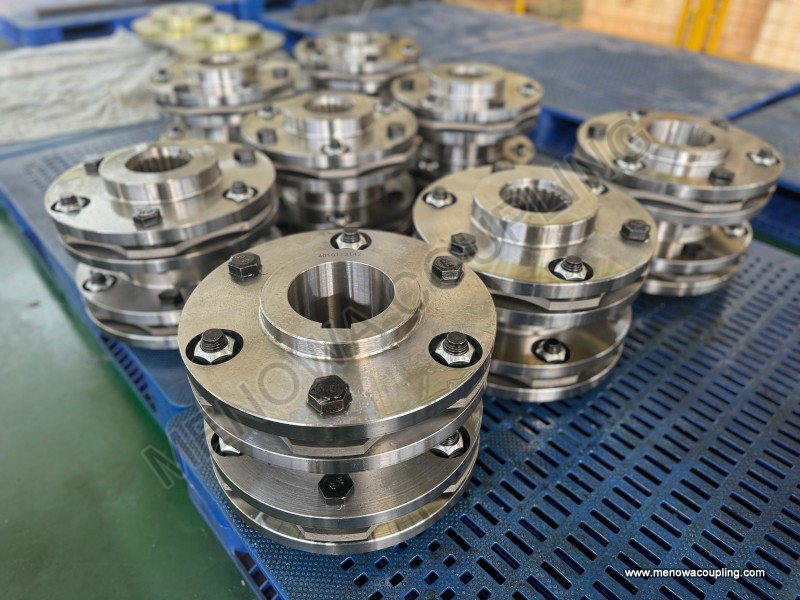
The basic working logic and core operating principle of diaphragm flexible coupling are built on the physical characteristics of metal elastic deformation and the structural stress transmission law of thin plate components. The overall operation process follows a stable mechanical transmission cycle without any complex mechanical friction, sliding contact or relative movement between internal parts, which is also the essential reason why this type of coupling can maintain efficient transmission and low wear operation for a long time. In the actual assembly and working state, the diaphragm flexible coupling is fixedly installed between the driving shaft end of power equipment such as motors, engines and reducers and the driven shaft end of load equipment such as fans, water pumps, compressors and production processing machinery. When the power equipment starts to operate and output rotational torque, the torque is first transmitted to the hub components on both sides of the coupling through the interference fit or key connection structure between the shaft and the coupling hub, and then the torque is evenly transmitted to the multi-layer metal diaphragm group arranged in the middle of the coupling through precision connecting bolts. The metal diaphragm group is the core functional component of the entire coupling, undertaking the dual core tasks of rigid torque transmission and flexible displacement compensation at the same time. In the process of rotational torque transmission, the diaphragm itself maintains stable structural rigidity in the torsional direction, ensuring that the torque output by the power equipment can be efficiently and completely transmitted to the driven equipment shaft without obvious torsional deformation and torque loss, maintaining the synchronization of rotational speed and motion state between the driving and driven shafts. At the same time, when relative misalignment occurs between the two connected shafts due to installation deviation, thermal deformation or operational vibration, the thin metal diaphragm will produce tiny and controllable elastic bending and tensile deformation in the corresponding direction. This natural elastic deformation can effectively absorb and buffer various displacement deviations between the shafts, offset the additional mechanical stress caused by misalignment on the shaft system and equipment bearings, and ensure that the entire transmission system always operates within a safe and stable mechanical stress range. All deformation processes of the diaphragm belong to reversible elastic deformation within the material fatigue limit, and no permanent structural deformation or material damage will occur after long-term repeated deformation and rotation, which lays a solid foundation for the long-term stable and reliable operation of the coupling.
The common misalignment states between the driving shaft and the driven shaft in actual mechanical operation can be mainly divided into three typical types, and the diaphragm flexible coupling can effectively compensate all three types of misalignment through the elastic deformation of the diaphragm structure, which is an important advantage that many traditional coupling products do not have. The first type is angular misalignment, which means that the center lines of the two connected shafts are not parallel and intersect at a certain tiny angle. This misalignment state is mostly caused by slight inclination of the equipment base during installation or uneven settlement of the equipment foundation after long-term operation. When angular misalignment occurs, the metal diaphragm group of the coupling will produce uniform bending deformation in the circumferential direction during each rotation cycle, and the elastic bending force generated by the diaphragm can balance the angular deviation between the two shafts, avoiding additional bending moment acting on the shaft body and bearings. The second type is axial misalignment, which refers to the relative displacement of the two shafts in the axial linear direction. This kind of misalignment is mainly caused by thermal expansion and contraction of the shaft body and equipment shell during the heating process of equipment operation, as well as tiny axial movement of the shaft system during start-up and shutdown. The thin-plate structure of the metal diaphragm has good axial telescopic deformation performance, which can freely adapt to the axial position change between the two shafts without generating additional axial pressure on the connected equipment, ensuring that the axial stress of the shaft system is always kept within a low level. The third type is radial misalignment, also known as parallel offset misalignment, which means that the center lines of the two shafts are parallel to each other but have a certain radial offset in the horizontal or vertical direction. This misalignment is usually caused by installation positioning errors or slight structural deformation of the equipment support frame under load. The multi-layer stacked structure of the diaphragm group can produce coordinated elastic deformation between layers, effectively offsetting the radial offset between the shafts and maintaining the stability of the torque transmission process. In the actual complex industrial working environment, the three types of misalignment often do not exist alone, but appear in a mixed state at the same time. The structural design of the diaphragm flexible coupling can adapt to the composite deformation generated by mixed misalignment, and realize synchronous compensation for multiple displacement deviations without mutual interference between various deformation states, ensuring that the transmission system will not be affected by various installation and operation deviations.
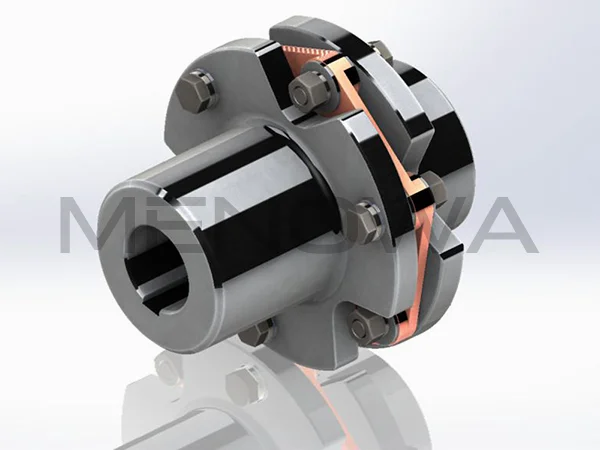
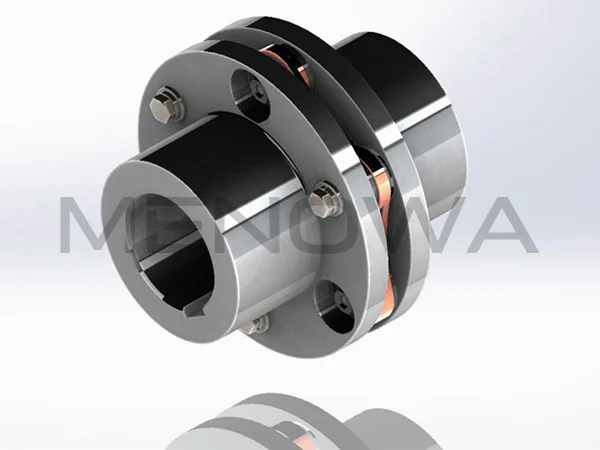
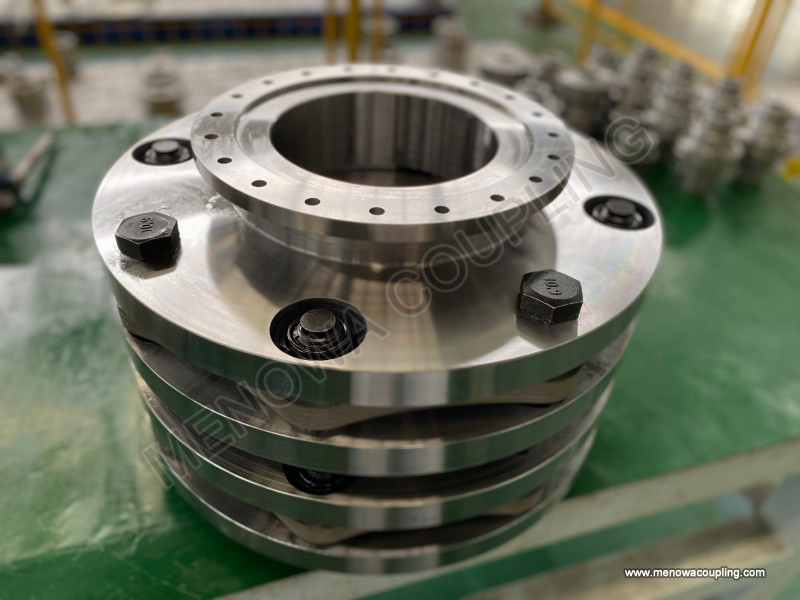
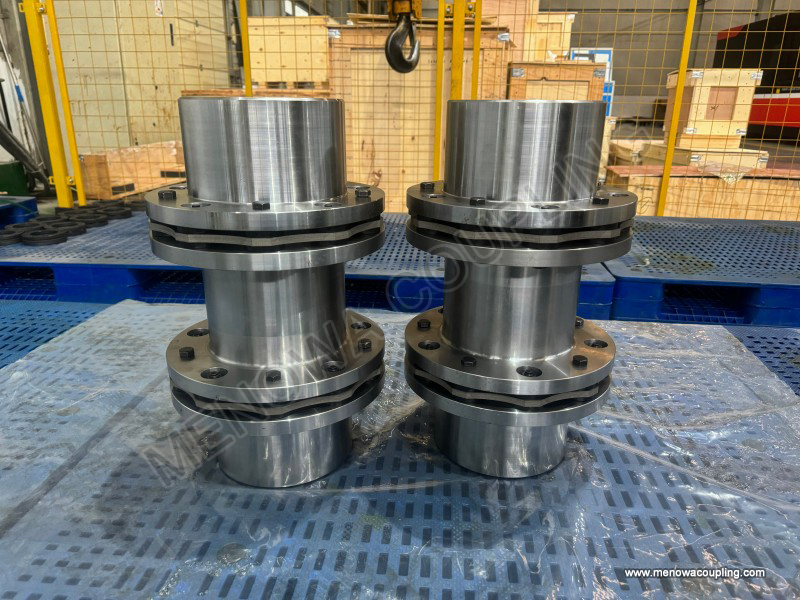
The overall structural composition of diaphragm flexible coupling is simple and compact, with fewer internal parts, and all components are made of high-strength metal materials, which simplifies the assembly, disassembly and subsequent maintenance work while ensuring structural stability. The whole coupling is mainly composed of three core parts, including two metal hubs distributed on both sides, a middle metal diaphragm group and supporting high-strength precision connecting bolts and fastening accessories. The hub components on both sides are the basic connecting parts of the coupling and the equipment shaft, usually made of high-quality alloy steel materials with high structural strength, good rigidity and strong fatigue resistance. According to different equipment installation and connection requirements, the inner hole of the hub can be designed with keyway structure, expansion sleeve connection structure or flange connection structure to meet the fixed assembly requirements of different shaft diameters and different installation space conditions. The outer end face of the hub is processed with precision bolt mounting holes, which are used for fixed connection with the diaphragm group, ensuring that the connection position is accurate and the fastening state is stable, and no loosening or position deviation will occur during high-speed rotation and long-term operation. The diaphragm group located in the middle of the coupling is composed of multiple ultra-thin stainless steel thin plates stacked together in a layered manner. The thickness of each single diaphragm thin plate is controlled within a reasonable small range, and the number of stacked diaphragms can be adjusted according to the torque transmission demand and displacement compensation demand of different working conditions. The multi-layer stacked design of the diaphragm group can not only improve the overall torsional stiffness of the coupling and ensure the stability of torque transmission, but also enhance the flexibility of elastic deformation and improve the displacement compensation capacity of the coupling. The diaphragm thin plates are processed by precision stamping and heat treatment process, with uniform material texture, stable elastic performance and strong fatigue resistance, which can withstand long-term repeated elastic deformation and high-speed rotation load without material fatigue failure. The high-strength precision connecting bolts adopt special anti-loosening design and high-precision machining technology, which are used to alternately fix the diaphragm group on the mounting end faces of the two hubs. The symmetrical fixing mode of the bolts makes the stress distribution of the diaphragm group uniform in the circumferential direction, avoids local stress concentration caused by uneven force, and further improves the structural stability and service life of the coupling.
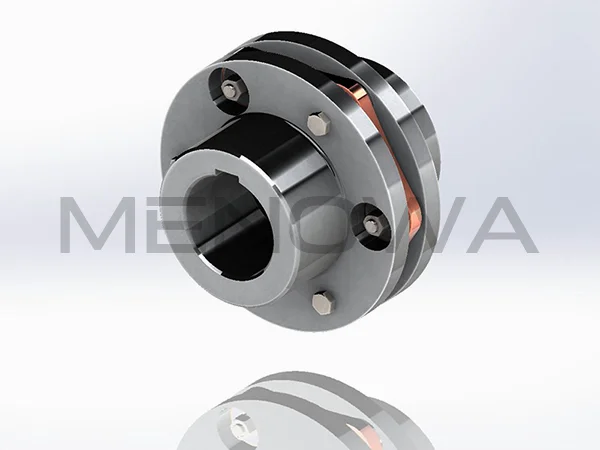
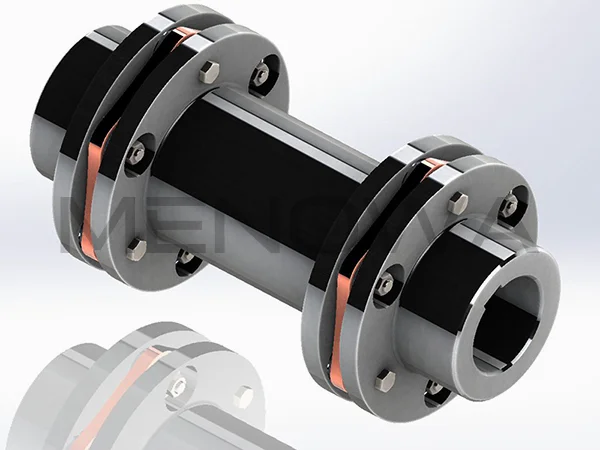
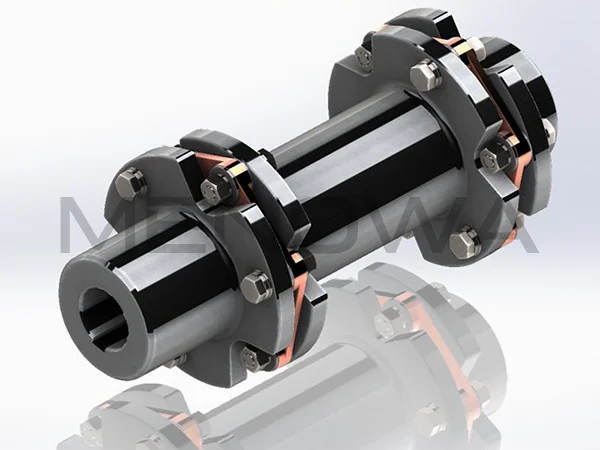
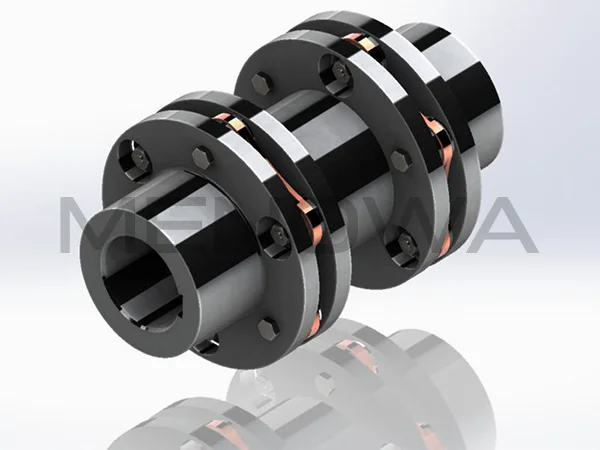
According to the different structural forms and diaphragm combination modes, diaphragm flexible couplings can be divided into two mainstream structural types in the industrial field, namely single diaphragm flexible coupling and double diaphragm flexible coupling, and the two types of couplings have their own applicable working condition scenarios and performance characteristics, which can be selected and matched according to the actual transmission demand and installation deviation range of mechanical equipment. The single diaphragm flexible coupling has the simplest overall structural form, with only one set of diaphragm group arranged between the two hubs, featuring fewer parts, smaller overall volume and lighter weight. This structural design is more suitable for mechanical transmission occasions with small installation misalignment deviation, low and medium rotation speed and general torque transmission demand. In the working process, the single diaphragm group relies on its own integral elastic deformation to complete torque transmission and basic displacement compensation, and the installation and disassembly process is very convenient, without the need to move the main equipment body during assembly and maintenance, which can effectively save equipment installation and later maintenance time and labor cost. However, due to the limited number of diaphragms and single structural form, the single diaphragm flexible coupling has a relatively limited compensation range for angular misalignment and radial misalignment, and is not suitable for working conditions with large installation deviation or frequent start-stop and impact load operation. The double diaphragm flexible coupling is composed of two sets of diaphragm groups and a middle spacer sleeve structure, with the two diaphragm groups symmetrically arranged on both sides of the spacer sleeve. The symmetrical structural design enables the two sets of diaphragm groups to produce coordinated elastic deformation during operation, which can effectively offset the additional bending moment generated during the deformation process, greatly improve the compensation capacity for angular misalignment and radial misalignment, and the compensation effect for various misalignments is significantly better than that of the single diaphragm structure. The double diaphragm flexible coupling has higher overall torsional stiffness and transmission stability, can adapt to high-speed rotation, large torque transmission and working conditions with relatively large installation deviation, and can still maintain stable transmission performance under the condition of frequent equipment start-stop and occasional impact load. Although the overall structure of the double diaphragm flexible coupling is slightly more complex than that of the single diaphragm type, the assembly and disassembly process is still simple and convenient, and it does not need complex lubrication and daily maintenance in the later stage, balancing the excellent compensation performance and convenient use characteristics.
Compared with other types of flexible couplings commonly used in the mechanical transmission industry, diaphragm flexible coupling has a series of prominent comprehensive performance advantages, which makes it widely used in various high-end and harsh industrial transmission occasions. First of all, this coupling adopts an all-metal structural design without any non-metal elastic accessories and friction transmission parts, so it does not need any lubricating oil, grease and other lubricating media in the whole service cycle. There is no relative friction and wear between internal parts during operation, which fundamentally eliminates the component aging and failure problems caused by lubricant deterioration, loss and non-metal material fatigue. This maintenance-free operation feature greatly reduces the daily operation and maintenance cost of equipment, avoids the production shutdown caused by regular lubrication replacement and accessory replacement, and improves the continuous operation efficiency of the production line. Secondly, the diaphragm flexible coupling has extremely high torque transmission efficiency, and the elastic deformation of the diaphragm in the torsional direction is extremely small during operation, which can realize almost lossless torque and power transmission, ensure the consistency between the output power of power equipment and the actual power received by load equipment, and avoid energy waste caused by torque loss. In addition, the all-metal structure and stable elastic deformation working mode enable the diaphragm flexible coupling to adapt to a wide temperature range and various harsh working environments. It can maintain stable working performance in low-temperature cold environments and high-temperature heating environments, and can also operate normally in working conditions with dust, humidity, slight corrosion and vibration impact, without performance attenuation and structural damage due to environmental changes. At the same time, the coupling has good damping and noise reduction effects during operation. There is no mechanical collision and friction between internal parts, the operation process is stable and smooth, the vibration and noise generated during high-speed rotation are very small, which can effectively improve the overall operation environment of mechanical equipment and reduce the vibration damage of precision mechanical components.
The selection of diaphragm flexible coupling is a key link related to the stable operation and service life of the transmission system, and it is necessary to comprehensively consider multiple key factors such as actual transmission torque, equipment rotation speed, installation misalignment range, working environment conditions and equipment start-stop state, instead of simply selecting according to the shaft diameter size. First of all, the rated torque of the coupling should be reasonably determined according to the actual working torque of the transmission equipment. It is necessary to fully consider the peak torque generated during equipment start-up, shutdown and load fluctuation, and reserve a reasonable torque safety margin on the basis of the normal operating torque, so as to avoid diaphragm fatigue damage caused by long-term overload operation of the coupling. Secondly, the high-speed rotation performance of the coupling should be matched according to the rated working speed of the equipment. The structural design and material selection of the coupling need to adapt to the centrifugal force generated by high-speed rotation, ensuring that no structural deformation and vibration resonance occur during high-speed operation. For high-speed rotating equipment such as high-power fans and centrifugal compressors, it is necessary to prioritize the optimization design of the diaphragm group structure and bolt fastening structure to ensure the dynamic balance performance of the coupling during rotation. In addition, according to the actual installation conditions of the equipment, including the reserved installation space between the two shafts and the actual misalignment deviation after equipment installation, the structural type of single diaphragm or double diaphragm should be selected reasonably to ensure that the coupling has sufficient displacement compensation capacity to adapt to the actual installation and operation deviation. At the same time, the influence of the working environment on the coupling material should be fully considered. For working conditions with corrosive media, humidity and high dust, diaphragm materials with stronger corrosion resistance and surface protection treatment should be selected to avoid material corrosion and performance degradation affecting the service life of the coupling.
The installation and commissioning work of diaphragm flexible coupling directly affects its later operation effect and service life, and standardized installation operation can give full play to the coupling's displacement compensation performance and transmission stability. Before formal installation, it is necessary to carefully check the dimensional accuracy and surface quality of all coupling components, ensure that there are no cracks, deformation, scratches and other defects on the surface of the hub, diaphragm and bolts, and check whether the matching size between the coupling inner hole and the equipment shaft end meets the assembly requirements. During the installation process, the two hubs of the coupling should be respectively installed and fixed on the driving shaft and the driven shaft first, and the coaxiality and installation distance between the two hubs should be accurately adjusted according to the equipment installation specifications, minimizing the initial installation misalignment between the two shafts, which can reduce the long-term deformation amplitude of the diaphragm during operation and help prolong the service life of the diaphragm group. After the hub is fixed, the diaphragm group is installed in place, and the connecting bolts are tightened evenly and symmetrically in accordance with the specified fastening torque. The fastening force of each bolt should be kept consistent to avoid local stress concentration of the diaphragm caused by uneven bolt tightening, which will lead to premature fatigue damage of local parts of the diaphragm. After the installation is completed, it is necessary to carry out low-speed trial operation of the equipment, check whether the coupling has abnormal vibration, noise and friction during operation, recheck the fastening state of the connecting bolts after a short period of trial operation, and ensure that all fastening parts are not loose. In the later daily use process, regular visual inspection and routine inspection are only needed, focusing on checking whether the coupling has obvious vibration, abnormal noise and bolt loosening during operation, without regular lubrication and complex maintenance operations, and the management and maintenance work is extremely simple.
In the long-term operation process of diaphragm flexible coupling, although it has excellent fatigue resistance and maintenance-free performance, reasonable daily management and regular simple inspection can further extend its overall service life and avoid unexpected failure problems. In the daily operation and management of the equipment, the operation load of the transmission system should be kept within the rated range of the coupling as far as possible, avoiding long-term overload operation and frequent sudden start-stop and impact load impact, so as to prevent the diaphragm from bearing excessive alternating stress and accelerating material fatigue aging. For the equipment operating in high-temperature, corrosive and dusty harsh environments, regular surface cleaning of the coupling should be done to avoid long-term accumulation of dust and corrosive substances on the surface of the diaphragm and hub, prevent material surface corrosion and structural performance changes, and maintain the normal elastic deformation performance of the diaphragm. During the regular equipment maintenance cycle, the fastening state of the coupling connecting bolts should be inspected keyly, and the bolts should be re-fastened in time if slight loosening is found, so as to avoid the change of stress distribution of the diaphragm group caused by bolt loosening, which affects the transmission stability and compensation performance. If abnormal vibration and noise of the coupling are found during equipment operation, the equipment should be shut down in time for inspection and troubleshooting, check whether the diaphragm has permanent deformation, fatigue cracks and other damage problems, and replace the damaged diaphragm group in time if any damage is found, so as to ensure the safe and stable operation of the entire transmission system.
Diaphragm flexible coupling has a very wide range of application coverage in modern industrial production and mechanical equipment manufacturing, and can be applied to almost all mechanical transmission occasions that require high stability, high precision and long-term continuous operation. In the metallurgical and steel industry, this kind of coupling is used for the power transmission connection of rolling mill equipment, sintering equipment and metallurgical fans. These equipment have large transmission torque, high operation continuity requirements and harsh on-site working environment, and the all-metal structure and maintenance-free characteristics of diaphragm flexible coupling can meet the long-term uninterrupted operation demand of metallurgical equipment. In the chemical industry, it is applied to various chemical pumps, chemical compressors and reaction kettle transmission equipment. The chemical production site is usually accompanied by corrosive gas and liquid media and large temperature changes, and the corrosion resistance and wide temperature adaptability of the coupling ensure the stable operation of chemical transmission equipment. In the power industry, diaphragm flexible coupling is used for the transmission connection of power plant fans, water supply pumps and power generation auxiliary equipment. These power equipment need to operate continuously for a long time with high operation stability requirements, and the low wear and high-efficiency transmission performance of the coupling reduce the failure rate of power auxiliary equipment. In the mining and cement industry, it is suitable for mine hoists, crushers and cement grinding equipment. These equipment have large load impact and harsh working conditions, and the good vibration damping and displacement compensation performance of the coupling can buffer the impact load and protect the shaft system and bearing components of the equipment. In addition, in shipbuilding, papermaking, textile, food processing and other industrial fields, as well as precision mechanical transmission equipment such as machine tools and automation production lines, diaphragm flexible coupling has become an indispensable core connecting component, providing reliable guarantee for the stable operation of various mechanical transmission systems.
With the continuous upgrading and development of modern industrial mechanical equipment towards high speed, high precision, high efficiency and long-cycle continuous operation, the performance requirements for supporting coupling components in the transmission system are also constantly improving. Traditional coupling products with short service life, large maintenance workload and poor environmental adaptability can no longer meet the operation needs of new industrial equipment. As an all-metal flexible connecting component with mature technology, stable performance and excellent comprehensive advantages, diaphragm flexible coupling has been continuously optimized and improved in structural design, material selection and processing technology with the development of industrial machinery. The continuous upgrading of diaphragm material heat treatment technology and precision machining technology further improves the elastic deformation performance and fatigue resistance of the diaphragm, and the optimized structural design further enhances the displacement compensation capacity and transmission stability of the coupling. In the future industrial mechanical transmission field, diaphragm flexible coupling will rely on its unique working principle, excellent comprehensive performance and wide working condition adaptability, and will be applied in more emerging industrial fields and high-precision mechanical equipment. By continuously optimizing the product structure and matching performance according to the actual development needs of the mechanical industry, it will continue to provide reliable and stable basic connection guarantee for the efficient and safe operation of various mechanical power transmission systems, and play an important supporting role in the stable production and efficient operation of the entire industrial industry.
Post Date: Apr 26, 2026
https://www.menowacoupling.com/coupling-supplier/diaphragm-flexible-coupling.html
Products
Related Articles
Working Principle of Flexible Diaphragm Coupling
Flexible diaphragm couplings are essential mechanical transmission components widely applied in modern industrial power transmission systems, serving as a critical bridge between driving and driven shafts to realize stable torque transmission while accommodating various shaft misalignments. Unlike rigid coupling structu…Maintenance of Flexible Diaphragm Coupling
Flexible diaphragm couplings serve as indispensable components in modern mechanical power transmission systems, designed to transmit torque between rotating shafts while compensating for minor axial, angular, and radial misalignments through the elastic deformation of metal diaphragm elements. Unlike rigid coupling stru…Flexible Diaphragm Coupling Production
The production of flexible diaphragm couplings is a sophisticated process that combines precision engineering, advanced material science, and strict quality control to create components that play a critical role in modern mechanical transmission systems. These couplings are designed to transmit torque between two shafts…Material of Flexible Diaphragm Coupling
Flexible diaphragm couplings stand as critical mechanical components in modern power transmission systems, renowned for their exceptional alignment compensation capability, high transmission efficiency, and maintenance-free operational characteristics. Unlike traditional flexible couplings that rely on elastomer deforma…Flexible Diaphragm Coupling Vendor In China
In the global mechanical transmission industry, flexible diaphragm couplings play an indispensable role as key components that connect rotating shafts, compensate for relative displacements, and ensure stable power transmission. As the world’s largest manufacturing base, China has nurtured a large number of flexible di…Dimensions of Flexible Diaphragm Coupling
The flexible diaphragm coupling is a high-performance metal elastic flexible coupling that plays a crucial role in connecting two rotating shafts in industrial machinery, enabling efficient torque transmission while accommodating various types of misalignment between the shafts. Unlike many other coupling types that rel…Parts of Flexible Diaphragm Coupling
A flexible diaphragm coupling stands as a vital mechanical transmission component widely adopted in high-precision and high-speed industrial transmission systems, serving the core purpose of connecting driving and driven shafts to achieve stable torque transmission while compensating for diverse shaft misalignments gene…Flexible Diaphragm Coupling Wholesale
In the realm of industrial power transmission, the flexible diaphragm coupling stands out as a critical component that bridges the gap between rotating shafts, ensuring efficient, reliable, and precise power transfer across a wide range of applications. As industries continue to evolve and demand higher performance from…Flexible Diaphragm Coupling Exporter
In the global industrial transmission system, flexible diaphragm couplings have become an indispensable core component, widely used in various fields that require high-precision, high-reliability torque transmission. As a professional exporter focusing on flexible diaphragm couplings, we are committed to providing high-…Specification of Flexible Diaphragm Coupling
Flexible diaphragm couplings represent a pivotal category of metal elastic transmission components widely adopted in high-precision mechanical power transmission systems, serving the core function of connecting driving and driven shafts to achieve stable torque transmission while accommodating inevitable shaft misalignm…
 WeChat
 WhatsApp