Menowa is a rubber tire couplings supplier from china, wholesale and direct sales rubber tire couplings, flexible tyre couplings at a reasonable price.
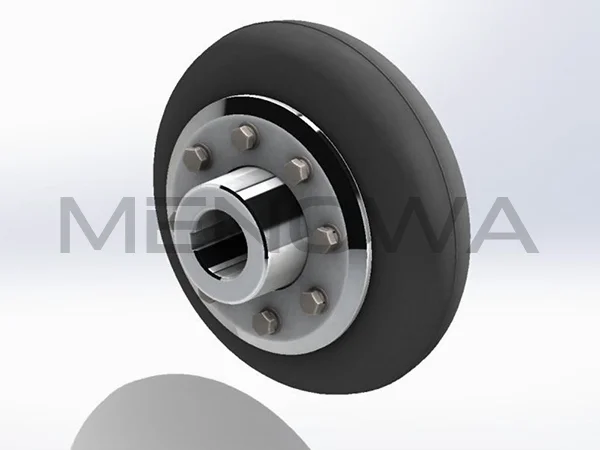
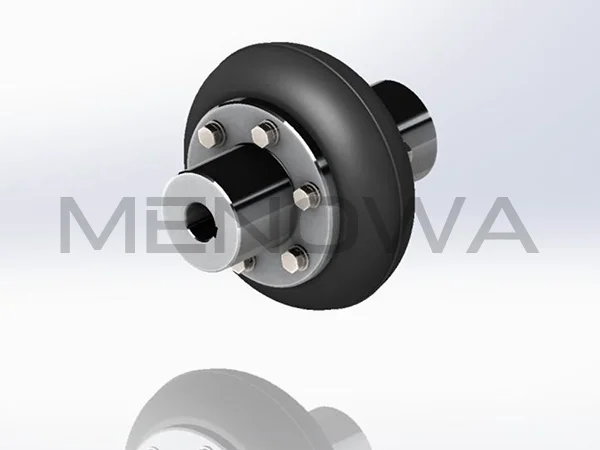
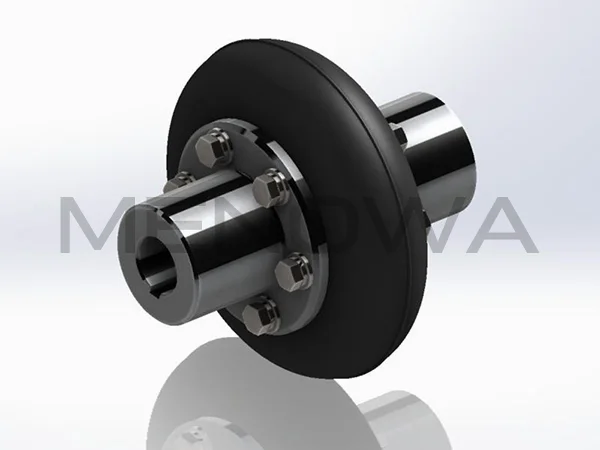
Menowa tire coupling is divided into two categories: convex type and concave type, and the convex type is divided into three types: skeleton integral type, boneless integral type and radial incision type. Menowa coupling assembly with the bolt and the flange of the two halves of the coupling connection, relying on tightening the bolt between the tire and the flange end face to transfer torque, tire ring working torsion shear deformation, so the tire coupling has a high elasticity, compensation for the relative displacement of the two axes is larger, and has good damping, and simple structure, no lubrication, installation and disassembly and maintenance are more convenient. The disadvantage is that the carrying capacity is not high and the overall size is large. With the increase of the relative torsion Angle of the two axes, the appearance of the tire is distorted, and the axial size is slightly reduced, which will produce a large additional axial force on the two axes, increasing the bearing load and reducing the life。 Menowa coupling suitable for wet, dusty, impact, vibration, positive and negative change and frequent starting working conditions, and easy to disassemble.
In the complex network of industrial transmission systems, the connection between rotating shafts is not merely a mechanical link but a key node that determines the stability, efficiency, and service life of the entire equipment. Among the numerous coupling types available, Rubber Tire Coupling and Flexible Tyre Coupling stand out as essential components in scenarios requiring vibration damping, misalignment compensation, and impact absorption. These two types of couplings, often regarded as interchangeable in casual terminology, share core functional characteristics while differing in structural details and application focuses. Their ability to balance torque transmission with flexible adaptation makes them indispensable in heavy machinery, precision equipment, and various industrial environments where operational reliability is paramount.
To begin with, it is necessary to clarify the definition and core functions of Rubber Tire Coupling and Flexible Tyre Coupling. Both belong to the category of flexible couplings with elastic elements, relying on the deformation of rubber components to achieve torque transmission, vibration absorption, and compensation for relative displacements between two shafts. A Rubber Tire Coupling typically consists of two metal flanges (or half-couplings) and a rubber tire body that connects them. The rubber tire serves as the core elastic element, transmitting torque through frictional force or mechanical clamping between the tire and the flanges. In contrast, a Flexible Tyre Coupling emphasizes enhanced flexibility and misalignment compensation capabilities, often featuring optimized rubber formulations and structural designs to accommodate larger axial, radial, and angular displacements. While the naming difference may stem from regional terminology or structural nuances—with "tire" and "tyre" being variant spellings of the same component—the essential distinction lies in the degree of flexibility, load-bearing capacity, and design focus. Both couplings are designed to address the limitations of rigid couplings, which cannot compensate for misalignments or absorb vibrations, thus avoiding excessive stress on shafts, bearings, and gears.
The performance of Rubber Tire Coupling and Flexible Tyre Coupling is inherently linked to the material properties of their rubber components. Rubber, as the core elastic element, must balance multiple contradictory requirements: high elasticity to absorb vibrations and compensate for displacements, sufficient strength to transmit torque without failure, and resistance to aging, wear, and harsh environmental conditions. The selection of rubber materials is therefore a critical aspect of coupling design. Common rubber types used in these couplings include natural rubber (NR), nitrile rubber (NBR), hydrogenated nitrile rubber (HNBR), polyurethane-modified rubber, and ethylene propylene diene monomer (EPDM). Each material offers unique advantages tailored to specific operating conditions. Natural rubber, for instance, exhibits excellent elasticity and fatigue resistance, making it suitable for general-purpose applications with moderate loads and temperatures. Nitrile rubber, on the other hand, provides superior oil resistance, making it ideal for environments where the coupling may come into contact with lubricants or hydraulic fluids. Hydrogenated nitrile rubber enhances the heat resistance and mechanical strength of NBR, extending service life in high-temperature and high-load scenarios. Polyurethane-modified rubber combines the elasticity of rubber with the wear resistance of polyurethane, suitable for applications involving frequent start-stop cycles and moderate impact loads. Ethylene propylene diene monomer offers excellent resistance to ozone, weathering, and chemical corrosion, making it a preferred choice for outdoor or chemical industry applications.
Beyond the base rubber material, the performance of the elastic element is further optimized through composite formulations and reinforcement techniques. Rubber compounding involves blending base rubber with various additives, including reinforcing fillers, vulcanizing agents, anti-aging agents, and plasticizers, to fine-tune properties such as hardness, tensile strength, tear resistance, and damping capacity. Reinforcing fillers like carbon black and nano-sized silica are commonly used to enhance the mechanical strength of rubber without compromising elasticity. Carbon black, in particular, forms a network structure within the rubber matrix, improving tensile strength, abrasion resistance, and fatigue life. Nano-sized silica, when surface-treated, can synergize with carbon black to achieve a balance between elasticity and strength, making it suitable for high-performance couplings requiring both vibration damping and load-bearing capacity. Vulcanizing agents play a crucial role in forming cross-links between rubber molecules, converting the linear rubber polymer into a three-dimensional network structure that retains elasticity while maintaining structural stability. The vulcanization process must be carefully controlled to ensure uniform cross-linking, as uneven vulcanization can lead to local stress concentrations and premature failure. Anti-aging agents are added to counteract the effects of oxidation, ozone, and thermal aging, which can degrade rubber properties over time. Composite anti-aging systems, combining primary and secondary anti-aging agents, are often used to extend the service life of coupling tire bodies in harsh operating environments.
The structural design of Rubber Tire Coupling and Flexible Tyre Coupling is another key factor influencing their performance. The basic structure of both couplings includes metal flanges and a rubber tire body, but variations in design affect load capacity, misalignment compensation, and vibration damping efficiency. The metal flanges, typically made of cast iron, steel, or aluminum alloy, are responsible for connecting the coupling to the drive and driven shafts. Steel flanges offer high strength and load-bearing capacity, suitable for heavy-duty applications, while aluminum alloy flanges reduce rotational inertia, making them ideal for high-speed equipment. The connection between the rubber tire and the flanges can be achieved through clamping, bonding, or a combination of both. Clamping designs use bolts and pressure plates to secure the rubber tire to the flanges, allowing for easy replacement of the tire body during maintenance. Bonded designs, which use high-strength adhesives to attach the rubber tire to the flanges, provide a more uniform force distribution and higher torque transmission capacity but make tire replacement more complex.
The shape and internal structure of the rubber tire body are optimized to enhance flexibility and stress distribution. Traditional Rubber Tire Couplings often feature a cylindrical or toroidal tire body with a uniform cross-section, which provides reliable torque transmission but has limited misalignment compensation capabilities. In contrast, Flexible Tyre Couplings may adopt a convex, wavy, or variable cross-section design, which distributes stress more evenly and allows for larger axial and angular displacements. The internal structure of the tire body may also include reinforcing elements such as polyester cords, nylon fibers, or steel wires. These reinforcing elements are arranged in a cross or diagonal pattern to provide radial support while maintaining flexibility, preventing excessive deformation under load. For example, high-strength polyester cords are often used in medium-load couplings to enhance tensile strength and fatigue resistance, while steel wires are employed in heavy-duty couplings to increase load-bearing capacity. The arrangement of reinforcing elements is determined through finite element analysis (FEA) to ensure optimal stress distribution and avoid local stress concentrations, which can lead to early cracking or permanent deformation of the rubber tire.
Stiffness curve customization is a advanced design feature employed in high-performance Flexible Tyre Couplings. Unlike rigid couplings with constant stiffness, flexible couplings can be designed with nonlinear stiffness curves that adapt to varying load conditions. A nonlinear stiffness curve typically exhibits low initial stiffness to facilitate small-displacement compensation and minor impact absorption, with stiffness increasing gradually as deformation increases to limit excessive displacement and protect equipment. This design ensures that the coupling is "adaptively flexible" rather than uniformly soft, balancing vibration damping with structural protection. Finite element analysis is used to simulate the deformation behavior of the rubber tire under different loads, optimizing the shape, material distribution, and reinforcing element arrangement to achieve the desired stiffness curve. This level of customization is particularly valuable in complex industrial applications where loads are variable or unpredictable, such as in mining, metallurgy, and port machinery.
The application scenarios of Rubber Tire Coupling and Flexible Tyre Coupling span a wide range of industries, each leveraging their unique performance characteristics to address specific operational challenges. In heavy machinery applications, such as mining crushers, ball mills, and vibrating screens, these couplings play a critical role in absorbing high-amplitude impact loads and reducing vibration transmission. Mining crushers, for example, experience intense impact loads when processing large ore chunks, which can damage shafts, bearings, and gears if not properly damped. Rubber Tire Couplings with high-damping rubber formulations and reinforced structures absorb these impact loads, reducing the peak torque transmitted to the drive system and extending equipment service life. Ball mills, used in cement and mineral processing, require couplings that can handle high torque and compensate for misalignments caused by thermal expansion and structural deformation. Flexible Tyre Couplings with large misalignment compensation capabilities and nonlinear stiffness curves are well-suited for this application, ensuring smooth operation and reducing maintenance downtime.
Port machinery, including gantry cranes, container handlers, and ship unloaders, relies heavily on Flexible Tyre Couplings to handle frequent start-stop cycles, load variations, and misalignments caused by structural deformation and wind loads. Gantry cranes, for instance, experience rapid load changes during lifting and lowering operations, generating torsional vibrations that can affect positioning accuracy and structural integrity. Flexible Tyre Couplings with high damping capacity and optimized stiffness curves absorb these vibrations, improving operational stability and reducing wear on gears and bearings. Additionally, the ability to compensate for large angular and axial displacements makes these couplings ideal for port machinery, where structural deformation due to heavy loads is common. In one port application, replacing standard couplings with customized Flexible Tyre Couplings resulted in a 50% reduction in vibration amplitude and a 20% extension in the service life of crane arm structures.
The steel and metallurgy industry also benefits significantly from the use of Rubber Tire Coupling and Flexible Tyre Coupling. Continuous casting machines, hot rolling mills, and cold rolling mills operate under high temperatures, high speeds, and cyclic loads, requiring couplings that can withstand thermal expansion, vibration, and misalignment. Hot rolling mills, in particular, experience periodic torque fluctuations during the rolling process, which can cause torsional vibrations and affect product quality. Flexible Tyre Couplings with optimized dynamic response characteristics and resonance avoidance capabilities are used to absorb these fluctuations, ensuring stable torque transmission and improving the uniformity of strip thickness. In steel mills, couplings must also resist exposure to high temperatures and oil contamination, making hydrogenated nitrile rubber and polyurethane-modified rubber formulations preferred choices for their heat and oil resistance.
Pump and fan systems, used in nearly every industry, rely on Rubber Tire Coupling and Flexible Tyre Coupling to ensure efficient and reliable operation. Centrifugal pumps, for example, experience vibration during startup and operation, which can be transmitted to the motor and pipeline system if not damped. Rubber Tire Couplings absorb these vibrations, reducing noise and extending the service life of pump bearings and mechanical seals. Additionally, the ability to compensate for minor misalignments between the motor and pump shafts simplifies installation and reduces maintenance requirements. In chemical processing plants, pumps handling corrosive fluids require couplings with chemical-resistant rubber materials, such as EPDM, to ensure long-term reliability. Fans used in power plants and industrial ventilation systems also benefit from flexible couplings, which absorb vibration and compensate for misalignments caused by thermal expansion of the fan shaft.
Precision machinery applications, such as textile machines, printing presses, and food processing equipment, require couplings that provide both flexibility and precise torque transmission. Textile machines, for instance, operate at high speeds and require stable torque transmission to ensure uniform fabric quality. Flexible Tyre Couplings with low rotational inertia and precise stiffness control are used to minimize vibration and maintain synchronization between multiple shafts. Food processing equipment, which often operates in clean environments, requires couplings with easy-to-clean designs and food-grade rubber materials to meet hygiene standards. In these applications, the coupling must balance flexibility with precision, avoiding excessive backlash or torsional deformation that could affect product quality.
Proper maintenance is essential to ensure the long-term performance and reliability of Rubber Tire Coupling and Flexible Tyre Coupling. Regular inspection and maintenance practices can identify potential issues early, prevent unexpected failures, and extend the service life of the coupling. Visual inspections should be conducted at regular intervals to check for signs of wear, damage, or degradation of the rubber tire body. Common indicators of damage include cracks, tears, bulges, permanent deformation, and discoloration of the rubber. If any of these signs are present, the rubber tire should be replaced promptly to avoid failure during operation. Additionally, the metal flanges and fasteners should be inspected for signs of wear, corrosion, or loosening. Bolts and nuts should be checked for tightness, and any worn or corroded fasteners should be replaced to ensure a secure connection between the coupling and shafts.
Alignment checks are another critical aspect of coupling maintenance. Misalignment between the drive and driven shafts can increase stress on the rubber tire, leading to premature wear and reduced vibration damping efficiency. Shaft alignment should be checked during installation and periodically during operation, especially after maintenance or equipment relocation. Various alignment methods, including laser alignment, dial indicator alignment, and visual alignment, can be used to ensure that the shafts are properly aligned. If misalignment is detected, adjustments should be made to the motor or equipment base to correct the issue. In some cases, flexible couplings can compensate for minor misalignments, but excessive misalignment should be avoided to prevent damage to the coupling and other components.
The operating environment has a significant impact on the maintenance interval and service life of Rubber Tire Coupling and Flexible Tyre Coupling. Couplings operating in harsh environments, such as high temperatures, high humidity, dusty areas, or corrosive environments, require more frequent inspections and maintenance. High temperatures can accelerate rubber aging and degradation, while dust and debris can cause abrasive wear on the rubber tire and metal components. Corrosive environments can damage the metal flanges and fasteners, reducing the structural integrity of the coupling. In these environments, additional protective measures, such as dust covers, heat shields, or corrosion-resistant coatings, can be used to extend the service life of the coupling. Additionally, the maintenance interval should be shortened to account for the increased wear and degradation caused by harsh conditions.
Lubrication is not typically required for the rubber components of Rubber Tire Coupling and Flexible Tyre Coupling, but some couplings with metal-on-metal contact points may require periodic lubrication to reduce friction and wear. If lubrication is necessary, a compatible lubricant should be used to avoid damaging the rubber tire. It is important to follow the manufacturer's recommendations regarding lubrication type and frequency, as improper lubrication can lead to premature failure.
Replacement intervals for Rubber Tire Coupling and Flexible Tyre Coupling vary depending on operating conditions, load levels, and material quality. Even with proper maintenance, the rubber tire will eventually wear out and need to be replaced. In general, couplings operating under normal loads and environments can have a service life of 12 to 24 months, while those operating under heavy loads or harsh conditions may need replacement every 6 to 12 months. The replacement interval should also be adjusted based on the criticality of the equipment; couplings used in critical applications, where downtime can result in significant production losses, may need to be replaced more frequently to ensure reliability. When replacing the rubber tire, it is important to use a compatible replacement part that matches the original specifications, as using an incompatible tire can affect coupling performance and lead to equipment damage.
Technological advancements in material science and structural design have continuously improved the performance and reliability of Rubber Tire Coupling and Flexible Tyre Coupling. One notable advancement is the development of high-performance rubber composites with enhanced damping capacity, strength, and durability. Researchers and manufacturers are increasingly using advanced materials, such as nanocomposites, hybrid rubber blends, and bio-based rubbers, to achieve superior performance characteristics. Nanocomposites, which incorporate nanoparticles into the rubber matrix, offer significant improvements in mechanical strength, wear resistance, and thermal stability compared to traditional rubber materials. Hybrid rubber blends, combining two or more rubber types with complementary properties, allow for precise tuning of coupling performance to meet specific application requirements. Bio-based rubbers, derived from renewable resources, offer environmental benefits while maintaining comparable performance to synthetic rubbers.
Finite element analysis (FEA) and computational fluid dynamics (CFD) have become indispensable tools in the design and optimization of Rubber Tire Coupling and Flexible Tyre Coupling. FEA allows engineers to simulate the deformation, stress distribution, and fatigue life of the rubber tire and metal components under various load conditions, enabling the design of more efficient and durable couplings. CFD is used to analyze the thermal behavior of the coupling, optimizing heat dissipation and reducing the risk of rubber degradation due to excessive heat buildup. These simulation tools allow for rapid prototyping and testing of new designs, reducing development time and costs while improving performance.
Another area of advancement is the integration of condition monitoring technologies into Rubber Tire Coupling and Flexible Tyre Coupling. Smart couplings equipped with sensors can monitor parameters such as vibration, temperature, and torque in real time, providing early warning of potential failures. Vibration sensors can detect changes in vibration patterns that indicate wear or damage to the rubber tire, while temperature sensors can identify excessive heat buildup caused by misalignment or friction. Torque sensors can monitor torque transmission, ensuring that the coupling is operating within its load capacity. This real-time data allows for predictive maintenance, enabling operators to replace worn components before they fail and minimizing downtime. Smart couplings are particularly valuable in critical applications where unplanned downtime can have significant economic impacts.
The trend toward customization is also shaping the development of Rubber Tire Coupling and Flexible Tyre Coupling. Manufacturers are increasingly offering customized coupling solutions tailored to the specific needs of individual applications. Customization can include optimized rubber formulations, structural designs, stiffness curves, and material selections, ensuring that the coupling meets the unique load, vibration, and environmental requirements of the application. For example, a coupling used in a high-impact mining application may be customized with a high-damping rubber formulation and reinforced structure, while a coupling used in a precision textile machine may be customized with low rotational inertia and precise stiffness control. This level of customization allows for improved performance, increased reliability, and reduced maintenance costs compared to standard off-the-shelf couplings.
Despite the numerous advancements, there are still challenges and limitations associated with Rubber Tire Coupling and Flexible Tyre Coupling. One major limitation is the temperature sensitivity of rubber materials. Rubber properties can degrade significantly at high temperatures, reducing elasticity, strength, and service life. While heat-resistant rubber formulations are available, they often come with trade-offs in terms of flexibility and cost. Another challenge is the limited load-bearing capacity of rubber components compared to metal elastic elements. In extremely heavy-duty applications, metal flexible couplings, such as membrane couplings or gear couplings, may be more suitable, although they lack the vibration damping capabilities of rubber couplings. Additionally, rubber components are susceptible to damage from oil, chemicals, and ozone, requiring careful material selection and environmental protection measures.
Future research and development efforts are focused on addressing these challenges and further improving the performance of Rubber Tire Coupling and Flexible Tyre Coupling. One area of focus is the development of rubber materials with enhanced high-temperature resistance and chemical stability, allowing for use in a wider range of harsh environments. Another area is the integration of advanced reinforcement technologies, such as carbon fiber composites, to increase the load-bearing capacity of rubber couplings without compromising flexibility. Additionally, researchers are exploring the use of additive manufacturing (3D printing) to produce complex rubber components with optimized shapes and structures, enabling more precise control over coupling performance.
In conclusion, Rubber Tire Coupling and Flexible Tyre Coupling are vital components in modern industrial transmission systems, offering a unique combination of torque transmission, vibration damping, and misalignment compensation capabilities. Their performance is determined by a combination of rubber material properties, structural design, and application-specific customization. From heavy machinery in mining and port operations to precision equipment in textile and food processing, these couplings play a critical role in ensuring reliable, efficient, and safe operation. Proper maintenance practices, including regular inspections, alignment checks, and timely replacement of worn components, are essential to maximize their service life and performance. Technological advancements in material science, simulation tools, and condition monitoring are continuously expanding the capabilities of these couplings, enabling their use in increasingly demanding applications. As industries continue to pursue higher efficiency, reliability, and sustainability, Rubber Tire Coupling and Flexible Tyre Coupling will remain indispensable components, evolving to meet the changing needs of modern industrial transmission.
 WeChat
 WhatsApp