Menowa is a roller chain coupling supplier from china, wholesale and direct sales at a reasonable price.
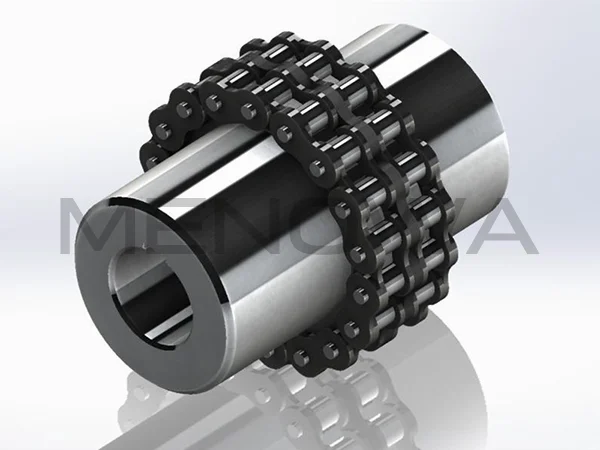
Menowa roller chain coupling has the advantages of simple structure (four parts), convenient assembly and disassembly, no need to move the two shafts that are connected when disassembly, compact size, light weight, certain compensation capacity, low installation accuracy requirements, reliable work, long life, low cost, and the roller chain coupling should work under the conditions of good lubrication and protective cover. The number of sprocket teeth on the roller chain coupling generally takes an even number of teeth in the range of 12 to 22, if the number of sprocket teeth is less, the force on the sprocket increases; If more sprockets are taken, the compensation capacity of the coupling decreases, and the index circle diameter of the sprocket on the half coupling dp=(12 ~ 13.5) or dp=(2 ~ 3.2)d; Shell outer diameter DK=(1.15 ~ 1.2)dp; Half coupling outer diameter D=(0.7 ~ 0.8)dp; Half coupling length L= (1.9 ~ 2.8) d, large torque, take a small coefficient. It is suitable for high temperature, wet and dusty working environment, not for high-speed, severe impact load and axial force transmission occasions, Menowa chain coupling should be in good lubrication and have a protective cover under the condition of work.
In the field of mechanical transmission, coupling devices play an indispensable role in connecting two shafts to transmit torque and motion while accommodating certain misalignments. Among various types of couplings, the roller chain coupling stands out for its balanced combination of simplicity, reliability, and adaptability to harsh working conditions. This mechanical component operates on a straightforward yet effective principle: engaging a common roller chain with two parallel sprockets of equal tooth count to establish a secure connection between the driving and driven shafts. Unlike more complex coupling designs that rely on intricate gear meshing or elastic elements, the roller chain coupling leverages the mature technology of chain transmission, making it a preferred choice in numerous industrial applications where durability and ease of maintenance are prioritized.
The fundamental structure of a roller chain coupling consists of four core components: two sprockets, a roller chain, fasteners, and an optional protective cover. Each sprocket is attached to the respective shaft of the machinery, with precise tooth profiles designed to mesh seamlessly with the roller chain. The sprockets are typically fabricated from high-strength steel or alloy steel, undergoes heat treatment processes such as induction hardening to enhance surface wear resistance and overall tensile strength. This heat treatment ensures that the sprocket teeth can withstand repeated contact with the chain rollers, reducing wear even under prolonged high-torque operation. The roller chain itself, which serves as the intermediary for torque transmission, is available in single-row, double-row, or multi-row configurations, each tailored to specific load and speed requirements. Double-row roller chains are widely adopted due to their ability to distribute torque more evenly, improve stability, and resist chain elongation under heavy loads compared to single-row alternatives. The fasteners, including spring clips, cotter pins, and joint pins, secure the chain ends together, preventing disengagement during operation and facilitating easy assembly and disassembly when maintenance is needed.
The operating principle of a roller chain coupling revolves around the meshing interaction between the chain and the sprockets. When the driving shaft rotates, it imparts motion to the attached sprocket, which in turn drives the roller chain through frictional and mechanical engagement. The chain then transfers this rotational motion to the second sprocket, which is connected to the driven shaft, thereby completing the torque transmission cycle. A key advantage of this design is its inherent ability to accommodate minor misalignments between the two shafts, including radial, angular, and axial displacements. The clearances between the chain rollers and the sprocket teeth, as well as the flexibility of the chain links, allow for small positional deviations without causing excessive stress or vibration. This compensation capability is particularly valuable in installations where precise shaft alignment is challenging to achieve, such as in large-scale machinery with multiple components or in environments where thermal expansion may alter shaft positions during operation.
Roller chain couplings can be categorized based on the type of chain used, leading to several common variants. Single-row roller chain couplings are lightweight and cost-effective, suitable for applications with moderate torque requirements and relatively clean working conditions. They are often employed in light-duty machinery such as small conveyors, agricultural implements, and textile equipment. Double-row roller chain couplings, by contrast, offer enhanced load-bearing capacity and stability, making them suitable for heavy-duty operations in mining, construction, and industrial processing. The dual rows of chain distribute the transmitted torque across a larger contact area, reducing wear on individual components and extending service life. Tooth chain couplings, another variant, use toothed chains instead of roller chains, featuring flat links with precision-cut teeth that mesh with the sprockets. These couplings operate with lower noise levels compared to roller chain versions and are preferred in applications where quiet operation is a consideration, such as in some food processing or packaging machinery. Nylon chain couplings, which utilize nylon chains instead of metal, provide corrosion resistance and electrical insulation, making them suitable for wet or corrosive environments, though they are limited to lighter load applications due to the lower tensile strength of nylon compared to steel.
Material selection for roller chain coupling components is critical to ensuring performance and longevity under specific operating conditions. Sprockets are commonly made from 45# steel, a medium-carbon steel that balances strength and machinability, or alloy steels for higher torque and wear resistance. After machining, sprockets undergo heat treatment to harden the tooth surfaces, while retaining ductility in the core to prevent brittle fracture under impact loads. The roller chain links and rollers are typically constructed from high-carbon steel, with surface treatments such as galvanization or chrome plating to enhance corrosion resistance in humid or dusty environments. For specialized applications involving high temperatures or chemical exposure, stainless steel components may be used, though this increases material costs. The optional protective cover, which prevents lubricant leakage and debris ingress, is often made from sheet metal, plastic, or aluminum, depending on the environmental conditions and the need for durability.
The performance characteristics of roller chain couplings are shaped by their design and material properties, resulting in a set of advantages and limitations that define their application scope. One of the primary advantages is their simple structure, which facilitates easy assembly and disassembly without the need to move the connected shafts. This feature significantly reduces maintenance time and labor costs, as components can be inspected, repaired, or replaced quickly. Additionally, roller chain couplings exhibit compact dimensions and light weight relative to their load-bearing capacity, making them suitable for installations with limited space. They also offer a favorable balance between cost and performance, being more affordable than precision gear couplings while providing greater durability than elastic couplings in harsh environments. When properly lubricated and equipped with a protective cover, roller chain couplings can achieve long service lives, with some units operating reliably for tens of thousands of hours before requiring major maintenance.
However, roller chain couplings also have inherent limitations that restrict their use in certain applications. They are not well-suited for high-speed operations, as the centrifugal force generated at high rotational speeds can accelerate wear between the chain and sprockets, increase noise levels, and potentially lead to chain disengagement. The maximum allowable speed varies depending on the chain size and sprocket diameter, but in general, roller chain couplings are recommended for low to moderate speed applications. Another limitation is their relatively limited shock absorption capability compared to elastic couplings, which use rubber or polyurethane elements to dampen vibrations. This means roller chain couplings may not be ideal for machinery with frequent start-stop cycles or significant impact loads, as the resulting stress can accelerate component wear and failure. Additionally, the presence of gaps between the chain and sprockets can cause slight backlash, which may affect positioning accuracy in precision machinery applications.
The versatility of roller chain couplings is evident in their wide range of applications across multiple industries, each leveraging their unique performance characteristics to address specific operational needs. In the mining industry, roller chain couplings are extensively used to connect motors and crushers, conveyors, and other heavy-duty equipment. Mining operations involve harsh conditions, including high torque, frequent start-stops, dust, and moisture, and roller chain couplings excel in these environments due to their durability and ability to accommodate minor misalignments. For example, in large-scale ore crushing plants, GL-type roller chain couplings are commonly used to transmit torque from the motor to the crusher spindle, withstanding the intense loads and vibrations associated with crushing hard rock. Their simple maintenance requirements are also a significant advantage in remote mining locations, where access to specialized repair equipment may be limited.
In the agricultural sector, roller chain couplings play a vital role in power transmission for machinery such as combine harvesters, tractors, and irrigation systems. Agricultural equipment operates in variable outdoor conditions, including dirt, moisture, and temperature fluctuations, and requires components that can withstand these challenges while maintaining reliability. In combine harvesters, roller chain couplings connect the engine to the cutting platform and threshing mechanism, ensuring efficient power transfer even as the machine moves over uneven terrain. The ability to disassemble the coupling without moving the shafts is particularly useful for on-field maintenance, allowing farmers to quickly address issues and minimize downtime during critical harvesting periods. Additionally, the cost-effectiveness of roller chain couplings makes them accessible for small-scale and large-scale agricultural operations alike.
The manufacturing and material handling industries also rely heavily on roller chain couplings for conveyor systems, pumps, compressors, and other equipment. Conveyor systems, which are essential for moving materials in factories, warehouses, and ports, require couplings that can maintain consistent torque transmission over long periods. Roller chain couplings are ideal for this purpose, as they can accommodate the minor misalignments that may occur in long conveyor lines due to structural deflection or thermal expansion. In chemical processing plants, roller chain couplings are used in material handling systems to connect reducers and conveyor rollers, ensuring the smooth and continuous transport of chemicals and raw materials. The optional protective cover is particularly important in these environments, as it prevents dust, chemicals, and moisture from contaminating the chain and sprockets, extending component life and reducing maintenance costs.
Wind energy is another sector where roller chain couplings find application, particularly in small to medium-sized wind turbines. These turbines require reliable coupling between the gearbox and generator to transmit the rotational energy captured by the blades. Roller chain couplings are suitable for this application due to their ability to compensate for the slight misalignments that occur as the turbine blades rotate and the tower sways in the wind. They also offer good durability in the harsh outdoor conditions of wind farms, including exposure to temperature extremes, wind, and moisture, when properly lubricated and protected. By ensuring stable power transmission, roller chain couplings contribute to the efficiency and reliability of wind energy systems, reducing the frequency of downtime and maintenance requirements.
Proper installation is critical to maximizing the performance and service life of roller chain couplings. Before installation, it is essential to clean the shafts and the inner bores of the sprockets to remove any dirt, grease, or debris that could affect the fit or cause misalignment. The sprockets should be mounted on the shafts using an interference fit, which can be achieved through cold mounting or hot mounting methods depending on the shaft size and material. Cold mounting involves pressing the sprocket onto the shaft, while hot mounting involves heating the sprocket to expand the inner bore, allowing it to slide onto the shaft before cooling and contracting for a secure fit. After mounting, the coaxiality and parallelism of the two sprockets must be checked and adjusted to ensure they are aligned within acceptable tolerances. A small gap of 3 to 5 millimeters should be maintained between the sprockets to accommodate axial displacement and prevent contact between the components.
Once the sprockets are properly aligned, the roller chain can be installed and tensioned. The chain tension should be adjusted to ensure it is neither too tight nor too loose. Excessive tension can increase friction and wear on the chain and sprockets, as well as place additional stress on the shafts and bearings. Insufficient tension, on the other hand, can lead to chain slack, which may cause jumping or disengagement during operation. After adjusting the tension, the chain ends should be secured using the appropriate fasteners, such as spring clips or cotter pins, to prevent accidental disconnection. If a protective cover is used, it should be installed after the chain and sprockets are in place, ensuring it fits securely without interfering with the rotating components. The cover should also provide easy access for maintenance, such as lubrication and inspection.
Lubrication is a key aspect of maintaining roller chain couplings, as it reduces friction between the chain and sprockets, minimizes wear, and prevents corrosion. The type of lubricant selected should be appropriate for the operating conditions, including temperature, load, and environmental factors. Lithium-based greases are commonly used for roller chain couplings, as they offer good adhesion, wear resistance, and stability over a wide temperature range. Lubrication intervals depend on the operating conditions, but in general, the chain and sprockets should be lubricated every 3 to 6 months, with a complete lubricant change and component cleaning performed annually. It is important to avoid mixing different types of lubricants, as this can reduce the effectiveness of the lubrication and potentially cause component damage. In dusty or corrosive environments, more frequent lubrication may be necessary to compensate for the increased wear and contamination.
Regular inspection and maintenance are essential to prevent unexpected failures and extend the service life of roller chain couplings. Daily inspections should include checking the chain tension, the condition of the sprocket teeth, and the integrity of the fasteners and protective cover. Any signs of loose fasteners should be addressed immediately by tightening them to the recommended torque. During operation, the coupling should be monitored for abnormal noises, such as rattling or grinding, which may indicate misalignment, excessive wear, or insufficient lubrication. Vibrations should also be checked, as unusual vibration patterns can signal issues with the coupling or the connected machinery.
Periodic maintenance should involve a more thorough inspection of all components. The chain should be checked for signs of wear, such as elongated links, damaged rollers, or bent plates. If the chain has stretched beyond acceptable limits, it should be replaced to prevent further damage to the sprockets. The sprocket teeth should be inspected for wear, pitting, or chipping, which can affect the meshing with the chain. Worn sprockets should be replaced promptly, as they can accelerate chain wear and reduce transmission efficiency. The protective cover should be inspected for cracks, corrosion, or damage, and replaced if necessary to ensure it continues to protect the coupling components from contamination and lubricant leakage. Bearings, if present, should be checked for smooth rotation, excessive noise, or overheating, as these are signs of potential failure.
Understanding common failure modes and their causes is crucial for effective maintenance and troubleshooting of roller chain couplings. One of the most common failures is chain wear and elongation, which occurs due to repeated friction between the chain rollers and sprocket teeth, as well as the load-bearing stress on the chain links. Factors that accelerate chain wear include insufficient lubrication, contaminated operating environments, overloading, and misalignment. Chain elongation can lead to slack, jumping, and eventual disengagement if not addressed. Another common failure mode is sprocket tooth wear, which can result from prolonged meshing with a worn chain, overloading, or improper lubrication. Worn sprocket teeth lose their ability to engage the chain effectively, leading to inefficient torque transmission and increased vibration.
Other potential failures include fastener loosening or failure, which can occur due to vibration, improper installation torque, or fatigue. Loose fasteners can cause the chain to disengage or the sprockets to shift position, leading to misalignment and further damage. Corrosion is another issue, particularly in humid, wet, or chemical-rich environments, which can weaken the chain and sprockets over time. Corrosion can be prevented through the use of corrosion-resistant materials, protective coatings, and regular lubrication. In some cases, coupling failure may be caused by overloading, which exceeds the torque capacity of the chain or sprockets, leading to bending, cracking, or breaking of components. Overloading can result from improper selection, changes in operating conditions, or mechanical issues with the connected machinery.
When troubleshooting a faulty roller chain coupling, a systematic approach should be adopted to identify the root cause. First, the equipment should be shut down and isolated to ensure safety during inspection. Visual inspection should be conducted to check for obvious signs of damage, such as worn or broken chain links, damaged sprocket teeth, loose fasteners, or corrosion. The chain tension should be measured and adjusted if necessary. If abnormal noises or vibrations were present, the alignment of the sprockets should be checked and corrected. Lubrication levels and quality should be inspected, and the lubricant should be replaced if it is contaminated or insufficient. If the issue persists, more detailed testing may be required, such as measuring vibration levels using specialized equipment or checking the torque transmission efficiency. In cases of severe damage, components should be replaced with matching parts to ensure compatibility and restore the coupling's performance.
The design and performance of roller chain couplings continue to evolve with advancements in materials science and manufacturing technologies. New steel alloys and heat treatment processes are being developed to enhance the wear resistance and strength of sprockets and chains, extending their service life in harsh conditions. The use of composite materials, such as reinforced polymers, is also being explored for certain components, offering weight reduction and corrosion resistance without compromising strength. Manufacturing processes such as precision machining and 3D printing are enabling more accurate production of sprocket teeth profiles, improving the meshing efficiency and reducing wear. Additionally, advancements in lubrication technology, such as the development of long-lasting synthetic lubricants, are reducing maintenance requirements and extending the intervals between lubrication cycles.
In terms of application trends, roller chain couplings are increasingly being used in renewable energy systems, such as small wind turbines and biomass processing equipment, as the demand for sustainable energy grows. They are also finding expanded use in automated manufacturing systems, where reliability and low maintenance are critical for minimizing downtime. As industries continue to focus on efficiency and cost reduction, the roller chain coupling's balance of performance, affordability, and ease of maintenance ensures it will remain a key component in mechanical transmission systems for years to come. However, as technology advances, it is likely that roller chain couplings will be further optimized for specific applications, with improved designs that address their current limitations, such as speed restrictions and shock absorption capabilities.
In conclusion, the roller chain coupling is a versatile and reliable mechanical component that plays a critical role in power transmission across a wide range of industries. Its simple structure, ease of installation and maintenance, and ability to accommodate minor misalignments make it a preferred choice for applications involving low to moderate speeds, high torque, and harsh operating conditions. While it has certain limitations, such as restricted use in high-speed or high-shock environments, these are often offset by its cost-effectiveness and durability. Proper installation, lubrication, and regular maintenance are essential to maximizing the performance and service life of roller chain couplings, preventing unexpected failures and ensuring efficient operation of the connected machinery. As manufacturing technologies and materials continue to advance, the roller chain coupling is poised to adapt to evolving industrial needs, maintaining its position as a staple in mechanical transmission systems worldwide.
The widespread adoption of roller chain couplings across mining, agriculture, manufacturing, and renewable energy sectors is a testament to their practicality and reliability. By understanding their design principles, performance characteristics, and maintenance requirements, operators and maintenance personnel can ensure that these couplings operate at peak efficiency, contributing to the overall productivity and longevity of the machinery they serve. Whether in a remote mining site, a busy factory floor, or a wind farm, the roller chain coupling remains a simple yet effective solution for connecting shafts and transmitting power in a variety of challenging environments.
As industries continue to evolve and demand higher levels of efficiency and reliability, the roller chain coupling will continue to be refined and optimized. New materials and manufacturing techniques will enhance its durability and performance, while improvements in lubrication and maintenance practices will further extend its service life. While alternative coupling technologies may emerge, the roller chain coupling's unique combination of simplicity, cost-effectiveness, and adaptability ensures that it will remain a vital component in mechanical transmission systems for the foreseeable future. Its ability to perform consistently in harsh conditions, coupled with ease of maintenance, makes it an indispensable tool for engineers and operators seeking reliable power transmission solutions.
 WeChat
 WhatsApp